July
2001
- $FreeBSD: www/en/news/status/report-2001-07.xml,v 1.8 2006/08/19 21:20:40 hrs Exp $
+ $FreeBSD: www/en/news/status/report-2001-07.xml,v 1.9 2007/04/11 04:11:09 brd Exp $
Introduction
Last month's status report was apparently a great success: I
received countless e-mails with comments, questions, and
suggestions. I've tried to incorporate any suggestions and address
any problems from these e-mails in this month's report, which
captures a far more extensive snapshot of FreeBSD activity in the
last month. Unlike last month's report, it does a better job of
reflecting non-development activity, such as on-going conference
planning, documentation, and so on. This is a trend I hope to see
improve in future months as well.
On the topic of conferences, in the future I'd like to report
more on publication activities relating to FreeBSD, including
online journals with articles relating to FreeBSD, paper journals,
conference papers, and so on. Likewise, I would be interested in
including references to Call for Papers relating to FreeBSD. I'll
take this opportunity to plug both registration and paper
submission for BSDCon Europe in November, which has status included
in this report, and for the general BSD Conference being hosted by
USENIX in February. Your attendance and submissions make these
conferences "happen", and promote FreeBSD as a platform for new
research, feature development, and application products. Work of
extremely high calibre is performed on FreeBSD, and we need to get
the word out.
Submission for Future Editions
Next month, we're maintaining much the same submission
requirements: reports should be one or two paragraphs long, sent by
e-mail, and approximate the layout of the entries this month
(Project, Contact, URL, and text). I'll send out reminders again
over the week before the deadline, with more specific instructions.
An area where I'd like to explore improvement lies in the
coordination of related status reports for larger projects, such as
new architectural work or platform ports. This might even have the
effect of encouraging communication within these projects :-). I'd
like to continue to focus on pulling in a broader range of groups
and their activities, including the Security Officer, Release
Engineer, and Core Team.
-- Robert Watson <
rwatson@FreeBSD.org
>
ACPI
Mike
Smith
msmith@FreeBSD.org
ACPI (Advanced Configuration and Power Interface) is an
industry standard which obsoletes APM, Intel MPS, PnPBIOS, and
other Intel PC firmware interface standards. It is also used on
the IA64 platform. More information on ACPI is available at
http://developer.intel.com/technology/iapc/acpi
The FreeBSD ACPI subsystem project is based heavily on the
Intel ACPI Component Architecture. This status report outlines
the current state of the project; future updates will focus on
changes as they occur.
The Intel ACPI interpreter is fully integrated, although bugs
are still coming out of the woodwork occasionally.
- PCI bus detection and interrupt routing are functional, but
power management interaction will require work on the core PCI
subsystem.
- Non-PCI motherboard peripheral probing is implemented, but
believed to have problems on some systems.
- A power policy manager has been implemented. The initial
policy manager has two modes, "performance" and "economy".
- CPU speed throttling is integrated with the platform power
policy.
- System thermal monitoring is implemented, but fan control
is believed to have problems.
- Pushbutton suspend and power-off is implemented.
- System timekeeping using the ACPI timer is supported.
- Battery status monitoring is implemented.
Work is ongoing in the following areas:
- System suspend and resume.
- Timekeeper accuracy/reliability.
- Power profiles.
- User-level management interfaces.
- PCI power management.
- Bug-hunting.
ARM Port
Stephane
Potvin
septovin@videotron.ca
The ARM port is currently going pretty well. The kernel is
compiling and is able to boot to the point where it panics trying
to initialize the network subsystem. The current reference
platform is the Netwinder but this may change as many people
expressed interest in a more broadly available platform. Things
that need to be done before it can get further includes adding
footbridge, timer and interrupt supports. The pmap module is not
completed yet either.
BIND 9
Doug Barton
dougb@FreeBSD.org
Jeroen Ruigrok
asmodai@FreeBSD.org
Now that BIND 8.2.4 is finally imported the time has come to
look at getting BIND 9 imported into CURRENT. The current idea is
to have it imported alongside BIND 8 so that people can play with
either one until all import problems have been taken care of and
people have tested it a bit.
binup
Eric Melville
eric@FreeBSD.org
Although gaining a new name, the project has been at a
standstill due to both resource availability during the move
between BSDi and Wind River, and other commitments of the
developers. The project should obtain an official mailing list,
as well as return to an active state after the dust settles.
BSDCon Europe
Paul Richards
paul@freebsd-services.co.uk
Josef Karthauser
joe@tao.org.uk
The conference will take place at the Thistle Hotel, Brighton,
UK from 9-11 November 2001.
The aim of the conference is to provide a focal point for
European users and developers of all the BSD derived operating
systems. The format will be similar to other conferences, with 2
days of technical sessions over the Saturday and Sunday.
We'll be finalizing the schedule towards the end of the month
and anybody who is interested in doing a talk should contact us
ASAP. There are no restrictions on the use of talks; if it's been
done before we may still be interested in having it presented to
an European audience, and we make no claims to the talks so
speakers are free to present the talks again at other
conferences.
We're also still looking for sponsors.
We had 80 pre-registrations in the first week so we're
expecting a good turnout.
CAM
Matthew Jacob
mjacob@FreeBSD.org
Justin Gibbs
gibbs@FreeBSD.org
The new CAM transport code is starting to get supported in
more HBAs and to get refined so that it does the intended
per-protocol support. No progress on doing any SMPng work for CAM
has been made yet. This is a fairly high priority.
Problem Reports
Poul-Henning
Kamp
phk@FreeBSD.org
Thanks to various outstanding individual efforts, we are now
down to just below 2300 open bug-reports. This means that we have
fought our way back to the level we had around march 2000.
Documentation Project
Documentation Project
doc@FreeBSD.org
Work continues (in large part sponsored by WRS) on updating
the Handbook ready for the second print edition. There has been a
flurry of activity in this area recently, and the ToDo list can
be seen at
http://www.FreeBSD.org/docproj/handbook.html
Dima and others are doing a stellar job of keeping up with the
steady flow of incoming PRs relating to the documentation
project.
The Developers' Handbook,
http://www.FreeBSD.org/doc/en_US.ISO8859-1/books/developers-handbook/index.html
is a year old; it contains a wealth of useful content for
developers developing on, or for, FreeBSD. As ever, more
contributions are always required, not only for the developers'
handbook, but for all of the FreeBSD documentation set.
Fibre Channel Support
Matthew Jacob
mjacob@feral.com
The basic design hasn't changed and this project mainly is in
the phase of continued hardening and test case development. The
next major feature will be to fully integrate into the new CAM
TRAN code and to fully support on the fly device addition and
removal. The only HBA supported is QLogic at this time. Future
support for the QLogic line is planned to have 2300 (2Gb) and IP
support before October.
Hardware Watchpoints in the Kernel Debugger
Brian Dean
bsd@FreeBSD.org
Hardware watchpoints are now available for kernel debugging on
the IA32 (i386) architecture. One can now set hardware
watchpoints using the new ddb command 'hwatch', which is
analogous to the existing 'watch' command. Alternatively, if
greater flexibility is required, direct access to the debug
registers is available using the ddb 'set' command which allows
complete control over the processor hardware debug facilities.
Hardware watchpoints are very useful in tracking down those
elusive memory overwrite bugs in the kernel. Hardware watchpoints
can even be used to set a code breakpoint in ROM, which is
commonly found in embedded systems.
ifconfig support for IEEE 802.11 wireless devices
Brooks Davis
brooks@FreeBSD.org
Support for configuring IEEE 802.11 wireless devices via
ifconfig has been committed to -current and -stable. It contains
most of the functionality needed to configure an wireless device.
Some missing features are being worked on including integrated
support for DHCP so a single entry in /etc/rc.conf can be used to
fully configure a wireless device on a DHCP lan and setting the
CTS/RTS threshold. Currently the an(4) and wi(4) drivers are
supported in -current and -stable with the awi(4) device
supported in -current. Further work is needed to support
Frequency Hopping devices such as ray(4).
jailNG
Robert Watson
rwatson@FreeBSD.org
jailNG is a from-scratch rewrite of the popular jail(8)
service, focusing on improved management functions, as well as
more fine-grained configurability. An initial prototype has been
written, based on explicitly named and configured jails, and work
is proceeding on userland integration. Currently, it's not clear
if the timeline for this will be 5.0-RELEASE, or 5.1-RELEASE.
FreeBSD Java Project
Greg Lewis
glewis@eyesbeyond.com
The main development in the FreeBSD Java Project over the last
month was the release of an initial "Developers Only" patchset
for the JDK 1.3.1. Since that release progress had been made
towards a much more usable alpha quality patchset which is
likely to be turned into a port, as per the current JDK 1.2.2
patchset. This new patchset will feature a number of bugfixes,
which essentially get the JDK to a working state for early
adopters, and an initial implementation of "native threads" based
on FreeBSD's userland pthreads. Unfortunately this implementation
isn't fully functional, but is included in the hope of
getting more eyeballs on the code (particularly experienced
pthread programmers). We'd also like to welcome Fuyuhiko
Maruyama-san as a new committer, the usual punishment for too
many good patches.
jpman project
Japanese Man Page Project
man-jp@jp.FreeBSD.org
We have been working to provide Japanese version of FreeBSD
online manuals, since 1996. Currently, RELENG_4 manuals are
based. Translated versions are placed on doc/ja_JP.eucJP/man and
provided to users using ports/japanese/man-doc. Also, we discuss
about related commands (e.g. ports/japanese/man and
ports/japanese/groff).
Kernel Summit - Usenix 2001
John Baldwin
jhb@FreeBSD.org
The first FreeBSD kernel summit meeting was held June 29-30,
2001 in Boston, MA at the Usenix 2001 Annual Technical
Conference. Links to a variety of files are posted on the web
site.
Note: I (jhb) am still working on writing up a general summary
of the meeting. When that is completed it will be posted here and
mailed to the -hackers mailing list.
KSE threading the kernel
Julian Elischer
julian@elischer.org
I'm working on multithreading the kernel. So far I have over
- 400KB of diffs relative to todays -current (I'm keeping my tree
+ 400KB of diffs relative to today's -current (I'm keeping my tree
updated with changes as they occur rather than get hit with a big
update at the end).
I have split the proc structure and am changing most of the
kernel to pass around a thread identifier instead of a proc
structure.
The following interfaces have been changed so far:
- device devsw entries
- vfs calls
- mutexes
- events
- system calls
- scheduler
- + a lot of code in between.
I have still a lot of work to go with a lot of "dumb editing"
(s/struct proc \*p/struct thread \*td/) usually I change a few
items and then fix everything that breaks when I try compile it.
I'd like to check it in on a branch so others can help the
editing but haven't worked out the best way to do it yet.
I have implemented changes to the scheduler so that KSE's are
scheduled instead of processes, and threads sleep, letting the
KSE pick up a new thread. but it's not anywhere ready yet (heck
it doesn't compile yet :-)
Note that I have not yet updated the document listed above..
everywhere it mentions "ksec" or "KSE-context", the code uses the
word "thread". I will update it soon as Jason has sent me the
source.
FreeBSD Monthly Development Status Reports
Robert Watson
rwatson@FreeBSD.org>
Chris Costello
chris@FreeBSD.org
The FreeBSD Monthly Development Status Report aims to keep
users and developers up-to-date on the latest goings-on in the
FreeBSD project by providing summaries of each project and its
status. At the time of this writing, the July 2001 status report
is being prepared and is very near release. The FreeBSD Web site
now has a Status Reports section, which, when the July 2001
report is released, will be updated to include a link to an
HTML-ified version.
NetBSD rc.d port
Doug Barton
dougb@FreeBSD.org
Sheldon Hearn
sheldonh@FreeBSD.org
The NetBSD rc.d port aims to improve the FreeBSD startup
process by porting Luke Mewburn's rc.d work from NetBSD to
FreeBSD. This will score FreeBSD startup and shutdown
dependencies without losing the traditional and much loved
monolithic configuration filesystem.
Luke Mewburn's USENIX paper and slides on the system as
implemented in NetBSD are available here:
http://groups.yahoo.com/group/FreeBSD-rc/message/3
Interested parties are urged to study this material before
joining the discussion list.
The intention at this stage is to decide on an approach that
will ensure that the differences between the NetBSD rc.d system
and the system as ported to FreeBSD will be kept to a minimum.
This will probably involve discussions with Luke around those
areas of the system that are identified as areas for potential
improvement.
Netgraph ATM
Hartmut Brandt
brandt@fokus.gmd.de
The goal of this project is the implementation of ATM
signalling and other ATM protocols by means of the netgraph(4)
framework. This should provide an easily extensible architecture
for using ATM on FreeBSD. Currently the full UNI4.0 stack (except
for the LIJ capability) has been implemented, including ILMI and
a first version of the ATM Forum API for UNI. An implementation
of Classical IP over ATM is also available. Drivers have been
implemented for the Fore PCA200E and Fore HE-155 cards.
network device cloning
Brooks Davis
brooks@FreeBSD.org
Network device cloning support has been imported from NetBSD.
This allows virtual devices to be allocated on demand rather then
being statically allocated at compile time. Our implementation
differs slightly from that of NetBSD's in that we allow both the
creation of specific devices (i.e. gif0) and arbitrary devices
instead of just allowing specific devices. Currently, the only
device in the tree which has been converted is the gif(4) device
which has been converted in both -current and -stable. Work is
ongoing to convert all other virtual network devices with work in
progress on faith, stf, and vlan interfaces. In general this
conversion is accompanied by appropriate modifications to make
these devices fully modular.
Next Generation POSIX threads (NGPT)
Arun Sharma
arun@sharma.dhs.org
Porting NGPT (next generation pthreads) to FreeBSD
NGPT is an effort led by IBM engineers to implement MxN
threads (also known as many user threads to one kernel thread
mapping) on Linux. I have ported it to FreeBSD to use
rfork(2).
The port is right here:
http://www.FreeBSD.org/cgi/query-pr.cgi?pr=29239
OLDCARD upgrade to support PCI cards
Warner Losh
imp@village.org
Funded by: Monzoon Networking, LLC
This month has been a month of conventration and
consolidation. Much of the changes from current have been
migrating into stable. I've improved power support,
suspend/resume interactions, interrupt handling, and ability to
work after windows/NEWCARD has run. Interrupt routing continues
to be a locking issue for a complete MFC. Current patches are
available at the above website. I'm racing to get this done
before 4.4 is released.
Open Runtime Platform (ORP)
Arun Sharma
arun@sharmas.dhs.org
eGroups: ORP
orp@egroups.com
Information on Intel ORP - a BSD licensed Java VM is right
here:
http://www.intel.com/research/mrl/orp/
A FreeBSD patch has been tested to work with NGPT and
submitted to the ORP project. The patch is available here:
http://www.sharma-home.net/~adsharma/projects/orp/orp-freebsd-1.0.5.patch.txt.gz
There are some issues to be ironed out to make it work with
FreeBSD's default (user level) pthread implementation.
OpenPackages
OpenPackages intends to create a software packaging system
that will allow third-party programs to be installed, without
operating system dependent changes, on as many platforms as are
feasible. OpenPackages was originally based on code from the BSD
ports systems, and has been improved and extended by developers
of many heritages.
The OpenPackages Project is pleased to release the Milestone 2
codebase. This release contains a working package building system
and a single test package. OP currently is known to build on
certain instances of the following operating systems: FreeBSD,
HP/UX, IRIX, Linux (Debian, Red Hat, Suse, Mandrake, TurboLinux,
Caldera, etc.), NetBSD, OpenBSD, Solaris
PAM
Mark R V Murray
mark@grondar.za
(First report)
Large cleanup and extension of FreeBSD PAM modules. All
modules are to be documented, consistent in style (style(9) used)
and as complete as possible WRT functionality. Mostly done.
PowerPC Port
Benno Rice
benno@FreeBSD.org
We now have the rudiments of device support. We have a nexus
driver for OpenFirmware machines, along with support for the
Apple UniNorth PCI/AGP host bridge. I'm currently trying to get
the USB hardware working so that I can get closer to having a
console driver independent of OpenFirmware, then I'll be trying
to get the system to get to single-user mode using NFS.
PPP IPv6 Support
Brian Somers
brian@freebsd-services.com
Work has begun, but nothing has yet been committed. The NCP
addresses used by ppp have been abstracted and initial support
has been added to the filter set for ipv6 addresses. NCP
negotiation hasn't yet been started.
Porting ppp to hurd & linux
Brian Somers
brian@Awfulhak.org
Patches have been submitted to get ppp working under HURD, and
mostly under Linux. There are GPL copyright problems that need to
be addressed.
pppoed
Brian Somers
brian@freebsd-services.com
Making pppoed function in a production environment. Most of
the work is complete and committed. Additional work includes
adding a -l option where ``-l label'' is shorthand for ``-e exec
ppp -direct label'' and discovering why rogue child processes are
being left around.
PRFW - Hooks within the FreeBSD kernel
Evan Sarmiento
ems@open-root.org
PRFW is a set of hooks which I have integrated into the
FreeBSD kernel. This allows modules to easily intercept system
calls with less overhead. It also supports per-pid restrictions,
which means, one process may not be able to use X function in Y
manner, but another process may.
Progress: I was working on this in 4.3-RELEASE, but now I'm
merging it into current. I will be submitting a patch to the
mailing lists in about a week.
SCSI Tape Support
Matthew Jacob
mjacob@feral.com
This driver is currently not working well under -current and
is undergoing some work at this time. No major design or feature
changes are planned. There was some notion of adding TapeAlert
support, but HP supports that as a binary product via a user
library and it was felt that it'd be more politically prudent to
leave it alone.
SMPng
Peter Wemm
peter@FreeBSD.org
John Baldwin
jhb@FreeBSD.org
Development
In the 'smpng' p4 branch there is code to make the ast()
function loop to close the race when an AST is triggered while we
are handling previously triggered AST's.
In the 'jhb_preemption' p4 branch work is being done to make
the kernel fully preemptive. It is reportedly stable on UP x86,
but SMP x86 locks up, UP alpha has problems during shutdown and
can recurse indefinitely until it exhausts its stack.
Management
We are using a perforce repository for live development work,
which can track multiple separate long-lived works-in-progress
and collaborate between multiple developers at the same time on
the same change set.
FreeBSD-current is being imported into p4 hourly, for easy
tracking of the moving -current tree.
I haven't written up a good primer yet, but we're able to open
this up to the general developer community. NEWCARD work looks
like it will be done here too. Perforce is ideal for tracking
this sort of long-lived project without having to resort to
passing patches around.
KSE work is now being checked into a kse p4 branch - thanks
Julian!
KSE work is focusing on getting the main API changes into the
base tree well before 5.0.
SMPng mbuf allocator
Bosko Milekic
bmilekic@FreeBSD.org
mb_alloc is a specialized allocator for mbufs and mbuf
clusters. It offers various important advantages over the old
mbuf allocator, particularly for MP machines. Additionally, it
is designed with the possibility of important future
enhancements in mind.
The mb_alloc code has been committed to -CURRENT a month ago
and appears to be holding up well. Prior to committing it,
preliminary performance measurements were done merely to ensure
that it is not significantly worse than the old allocator, even
with Giant still in place. Results were promising
[http://people.FreeBSD.org/~bmilekic/code/mb_alloc/results.html]
- also see jlemon's results (link at the bottom of accompanying
text). Since the commit, Matt Jacob has provided useful feedback
and bugfixes. Work is now being done to re-enable mbtypes
statistics and make appropriate changes to netstat(1) and
systat(1).
sparc64 port
Jake Burkholder
jake@FreeBSD.org
The sparc64 port has been committed to the FreeBSD repository.
As such further development will occur in cvs, rather than as a
separately maintained patch set. Significant progress has been
made since the last status report, including; support for kernel
debugging with ddb, much more complete pmap support, support for
context switching and process creation, and filling out of
important machine dependent data structures. Thomas Moestl has
shown a strong interest in working on the port and is in the
process of implementing support for saving and restoring a
process's floating point context. I look forward to working with
him and any other developers that happen to fall out of the wood
works.
FreeBSD/sparc64 kernel loader
Robert Drehmel
robert@ferrari.de
The sparc64 loader is functional enough to boot an ELF binary
from an UFS filesystem using the existent openfirmware library,
which has been revised to work flawlessly on 32-bit and 64-bit
architectures. Support for netbooting and modules will be
implemented next, followed by a better openfirmware mapping
strategy.
SYN cache implementation for FreeBSD
Jonathan Lemon
jlemon@FreeBSD.org
This project brings a SYN cache implementation to FreeBSD, in
order to make it more robust to DoS attacks. A SYN cookie
approach was considered, but ultimately rejected because it does
not conform to the TCP protocol. The SYN cache will work with
T/TCP, IPV6 and IPSEC, and the size of each cache element is
currently is less than 1/5th the size of a normal TCP control
block.
TrustedBSD Project
Robert Watson
rwatson@FreeBSD.org
It's been a busy month, with a number of relevant news items.
Not least important is that NAI Labs was awarded a $1.2M contract
from the US Defense Advanced Research Projects Agency (DARPA) to
work on a variety of components relevant to the TrustedBSD
Project, including support for pluggable security models, and
supporting features such as improving the extended attributes
implementation, simple crypto support for swap and filesystems,
documentation, and much more.
On the features side, progress continues on Mandatory Access
Control, object labeling, and improving the consistency of kernel
access control mechanisms--in particular, with regard to
inter-process authorization and credential management. Work has
begun on porting LOMAC, NAI Labs' Low-Watermark Mandatory Access
Control scheme, from Linux to FreeBSD, and it has been
re-licensed under a BSD license. We hope to have an initial port
complete in time for 5.0-RELEASE later this year.
diff --git a/en/news/status/report-2002-11-2002-12.xml b/en/news/status/report-2002-11-2002-12.xml
index 33ee10ae3c..52db54df8e 100644
--- a/en/news/status/report-2002-11-2002-12.xml
+++ b/en/news/status/report-2002-11-2002-12.xml
@@ -1,881 +1,881 @@
-
+
November-December
2002
Introduction:
At long last, FreeBSD 5.0 is here. Along with putting the final
polish on the tree, FreeBSD developers somehow found the time to
work on other things too. IA64 took some major steps towards
working on the Itanium2 platform, an effort was started to
convert all drivers to use busdma and ban vtophys(), hardware
crypto support and DEVD hit the tree, NewReno was fixed and
effort began on locking down the network layer of the kernel.
Also high performance, modular scheduler started taking shape
and will be a welcome addition to the kernel soon.
Looking forward, the focus will be on stabilizing and
improving the performance of 5.0. The RELENG_5 (aka 5-STABLE)
branch will be created once we've reached our goals in this
area, so hopefully we will get there quickly. Meanwhile,
preparations for the next release from the 4.x series, 4.8,
will begin soon. Of course, the best way to get 5.x to
stabilize os to install and run it!
Thanks,
Scott Long, Robert Watson
Bluetooth stack for FreeBSD (Netgraph implementation)
Maksim
Yevmenkin
m_evmenkin@yahoo.com
Latest snapshot
Linux BlueZ stack
OpenOBEX
I'm very pleased to announce that all kernel modules and few userland
tools made it to the FreeBSD source tree. Many thanks to Julian
Elischer.
Unfortunately no big changes since the last report. Some minor problems
have been discovered and patches are available on request. I will prepare
all the patches and submit them to Julian for review.
OBEX server and client (based on OpenOBEX library) is almost complete.
I'm currently doing interoperability testing. If anyone has hardware and
time please contact me. The HCI security daemon has been implemented and
tested with Sony Ericsson T68i cell phone and Windows stack. It is now
possible to setup secure Bluetooth connections.
A few people have complained about RFCOMM daemon. These individuals want
to use GPRS and Bluetooth enabled cell phone to access Internet. If you
have this problem please contact me for possible workaround. My next goal
is to get robust RFCOMM implementation to address all these issues.
TrustedBSD Project: Access Control Lists
Robert
Watson
rwatson@FreeBSD.org
TrustedBSD Discussion List
trustedbsd-discuss@TrustedBSD.org
TrustedBSD Project
Largely bug-fixing and userland application tweaks; new
interfaces were added to manipulate ACLs on extended attributes;
bugs were fixed in ls relating to ACL flagging. Patches to
teach cp, mv, gzip, bzip, and other apps about ACL preservation
are in testing and review. tunefs flags were added to ease
configuration of ACLs, especially on UFS2 file systems.
Possible changes to make use of Linux/Solaris umask semantics
are under consideration: right now we implement verbatim
POSIX.1e/IRIX merging of the umask, ACL mask, and requested
creation mode during file, device, fifo, and directory creation.
Solaris and the most recent Linux patches ignore the umask in
the context of a default ACL; this requires some rearrangement
of umask handling in our VFS, although the results would be
quite useful. We're exploring how to do this in a low impact
way.
TrustedBSD Project: MAC Framework
Robert
Watson
rwatson@FreeBSD.org
TrustedBSD Discussion List
trustedbsd-discuss@TrustedBSD.org
TrustedBSD Project
Framework changes:
Instrument KLD system calls (module and kld load, unload, stat)
Instrument NFSd system call. Instrument swapoff(2).
Instrument per-architecture privileged parts of sysarch().
Make use of condition variables to allow callers to wait for the
framework to "unbusy" when loading/unloading policies, rather than
returning EBUSY. Store mount pointer in devfs_mount structure for
use by policies. Improve handling of labels in loopback interface
"re-align" packet copy case. Provide full paths on devfs object
creations to help policies label them properly (not merged).
Experimentation with moving MAC labels into m_tags (not merged).
NFS server now uses real ucreds, not hacked up ucreds,
meaning we can start laying the groundwork for enforcement on
NFS operations. (not merged)
Policy changes
LOMAC: mac_lomac replaces lomac (LOMAC now uses the MAC Framework),
SEBSD: Improved support for devfs labeling based on SELinux genfs.
Handling of hard link checks. Support export of process transition
information for login and others using sysctl. Login now prompts
for roles. Allow policy reload. TTY labeling. Locking adaptation
from Linux. Many, many policy adaptations and fixes. We can
now boot in enforcing mode! mac_bsdextended: fix a bug in which
VAPPEND wasn't mapped to VWRITE, so opens with the O_APPEND bug
failed improperly.
Userland changes
setfmac(8) now supports a setfsmac(8) execution mode, which accepts
initial labeling specification files. Supports an SELinux compatibility
mode so it can accept SELinux label specfiles using the SEBSD module.
sendmail(8) now sets user labels as part of the context switch for mail
delivery.
Documentation changes
Man page updates for MAC command line tools, modules, admin hints, etc.
Updates to the FreeBSD Developer's Handbook chapter on MAC policies
and entry points. MAC section in FreeBSD Handbook.
busdma driver conversion project
Maxime
Henrion
mux@FreeBSD.org
This project has been coming along pretty well. The amd(4) and
xl(4) drivers have now been converted to use the busdma API,
sparc64 got the bus_dmamap_load_mbuf() and bus_dmamap_load_uio()
functions, and the gem(4) and hme(4) drivers have been updated
to use bus_dmamap_load_mbuf() instead of bus_dmamap_load().
A lot more still needs to be done, as shown on the project's
page. A fair number of conversions are on their way though,
and we can expect a fair number of drivers to be converted
soon, thanks to all the developers who are working on this
project.
FreeBSD C99 & POSIX Conformance Project
Mike
Barcroft
mike@FreeBSD.org
FreeBSD-Standards Mailing List
standards@FreeBSD.org
The POSIX Utility Conformance in FreeBSD list (link above) has
been updated to reflect current reality. Not much work remains
to complete base utility conformance.
On the API front, grantpt(), posix_openpt(), unlockpt(),
wordexp(), and wordfree() were implemented. The header
<wordexp.h> was added.
There are currently about 40 unassigned tasks on our project's
status board ranging from documentation, utilities, to kernel
hacking. We would encourage any developers looking for something
to work on to check out the status board and see if anything
interests them.
Hardware Crypto Support Status
Sam
Leffler
sam@FreeBSD.org
The goal of this project is to import the OpenBSD kernel-level crypto
subsystem. This facility provides kernel- and user-level access to
hardware crypto devices for the calculation of cryptographic hashes,
ciphers, and public key operations. The main clients of this facility
are the kernel RNG (/dev/random), network protocols (e.g. IPsec), and
OpenSSL (through the /dev/crypto device).
This work will be part of the 5.0 release and has been committed to
the -stable source tree for inclusion in the 4.8 release.
Recent work has focused on improving performance. System statistics are
now maintained and an optional profiling facility was added for
analyzing performance. Using this facility the overhead for using the
crypto API has been significantly reduced.
The ubsec (Broadcom) driver was changed to significantly improve
performance under load. In addition several memory leaks were fixed in
the driver and the public key support was enabled for use.
Upcoming work will focus on load-balancing requests across multiple
crypto devices and integrating OpenSSL 0.9.7 which will automatically
enable application use of crypto hardware.
DEVD
Warner
Losh
imp@FreeBSD.org
Devd has been integrated into FreeBSD 5.0-RELEASE. The
integrated code supports a range of configuration options. The
config files are fully parsed now and their actions are
performed.
Future work in this area is likely to be limited to improving
the devctl interface. /dev/devctl likely will be a cloneable
device in future versions. Individual device control via devctl
is also planned.
Donations Team Status Report
Michael
Lucas
donations@FreeBSD.org
Donations main page
FreeBSD
developer wantlist
completed donations
The Donations project expedited several dozen donations during
2002, and was able to place most of what was offered. We still
are in dire need of SMP and Sparc systems. You can see
information on our needs and donations that have been handled by
the team on the donations web page.
We are relying increasingly upon the developer wantlist to
place items offered to the Project, and using the commit
statistics to help place items. As such, active committers who
ask for what they want beforehand have a decent chance of
getting it. Less active committers, and committers who do not
ask for what they want, will be lower in our priorities but will
not be excluded.
We are in the process of streamlining the tax deduction process
for donations, and hope to have news on that shortly. We are
also always working to accelerate and reduce our internal
processes, to get the most equipment in the hands of the most
people as quickly as possible.
I especially want to thank David O'Brien and Tom Rhodes for
stepping up and making the team far more successful. Also, the
FreeBSD Foundation has been quite helpful in handling
tax-deductible contributions.
Fast IPsec Status
Sam
Leffler
sam@FreeBSD.org
The main goal of this project is to modify the IPsec protocols to use
the kernel-level crypto subsystem imported from OpenBSD (see elsewhere).
A secondary goal is to do general performance tuning of the IPsec
protocols.
This work will be part of the 5.0 release. Performance has been improved
due to work on the crypto subsystem.
FFS volume label support
Gordon
Tetlow
gordon@FreeBSD.org
Current patch set.
The goal of the project is to use a small amount of space in the FFS
superblock to store a volume label of the user's choice. A GEOM module
will then expose the volume labels into a namespace in devfs. The idea
is to make it easier to manage filesystems across disk swaps and
movement from system to system.
At this point, everything pretty much works. I've submitted parts of
the patch to respective subsystem maintainers for review. There are some
issues with namespace collision that I haven't addressed yet, but the
basic functionality is there
French FreeBSD Documentation Project
Sebastien
Gioria
gioria@FreeBSD.org
Marc
Fonvieille
blackend@FreeBSD.org
Stéphane
Legrand
stephane@FreeBSD.org
The French FreeBSD Documentation Project.
The FreeBSD Web Server translated in French.
Translation of the hanbook.
French Daemon News like web site.
Most of the articles are translated too. Marc is still translating the
handbook, 60% is currently translated. Stéphane has began the
integration of our French localization web site in the US CVS Tree.
Sébastien is still maintaining the Release Notes.
We launched a new site, www.FreeBSD-fr.info, consisting in a French
Daemon News like site. Netasq have donated our new server; we will
install it in a new hosting provider in the few next weeks. One of the
big job now is the translation of the FAQ, and the big
project will be the manual pages.
FreeBSD GNOME Project
Joe
Marcus
marcus@FreeBSD.org
Maxim
Sobolev
sobomax@FreeBSD.org
Adam
Weinberger
adamw@FreeBSD.org
FreeBSD GNOME Project
Homepage.
Since the ports tree has been frozen for most of this reporting period,
there have not been too many GNOME updates going into the official CVS
tree. However, development has not stopped. GNOME 2.2 is nearing
completion, and quite a few FreeBSD users have stepped up to test the
GNOME 2.1 port sources from the
MarcusCom
CVS repository. If anyone else is interested, follow the
instructions on the aforementioned cvsweb URL, and checkout the "ports"
module.
The upcoming FreeBSD 5.0-RELEASE will be the first release to have the
GNOME 2.0 desktop as the default GNOME desktop choice. During the
previously mentioned ports freeze, all the GNOME 2 ports were fixed up
so that they build and package on both i386 and Alpha platforms. Alas,
the one port that will not make the cut for Alpha is Mozilla. There are
still problems with the xpcom code, but work is ongoing to get a working
Alpha port.
Finally, the FreeBSD Mono (an OpenSource C# runtime) port has also
received some new life. Mono has been updated to 0.17 (the latest
released version), and Juli Mallett has ported gtk-sharp (GTK+ bindings
for C#).
FreeBSD/ia64 Status
Peter
Wemm
peter@FreeBSD.org
Marcel
Moolenaar
marcel@FreeBSD.org
The ia64 port is up and running on the new Itanium2 based hp
machines thanks to a lot of hard work by Marcel Moolenaar. So
far we are running on the hp rx2600 as these were the machines
graciously donated by Hewlett-Packard and Intel. We had a
prototype Intel Tiger4 system for a while, but we had to return
the machine and we do not know if it currently runs. Most of
the changes necessary to run these are sitting in the perforce
tree and are not in the -current or RELENG_5 cvs tree. As a
result, the cvs derived builds (-current and the 5.0-RC series
and presumably 5.0-RELEASE) are only usable on obsolete Itanium1
systems.
Lots of other stability and functionality fixes have been made
over the last few months, including initial libc_r support. The
OS appears to be stable enough for sustained workloads - it is
building packages now, for example. We still do not have gdb
support, even for reading core files.
jpman project
Kazuo
Horikawa
horikawa@FreeBSD.org
jpman project
We have been updating our Japanese translated manual pages to
RELENG_5 based. All existing entries have been updated, but 15
exceptions are not, most of which require massive update. We
will also need to add translations which did not exist on RELENG_4.
KGI/FreeBSD Status Report
Nicholas
Souchu
nsouch@FreeBSD.org
KGI (Kernel Graphic Interface) is a kernel infrastructure providing user
applications with means to access hardware graphic resources (dma,
irqs, mmio). KGI is already available under Linux as a separate
standalone project. The KGI/FreeBSD project aims at integrating KGI
in the FreeBSD kernel.
KGI/FreeBSD has been recently donated 2 PCI graphic cards (Matrox
- Millenium II and a coming Mach64) and other have been proposed.
+ Millennium II and a coming Mach64) and other have been proposed.
Please see the FreeBSD web pages for details. Thanks to donation@ for
organizing and promoting donations. Thanks to the donators for their
contribution to KGI/FreeBSD.
KGI/FreeBSD progressed fine the last months. Most of the VM issues for
mapping HW resources in user space have been addressed and a first
attempt of coding was made. This prototyping raised some API
compatibility problems with the current Linux implementation and was
discussed heavily on the kgi devel lists. Ask if you're
interested in such issues, I'll be pleased to share them.
Most of coding is now done. Let's start debugging!
SMP locking for network stack
Jeffrey
Hsu
hsu@FreeBSD.org
Work is ongoing to continue to lock up the network stack.
Recently, the focus has been on the IP stack. The plan there
involves a series of inter-related pieces to lock up the
ifaddr ref count, the inet list, the ifaddr uses, the ARP code,
the routing tree, and the routing entries. We are over 3/5 of
the way done down this path.
In addition to TCP and UDP, the other networking protocols
such as raw IP, IPv6, AppleTalk, and XNS need to be locked up.
Around 1/4 these remaining protocols have been locked and
will be committed after the IP stack is locked.
The protocol independent socket layer needs to be locked and
operating correctly with the protocol dependent locks. This
part is mostly done save for much needed testing and code cleanup.
Finally, a pass will be need to be made to lock up the devices drivers
and various statistics counters.
TCP congestion control
Jeffrey
Hsu
hsu@FreeBSD.org
This effort fixes some outstanding problems in our TCP
stack with regard to congestion control. The first
item is to fix our NewReno implementation. Following that,
the next urgent correction is to fix a problem involving window updates
and dupack counts. When that stabilizes, we will then change
the recovery code to make use of SACK information.
Eventually, this project will update the BSD stack to add Limited Transmit
and other new internet standards and standards-track improvements.
FreeBSD Package Cluster work
Kris
Kennaway
kris@FreeBSD.org
The 3 FreeBSD package clusters (i386, alpha, sparc64) have been
unified to run from the same master machine, instead of using 3
separate masters. This has freed up some machine resources to
use as additional client machine, as well as simplifying
administrative overheads. Build logs for all 3 architectures
can now be found on the http://bento.FreeBSD.org webpage. The
sparc64 package cluster now has 3 build machines (an u5 and two
u10s), and an ia64 cluster is about to be created.
Package builds now keep track of how many sequential times a
port has failed to build (html summaries are available on the
bento website). This allows tracking of ports which have
suddenly become broken (e.g. due to a bad upgrade, or due to
changes in the FreeBSD source tree), and in the future will be
used to send out notifications to port maintainers when their
port fails to build 5 times in a row. This feature is currently
experimental, and further code changes will be needed to
stabilize it.
Wireless Networking Status
Sam
Leffler
sam@FreeBSD.org
The goal of this project is to improve the wireless networking support in
the system. By the time of this report the 802.11 link layer code should
be committed. A version of the wi driver that uses this code should be
committed shortly. Conversion of other drivers is planned as are drivers
for new devices.
Support for 802.1x/EAP is the next planned milestone (both as a
supplicant and authenticator).
FreeBSD Release Engineering
Scott
Long
re@FreeBSD.org
Release Engineering
Homepage
November and December were especially busy for the release engineering
team. Scott Long joined the team to help with secretary and
communications tasks while Brian Somers bowed out to focus on other
projects.
FreeBSD 5.0-DP2 was released in November after much delay and
anticipation, and marked the final milestone needed for 5.0 to
become a reality. Shortly after that, we imposed a code freeze on
the HEAD branch of CVS and released 5.0-RC1. Creation of the
RELENG_5_0 branch came next, followed by the release of 5.0-RC2 from
this branch. At this point, enough critical problems still existed
that we scheduled an RC3 release for the new year, and pushed the
final 5.0-RELEASE date to mid-January. By the time this is published,
FreeBSD 5.0-RELEASE should be a reality.
For the time being, there will not be a RELENG_5 (aka 5-STABLE)
branch. FreeBSD 4.x releases will continue, with 4.8 being
scheduled for March 2003. Release in the 4.x series will be
lead by Murray Stokely, and releases in the 5.x series will be
lead by Scott Long. Once HEAD has reached acceptable performance
and stability goals, the RELENG_5 branch will be created and HEAD
will move towards 6.0 development. We hope to reach this with
the 5.1 release this spring.
SMP aware scheduler
Jeff
Roberson
jeff@FreeBSD.org
A new scheduler will be available as an optional component along side
the current scheduler in the 5.1 release. It has been designed to
work well with KSE and SMP. Some ideas have been borrowed from solaris
and linux along with many novel approaches. It has O(1) performance
with regard to the number of processes in the system. It also has
cpu affinity which should provide a speed boost for many applications.
The scheduler has a few loose ends and lots of tuning before it is
production quality although it is quite stable. Please see the post
to arch and subsequent discussion for more details.
diff --git a/en/news/status/report-2003-03-2003-09.xml b/en/news/status/report-2003-03-2003-09.xml
index 78306496c5..5f20f33720 100644
--- a/en/news/status/report-2003-03-2003-09.xml
+++ b/en/news/status/report-2003-03-2003-09.xml
@@ -1,974 +1,974 @@
-
+
March-September
2003
Introduction:
The FreeBSD Bi-monthly status reports are back! In this edition, we
catch up on seven highly productive months and look forward to
the end of 2003.
As always, the FreeBSD development crew has been hard at work. Support
for the AMD64 platform quickly sprang up and is nearly complete. KSE
has improved greatly since the 5.1 release and will soon become the
default threading package in FreeBSD. Many other projects are in the
works to improve performance, enhance the user experience, and expand
FreeBSD into new areas. Take a look below at the impressive summary of
work!
Scott Long, Robert Watson
VideoBSD
John-Mark
Gurney
jmg@FreeBSD.org
Documentation of
VideoBSD
Still in the planning stage. Working on creating an extensible
interface that is usable for both userland and kernel implementations
for device drivers. Deciding on how to interface userland implemented
device drivers with applications.
KSE
Dan
Eischen
deischen@FreeBSD.org
David
Xu
davidxu@FreeBSD.org
KSE Project
Page
KSE seems to be working well on x86, amd64, and ia64. The
alpha userland bits are done, but a couple of functions are
unimplemented in the kernel. For sparc64, the necessary
functions are implemented in the kernel, but the userland
context switching functions need more attention.
Since 5.1, efficient scope system threads (no upcalls when they block)
have been implemented, and KSE based pthread library can have both POSIX
scope process threads and scope system threads. It is also possible
that KSE based pthread library can implement pthread both in 1:1 and M:N
mode, I know Dan has such Makefile file patch for libkse not yet
committed.
KSE program now can work under ULE scheduler, its efficient should be
improved under the new scheduler in future. BSD scheduler is still the
best scheduler for current KSE implement.
FreeBSD/ia64
Marcel
Moolenaar
marcel@FreeBSD.org
Project home
page.
Much has happened since the last bi-monthly report, which was more
than half a year ago. FreeBSD 5.0 and FreeBSD 5.1 have been released
for example. With FreeBSD 5.2 approaching quickly, we're not going
to look back too far when it comes to our achievements. There's too
much ahead of us...
Two milestones have been reached after FreeBSD 5.1. The first is the
ability to support both Intel and HP machines with sources in CVS.
This due to a whole new driver for serial ports, or UARTs. Unfortunately
this still implies that syscons is not configured. That's another task
for another time, but keep an eye on KGI/FreeBSD...
The second milestone is the completion of KSE support. Both M:N and
1:1 threading is functional on ia64 and the old libc_r library has been
obsoleted. Testing has shown that KSE (i.e. M:N) may well become the
default threading model. It's looking good.
The ABI hasn't changed after 5.1 and the expectation is that it won't
change much. This means that we can think about becoming a tier 1
platform. This also means we need gdb(1) support. Work on it has been
started but the road is bumpy and long.
Kernel stability also has improved significantly and we typically have
one kernel panic remaining: VM fault on no fault entry. This will be
addressed with the long awaited PMAP overhaul (see below).
Most work for FreeBSD 5.2 will be "sharpening the saw". Get those
loose ends tied. This is a slight change of plan made possible by a
slip in the release schedule. The 5.2 release is not going to be the
start of the -stable branch; it has been moved to 5.3. So, we use the
extra time to prepare the ground for 5.3.
The planned PMAP overhaul will probably be finished after 5.2. This
should address all known issues with SMP and fix those last panics.
As a side-effect, major performance improvements can be expected. More
news about this in the next status reports.
Disk I/O
Poul-Henning
Kamp
phk@FreeBSD.org
The following items are in progress in the Disk I/O area:
Turn scsi_cd.c into a GEOM driver. (Patch out for review).
Turn atapi-cd.c into a GEOM driver.
Turn fd.c into a GEOM driver.
Move softupdates and snapshot processing from SPECFS to UFS/FFS.
Move userland access to device drivers out of vnodes.
Once these preliminaries are dealt with, scatter/gather and
mapped/unmapped support will be added to struct bio/GEOM.
Binary security updates for FreeBSD
Colin
Percival
cperciva@daemonology.net
FreeBSD Update is a system for tracking the FreeBSD release
(security) branches. In addition to being faster and more
convenient than source updates, FreeBSD Update also requires
less bandwidth and is more secure than source updates via
CVSup. However, FreeBSD Update is limited; it can only
update files which were installed from an official RELEASE
image and not recompiled locally. Right now I'm publishing
binary updates for 4.7-RELEASE and 4.8-RELEASE; since my
only available box takes 3.5 hours to buildworld, I don't
have enough resources to do any more than that.
In the near future, I'd like to: Find someone who is
willing to donate a faster buildbox; start building updates
for other releases (at a minimum, for all "supported" FreeBSD
releases); add warnings if a file would have been updated
but can't be updated because it was recompiled locally; add
code to compare the local system against a list of "valid"
MD5 hashes for intrusion detection purposes; and add support
for cross-signing, whereby several machines could build
updates independently to protect against buildbox
compromise.
Porting OpenBSD's pf
Max
Laier
max@love2party.net
Pyun
YongHyeon
yongari@kt-is.co.kr
http://pf4freebsd.love2party.net
PF homepage
PF FAQ
The project started this spring and released version 1.0 with a port
installation (security/pf) in may 2003. Version 2.0 is on the doorstep
as OpenBSD 3.4 will be released. Due to the porting efforts we were
able to reveal some bugs in the OpenBSD code and provided locking for
the PFIL_HOOKS, which we utilize. Tarball installation of a loadable
kernel module for testing can be found on the project homepage, a
patchset is in the making.
PF was started at OpenBSD as a substitute for ipfilter and provides
the same function set. However, in the two years it exists now, it has
gained many superior features that no other packet filter has. For a
impression take a look at the pf FAQ.
We hope to be eventually integrated into the base system. Before that
we have to resolve some issues with tcpdump and kame.
Bluetooth stack for FreeBSD (Netgraph implementation)
Maksim
Yevmenkin
m_evmenkin@yahoo.com
Latest snapshot
Linux BlueZ stack
OpenOBEX
I'm very pleased to announce that another release is available for
download at
http://www.geocities.com/m_evmenkin/ngbt-fbsd-20030908.tar.gz.
I have also prepared patch for the FreeBSD source tree. The patch
was submitted for review to the committers.
Fixed few bugs in kernel modules. The ng_hci(4) and ng_l2cap(4)
modules were changed to fix issue with Netgraph timeouts. The
ng_ubt(4) module was changed to fix compilation issue on -current.
Improved user-space utilities. Implemented new libsdp(3). Added
new sdpcontrol(8) utility. The rfcomm_sppd(1), rfcomm_pppd(8) and
obexapp(1) were changed and now can obtain RFCOMM channel via SDP
from the server. The hccontorol(8) utility now has four new
commands. The hcsecd(8) daemon now saves link keys on the disk.
I've been recently contacted by few individuals who whould like to
port current FreeBSD Bluetooth code to other BSD systems (OpenBSD
and NetBSD). The work is slowly progressing towards
un-Netgraph'ing current code. In the mean time Netgraph version
will be the primary supported version of the code.
Rescue build infrastructure
Gordon
Tetlow
gordon@FreeBSD.org
Tim
Kientzle
kientzle@FreeBSD.org
The rescue build infrastructure has been committed. There is one
known issue with make using both the '-s' and '-j' flags that appears
to be a bug in make. Anyone interested in tracking down should contact
us.
Dynamically Linked Root Support
Gordon
Tetlow
gordon@FreeBSD.org
Support for a dynamically linked /bin and /sbin has been committed,
although it is not turned on by default. Adventurous users can try it
out by building /bin and /sbin using the WITH_DYNAMICROOT make flag.
More testing is needed to determine if this is going to be default for
5.2-RELEASE. If anyone would like to benchmark worldstones with and
without dynamically linked /bin and /sbin, please feel free to do so
and submit the results.
ACPI Status Report
Nate
Lawson
njl@FreeBSD.org
Work is continuing on updating ACPI with new features as well
as bugfixing. A new embedded controller driver was written in
July with support for the ACPI 2.0 ECDT as well as more robust
polling support. Also, a buffer overflow in the ACPICA resource list
handling that caused panics for some users was fixed. Marcel
helped get acpidump(8) tested and basically working on ia64.
Upcoming work includes integrating ACPI notifies with devd(8),
committing user-submitted drivers for ASUS and Toshiba hotkeys,
Cx processor sleep states (so my laptop doesn't burn my lap), and
power resource support for intelligently powering down unused or idle
devices.
Users who have problems with ACPI are encouraged to submit a PR
and email its number to acpi-jp@jp.FreeBSD.org. Bug reports
of panics or crashes have first priority and non-working features
or missing devices (except suspend/resume problems) second.
Reports of failed suspend/resume should NOT be submitted as PRs
at this time due to most of them being a result of incomplete
device support that is being addressed. However, feel free
to mail them to the list as any information is helpful.
uart(4)
Marcel
Moolenaar
marcel@FreeBSD.org
The uart(4) project was born out of the need to have a working
serial interface (i.e. an RS-232-C interface) in a legacy-free
configuration and after an unsuccessful attempt to convert sio(4).
The biggest problem with sio(4) is that it has been intertwined
in many ugly ways into the kernel's core. Conversion could not
happen without breaking something that invariably affects some
group of people negatively. With sio(4) as a good bad example
and a strong desire to solve multiple problems at once, the
idea of an UART (Universal Asynchronuous Receiver/Transmitter)
device that, given its generic name, could handle different
flavors of UART hardware started to settle firmly in the authors
mind.
The biggest challenge was of course solving the problem of the
low-level console access prior to the initialization of the bus
infrastructure and still have a driver that uses the bus access
exclusively. Along the way the problem of having an UART function
as the keyboard on sparc64 was solved with the introduction of
system devices, which also encapsulated the console as a system
device.
The uart(4) driver can be enhanced to support the various UART
hardware on pc98 and this is currently being worked on. Keyboard
support on sparc64 is underway as well. Plans exist for a rewrite
of the remote gdb support that uses a generic interface to allow
various drivers, including uart(4), to register itself as a
communications channel. And since uart(4) does not support multi-
port cards by itself, we likely need to either enhance puc(4) or
otherwise introduce other umbrella drivers
Compile FreeBSD with Intels C compiler (icc)
Alexander
Leidinger
netchild@FreeBSD.org
Some patches.
Since I ported icc to FreeBSD I wanted to build FreeBSD with icc. Now
with icc 7.1 (and some patches) it is possible. There are still some bugs,
e.g. NFS doesn't work with an icc compiled kernel, IP seems to be fragile,
and some advanced optimizations trigger an ICE (Intel is working on it).
At the moment I'm waiting for our admins to install icc on the FreeBSD
cluster (we got a commercial license from Intel, so we are allowed to
distribute binaries which are compiled with icc), after that I will try
to convince some people with more knowledge of the IP and NFS parts of
the kernel to debug the remaining problems. When the icc compiled kernel
seems to work mostly bugfree the userland will get the porting focus.
Interested people may try to do a build of the ports tree with icc
independently from the status of the porting of the userland... if this
happens at the FreeBSD cluster, we would also be allowed to distribute
the binaries.
Benefits include: another set of compiler errors (debugging help),
more portable source, and code which is better optimized for a P4 (gcc
has some drawbacks in this area)
KDE FreeBSD Project
KDE-FreeBSD
Mailinglist
kde@FreeBSD.org
The FreeBSD ports were updated to KDE 3.1.4, another bug- and
security-fixes release. With this update, the QT port was updated
to version 3.2. Both will be included in FreeBSD 4.9.
Significant work was spent to fix KDE on FreeBSD-CURRENT after the
removal of the gcc -pthread Option. Automatic package builds from
KDE CVS continued to ensure and improve the quality of the upcoming
KDE 3.2 release.
Future: Work is in progress to setup a new server for hosting the
KDE-FreeBSD Website, Repository and another KDE CVS mirror. With
help from Marcel Moolenaar the project will try to make KDE compile
and working on the Intel IA64. And last but not least efforts are
being made to fix the currently broken kdesu program.
WifiBSD Status Report
Jon
Disnard
masta@wifibsd.org
www.wifibsd.org
WifiBSD is a miniture version of FreeBSD for wireless applications.
Originally for the Soekris Net45xx line of main-boards, but is now
capable of being targeted to any hardware/architecture FreeBSD itself
supports. Although not feature complete, WifiBSD is expected to be
ready for 5.2-RELEASE. The design goal is to meet, or exceed, the
functionality of commercial/consumer 802.11 wireless gear. Features
that need attention (to name just a few) are: http interface, consol
menu interface, and installation. Volunters are welcome.
PowerPC Port
Peter
Grehan
grehan@FreeBSD.org
Work has restarted after a hiatus. Current focus is on getting
loadable modules working, NEWBUSing the NetBSD dbdma code, and
completing the BMAC ethernet driver.
There is a huge amount of work to do. Volunteers more than welcome!
AMD64 Porting
Peter
Wemm
peter@FreeBSD.org
The last known bug that prevented AMD64 machines completing a
full release has been fixed - one single character error that
caused ghostscript to crash during rendering diagrams. SMP work
is nearing completion and should be committed within the next few
days. The SMP code uses the ACPI MADT table based on John Baldwin's
work-in-progress there for i386. We need to spend some time on
low level optimization because there are several suboptimal places
that have been ignored for simplicity, context switching in
particular. MTRR support has been committed and XFree86 can use
it. cvsup now works but the ezm3 port has not been updated yet.
The default data segment size limit is 8GB instead of 512M, and
the (primitive) i386 binary emulation support knows how to lower
the rlimits for executing 32 bit binaries.
Notable things missing still: Hardware debug register support
needs to be written; gdb is still being done as an external
set of patches relative to the not-yet-released FSF gdb tree;
DDB does not disassemble properly; DDB cannot do stack traces
without -fno-omit-frame-pointer - a stack unwinder is needed;
i386 and amd64 linux binary emulation is needed, and the i386
FreeBSD binary emulation still needs work - removing the
stackgap code in particular.
The platform in general is very reliable although a couple of
problems have been reported over the last week. One appears to
be a stuck interrupt, but all that code has been redone for SMP
support.
bsd.java.mk version 2.0
Ernst
De Haan
znerd@FreeBSD.org
Herve
Quiroz
herve.quiroz@esil.univ-mrs.fr
Project homepage
The FreeBSD Java community has started an effort to improve the
current framework for Java-based ports. The main objective is the
automation of JDK/JRE build and run dependency checking.
The original version was aimed to ease the life of porters. Although
it has proved to be useful and reliable to a great extend, we are
currently working on a new version. We intend to reach a high degree
of flexibility to cope with the recent increase of available JDK/JRE
flavors. Furthermore, the new version will be easier to maintain,
which means improved reliability, and hopefully more frequent
updates.
FreeBSD Java Project
Greg
Lewis
glewis@FreeBSD.org
FreeBSD Java Project
The BSD Java Porting Team has recently reached an exciting milestone
with the release of the first "Diablo" JDK and JRE courtesy of the
FreeBSD Foundation. The release of Diablo Caffe and Diablo Latte
1.3.1 was the first binary release of a native FreeBSD JDK since
1.1.8 and marks an important step forward in FreeBSD Java support.
The team is continuing development work, with a focus on achieving
a compliant JDK 1.4 release in the near future.
ATAPI/CAM Status Report
Thomas
Quinot
thomas@FreeBSD.org
With the introduction of ATAng, some users of ATAPI/CAM have
experienced various problems. These have been mostly tracked down
to issues in the new ATA code, as well as two long-standing problems
in portions of the CAM layer that are rarely exercised with
"real" SCSI SIMs. This has also been an occasion to cleanup
ATAPI/CAM to make it more robust, and to enable DMA for devices
accessed through it, resulting in improved performances.
jpman project
Kazuo
Horikawa
horikawa@FreeBSD.org
jpman project
package ja-man-doc-5.1.tbz
We have released Japanese translation of 5.1-RELEASE online manual
pages on June 10.
FreeBSD ports monitoring system
Mark
Linimon
linimon_at_lonesome_dot_com
FreeBSD ports monitoring system
Several months ago, I took it upon myself to to try present the
information contained on the bento
build cluster to be presented in a more user-friendly fashion; that
is, to be browsed by error type, by maintainer, and so forth. An early
addition was code to attempt to classify ports PRs by either "existing
port" (after assiging the most likely category and portname); "new port";
"framework" (e.g. bsd.port.mk changes); and "unknown". Various columns
about the ports PRs were added to the reports.
The initial intent of this was to make life easier for ports
maintainers; however, the "general" reports are also useful to anyone who
just wants to, e.g., find out if a particular port is working on their
particular architecture and OS combination before downloading it. Those
with that general interest should start with the
overview of one port.
kgi4BSD Status Report
Nicholas
Souchu
nsouch@FreeBSD.org
Project URL
- A lot of work done since last report: site reworked completly (see new
+
A lot of work done since last report: site reworked completely (see new
URL), console design with console message in text or graphic modes
implemented, implementation of a compatibility layer to compile Linux
fbdev drivers with more or less changes in the original driver
(experimental).
Except some memory allocation bugs, X (XGGI based on XFree 3.3.6) is
now working with the same driver as the console. A basic terminal has
now to be implemented.
- Volonteers are welcome to the project...
+ Volunteers are welcome to the project...
Device_t locking
Warner
Losh
imp@FreeBSD.org
A number of races have been identified in locking device_t.
Most of the races have been identified in making device_t have to
do with how drivers are written. Efforts are underway to identify
all the races, and to contact the authors of subsystems that can
help the drivers. Of special concern is the need for the driver
to ensure that all threads are completely out of the driver code
before detach() finishes. Of additional concern is making sure
that all sleepers are woken up before certain routines are called
so that other subsystems can ensure the last condition and leave
no dangling references. Locking device_t is relatively straight
forward apart from these issues. Towards the end of proper
locking, sample strawmen drivers are being used to work out what,
exactly proper is. Once these issues are all known and documented
in the code, efforts will be made to update relevant documentation
in the tree. There are many problems with driver locking that has
been done to date, but until we nail down how to write a driver in
current, it will be premature to contact specific driver writers
with specific concerns.
Cryptographic Support
Sam
Leffler
sam@FreeBSD.org
Support for several new crypto devices was added. The SafeNet 1141 is a
medium performance part that is not yet available on retail products. The
Hifn 7955 and 7956 parts are starting to appear on retail products that
should be available by the end of the year. Both devices support AES
encryption. Support for public key operations for the SafeNet devices was
recently done for OpenBSD and will be backported. Public key support for
the Hifn parts is planned.
A paper about the performance work done on the cryptographic subsystem
was presented at the Usenix BSDCon 2003 conference and received the best
paper award.
NetBSD recently imported the cryptographic subsystem.
Release Engineering Status
Scott
Long
re@FreeBSD.org
The release of 4.9 is just around the corner and offers Physical Address
Extensions (PAE) for x86 along with the same world-class stability and
performance that is expected from the 4-STABLE series. As always, don't
forget to purchase a copy of the CD set from your favorite FreeBSD
vendor.
FreeBSD 5.1 was released in June and offered vastly improved
stability over 5.0 along with a working implementation of Kernel
Scheduled Entities, allowing for true multithreading of applications
across multiple CPUs. FreeBSD 5.2 will be released by the end of 2003
and will focus on improved network and overall performance.
Wireless Networking Support
Sam
Leffler
sam@FreeBSD.org
Numerous bugs have been fixed since the last status report (and of
course a few new ones added). Progress on improved security has been
slowed by other work. But new features and fixes are coming in from
other groups that are now sharing the code. In particular NetBSD
recently imported the revised 802.11 layer and the Linux-based MADWIFI
project is using it too (albeit in an older form). The MADWIFI users
have already contributed features such as fragmentation reassembly of
802.11 frames and improved signal monitoring. Power save polling and
an improved rate control algorothm are expected to come in from the
NetBSD folks. WPA support is still in the plans; the best estimate is
that work on that will start in January.
Network Subsystem Locking and Performance
Sam
Leffler
sam@FreeBSD.org
The purpose of this project is to improve performance of the network
subsystem. A major part of this work is to complete the locking of the
networking subsystem so that it no longer depends on the "Giant lock"
for proper operation. Removing the use of Giant will improve
performance and permit multiple instances of the network stack to
operate concurrently on multiprocessor systems.
This project started in August. The emphasis has been on locking the
"lower half" of the networking code so that packet forwarding through the
IPv4 path can operate without the Giant lock as part of the 5.2 release.
To this end locking was added to several network interface drivers and
much of the "middleware" code in the network was locked (e.g. ipfw,
dummynet, then routing table, multicast routing support, etc). Work
towards this goal is still ongoing but should be ready for 5.2. A
variety of test systems have been running for several months without the
Giant lock in the network drivers and IP layer.
Past the 5.2 release Giant will be removed from the "upper half" of the
network subsystem and the socket layer. Once this is done the plan is to
measure and improve performance (though some work of this sort is always
happening). The ultimate goal is a system that performs at least as well
as 4.x for normal use on uniprocessor systems. On multiprocessor systems
we expect to see significantly better performance than 4.x due to greater
concurrency and reduced latency.
diff --git a/en/news/status/report-2004-07-2004-12.xml b/en/news/status/report-2004-07-2004-12.xml
index d706e6dbf3..d91fc0fbc7 100644
--- a/en/news/status/report-2004-07-2004-12.xml
+++ b/en/news/status/report-2004-07-2004-12.xml
@@ -1,2341 +1,2341 @@
July-December
2004
Introduction
The FreeBSD status report is back again after another small break. The
second half of 2004 was incredibly busy; FreeBSD 5.3 was released, the
6-CURRENT development branch started, and EuroBSDCon 2004 was a huge
success, just to name a few events. This report is packed with an
impressive 44 submissions, the most of any report ever!
It's also my pleasure to welcome Max Laier and Tom Rhodes to the status
report team. They kindly volunteered to help keep the reports on time
and help improve their quality. Max in particular is responsible for
the reports being divided up into topics for easier browsing. Many
thanks to both for their help!
proj
Projects
doc
Documentation
kern
Kernel
arch
Architectures
ports
Ports
vendor
Vendor / 3rd Party Software
misc
Miscellaneous
Project Frenzy (FreeBSD-based Live-CD)
Sergei
Mozhaisky
technix@ukrpost.com.ua
Official web site
English version
Frenzy is a "portable system administrator toolkit," Live-CD
based on FreeBSD. It generally contains software for hardware
tests, file system check, security check and network setup and
analysis. Current version 0.3, based on FreeBSD 5.2.1-RELEASE,
contains almost 400 applications in 200MB ISO-image.
Tasks for next release: script for installation to HDD; unified
system configuration tool; updating of software collection.
ALTQ
Max
Laier
mlaier@FreeBSD.org
ALTQ(4) man-page.
ALTQ is part of FreeBSD 5.3 release and can be used to do
traffic shaping and classification with PF. In CURRENT IPFW gained
the ability to do ALTQ classification as well. A steadily
increasing number of NIC drivers has been converted to support
ALTQ. For details see the ALTQ(4) man-page.
Convert/test more NIC drivers.
Write documentation.
TCP Reassembly Rewrite and Optimization
Andre
Oppermann
andre@FreeBSD.org
Currently TCP segment reassembly is implemented as a linked list
of segments. With today's high bandwidth links and large
bandwidth*delay products this doesn't scale and perform well.
The rewrite optimizes a large number of operational aspects of
the segments reassembly process. For example it is very likely that
the just arrived segment attaches to the end of the reassembly
queue, so we check that first. Second we check if it is the missing
segment or alternatively attaches to the start of the reassembly
queue. Third consecutive segments are merged together (logically)
and are skipped over in one jump for linear searches instead of
each segment at a time.
Further optimizations prototyped merge consecutive segments on
the mbuf level instead of only logically. This is expected to give
another significant performance gain. The new reassembly queue is
tracking all holes in the queue and it may be beneficial to
integrate this with the scratch pad of SACK in the future.
Andrew Gallatin was able to get 3.7Gb/sec TCP performance on
dual-2Gbit Myrinet cards with severe packet reordering (due to a
firmware bug) with the new TCP reassembly code. See second
link.
TTCPv2: Transactional TCP version 2
Andre
Oppermann
andre@FreeBSD.org
The old TTCP according to RFC1644 was insecure, intrusive,
complicated and has been removed from FreeBSD >= 5.3. Although
the idea and semantics behind it are still sound and valid.
The rewrite uses a much easier and more secure system with 24bit
long client and server cookies which are transported in the TCP
options. Client cookies protect against various kinds of blind
injection attacks and can be used as well to generally secure TCP
sessions (for BGP for example). Server cookies are only exchanged
during the SYN-SYN/ACK phase and allow a server to ensure that it
has communicated with this particular client before. The first
connection is always performing a 3WHS and assigning a server
cookie to a client. Subsequent connections can send the cookie back
to the server and short-cut the 3WHS to SYN->OPEN on the
server.
TTCPv2 is fully configurable per-socket via the setsockopt()
system call. Clients and server not capable of TTCPv2 remain fully
compatible and just continue using the normal 3WHS without any
delay or other complications.
Work on implementing TTCPv2 is done to 90% and expected to be
available by early February 2005. Writing the implementation
specification (RFC Draft) has just started.
CPU Cache Prefetching
Andre
Oppermann
andre@FreeBSD.org
Modern CPU's can only perform to their maximum if their working
code is in fast L1-3 cache memory instead of the bulk main memory.
All of today's CPU's support certain L1-3 cache prefetching
instructions which cause data to be retrieved from main memory to
the cache ahead of the time that it is already in place when it is
eventually accessed by the CPU.
CPU Cache Prefetching however is not a golden bullet and has to
be used with extreme care and only in very specific places to be
beneficial. Incorrect usage can lead to massive cache pollution and
a drop in effective performance. Correct and very carefully usage
on the other can lead to drastic performance increases in common
operations.
In the linked patch CPU cache prefetching has been used to
prefetch the packet header (OSI layer 2 to 4) into the CPU caches
right after entering into the network stack. This avoids a complete
CPU stall on the first access to the packet header because packets
get DMA'd into main memory and thus never are already pre-cache in
the CPU caches. A second use in the patch is in the TCP input code
to prefetch the entire struct tcpcb which is very large and used
with a very high probability. Use in both of these places show a
very significant performance gain but not yet fully quantified.
The final patch will include documentation and a guide to
evaluate and assess the use of CPU cache prefetch instructions in
the kernel.
TCP Cleanup and Optimizations
Andre
Oppermann
andre@FreeBSD.org
The TCP code in FreeBSD has evolved significantly since the fork
from 4.4BSD-Lite2 in 1994 primarily due to new features and
refinements of the TCP specifications.
The TCP code now needs a general overhaul, streamlining a
cleanup to make it easily comprehensible, maintainable and
extensible again. In addition there are many little optimizations
that can be done during such an operation propelling FreeBSD back
at the top of the best performing TCP/IP stacks again, a position
it has held for the longest time in the 90's.
This overhaul is a very involved and delicate matter and needs
extensive formal and actual testing to ensure no regressions
compared to the current code. The effort needed for this work is
about two man-month of fully focused and dedicated time. To get it
done I need funding to take time off my day job and to dedicate me
to FreeBSD work much the way PHK did with his buffer cache and
vnode rework projects.
In February 2005 I will officially announce the funding request
with a detailed description of the work and how the funding works.
In general I can write invoices for companies wishing to sponsor
this work on expenses. Tax exempt donations can probably be
arranged through the FreeBSD foundation. Solicitations of money are
already welcome, please contact me on the email address above.
Funding for two man-month equivalents of my time.
If you want or intend to sponsor US$1k or more please contact
me in advance already now.
Move ARP out of routing table
Andre
Oppermann
andre@FreeBSD.org
Qing
Li
qingli@speackeasy.net
The ARP IP address to MAC address mapping does not belong into
the routing table (FIB) as it is currently done. This will move it
to its own hash based structure which will be instantiated per each
802.1 broadcast domain. With this change it is possible to have
more than one interface in the same IP subnet and layer 2 broadcast
domain. The ARP handling and the routing table will be quite a bit
simplified afterwards. As an additional benefit full MAC address
based accounting will be provided.
Qing Li has become the driver and implementor of this project
and is expected to post a first patch for comments shortly in
February 2005.
Layer 2 PFIL_HOOKS
Andre
Oppermann
andre@FreeBSD.org
IPFW2 has been converted to use PFIL_HOOKS for the IP[46]
in/output path. (See link.) Not converted yet is the Layer 2
Etherfilter functionality of IPFW2. It is still directly called
from the ether_input/output and bridging code.
Layer 2 PFIL_HOOKS provide a general abstraction for packet
filters to hook into the Layer 2 packet path and filter or
manipulate such packets. This makes it possible to use not only
IPFW2 but also PF and others for Layer 2 filtering.
Common Address Redundancy Protocol - CARP
Max
Laier
mlaier@FreeBSD.org
CARP is an alternative to VRRP. In contrast to VRRP it has full
support for IPv6 and uses crypto to protect the advertisements. It
was developed by OpenBSD due to concerns that the HSRP patent might
cover VRRP and CISCO might defend its patent. CARP has, since then,
improved a lot over VRRP.
CARP is implemented as an in-kernel multicast protocol and
displays itself as a pseudo interface to the user. This makes
configuration and administration very simple. CARP also
incorporates MAC based load-balancing.
Patches for RELENG_5 and recent HEAD are available from the URL
above. I plan to import these patches in the course of the next two
to four month. RELENG_5 has all necessary ABI to support CARP and I
might MFC it for release 5.4 or 5.5 - depending how well the HEAD
import goes.
Please test and send feedback!
Write documentation.
Import newest OpenBSD changes.
FreeBSD Source Repository Mirror for svn/svk
Kao
Chia-liang
clkao@FreeBSD.org
Repository
browser.
RSS for RELENG_5 commits.
RSS for CURRENT commits.
svk homepage.
A public Subversion mirror of the FreeBSD repository is provided
at svn://svn.clkao.org/freebsd/. This is intended for people who
would like to try the svk distributed version control system.
svk allows you to mirror the whole repository and commit when
offline. It also provides history-sensitive branching, merging, and
patches. Non-committers can easily maintain their own branch and
track upstream changes while their patches are being reviewed.
Secure Updating
Colin
Percival
cperciva@FreeBSD.org
Portsnap
FreeBSD
Update
In my continuing quest to secure the mechanisms by which FreeBSD
users keep their systems up to date, I've added a new tool:
Portsnap. Available as sysutils/portsnap in the ports tree, this
utility securely downloads and updates a compressed snapshot of the
ports tree; this can then be used to extract or update an
uncompressed ports tree. In addition to operating in an end-to-end
secure manner thanks to RSA signatures, portsnap operates entirely
over HTTP and can use under one tenth of the bandwidth of cvsup for
users who update their ports tree more than once a week.
FreeBSD Update -- my utility for secure and efficient binary
tracking of the Security/Errata branches -- continues to be widely
used, with over 100 machines downloading security or errata updates
daily.
At some point in the future I intend to bring both of these
utilities into the FreeBSD base system, probably starting with
portsnap.
Cronyx Adapters Drivers
Roman
Kurakin
rik@FreeBSD.org
Cronyx Software download
page.
Currently FreeBSD supports three family of Cronyx sync adapters:
Tau-PCI - cp(4), Tau-ISA - ctau(4) and Sigma - cx(4). All these
drivers were updated (in 6.current) and now they are Giant free.
However, this is true only for sppp(4). If you are using Netgraph
or async mode (for Sigma) you may need to turn mpsafenet off for
that driver with appropriate kernel variable.
Now all these drivers and sppp(4) are using recursive lock.
So the first task is to make these locks non recursive.
Second task is to check/make drivers workable in
netgraph/async mode.
I think about ability to switch between sppp/netgraph mode at
runtime. For now you should recompile module/kernel to change
mode.
EuroBSDCon 2005 - Basel / Switzerland
Max
Laier
mlaier@FreeBSD.org
EuroBSDCon Homepage
This year's EuroBSDCon will be held at the University of Basel,
Switzerland from 25th through 27th November. The call for papers
should happen shortly. Please consider attending or even
presenting. Check the conference homepage for more information.
FreeSBIE Status Report
FreeSBIE
Staff
staff@FreeSBIE.org
FreeSBIE Website
FreeSBIE Mailing List
FreeSBIE is a Live-CD based on the FreeBSD Operating system, or
even easier, a FreeBSD-based operating system that works directly
from a CD, without touching your hard drive.
On December, 6th, 2004, FreeSBIE Staff released FreeSBIE 1.1,
based on FreeBSD 5.3-RELEASE. Some of the innovations are: a
renewed series of scripts to support power users in the use of
FreeSBIE 1.1, an installer to let users install FreeSBIE 1.1 on
their hard drives, thus having a powerful operating system such as
FreeBSD, but with all the personalizations FreeSBIE 1.1 carries,
the presence of the best open source software, chosen and
personalized, such as X.Org 6.7, XFCE 4.2RC1, Firefox 1.0 and
Thunderbird 0.9.2.
For a complete list of the included software, please consult:
http://www.freesbie.org/doc/1.1/FreeSBIE-1.1-i386.pkg_info.txt
At EuroBSDCon 2004 in Karlsruhe, Germany, people from the
FreeSBIE staff gave a talk, deeping into FreeSBIE scripts
implementation and use.
Translating website and documentation
PowerPC Port
Peter
Grehan
grehan@FreeBSD.org
Miniinst
ISO.
Miniinst
relnotes.
A natively built 6.0-CURRENT miniinst ISO is available at the
above link. It runs best on G4 Powermacs, but may run on other
Newworld machines. See the release notes for full details.
As usual, lots of help is needed. This is a great project for
those who want to delve deeply into FreeBSD kernel internals.
Dingo Monthly Report
George
Neville-Neil
gnn@FreeBSD.org
Network Stack Cleanup Project.
In the last month we set up the project page noted above and
also created a p4 branch for those of us who use p4 to do work
outside of CVS.
FreeBSD GNOME Project Status Report
Joe
Marcus
marcus@FreeBSD.org
FreeBSD GNOME
Project
We haven't produced a status report in a while, but that's just
because we've been busy. Since our last report in March 2004, we
have added three new team members: Koop Mast (kwm), Jeremy
Messenger (mezz), and Michael Johnson (ahze). Jeremy has been quite
helpful in GNOME development porting while Michael and Koop have
been focusing on improving GNOME multimedia, especially GStreamer.
The stable release of GNOME is now up to 2.8.2, and we are actively
working on the GNOME 2.9 development branch with is slated to
become 2.10 on March 9 of this year.
The
GNOME
Tinderbox
is still cranking away, and producing packages for both the stable
and development releases of GNOME for all supported i386 versions
of FreeBSD.
Thanks to Michael Johnson, the FreeBSD GNOME team has recently
been given
permission to use the Firefox and Thunderbird names
, official icons, and to produce officially branded builds. Mozilla
has also been very interested in merging our local patches back
into the official source tree. This should greatly improve the
quality of Firefox and Thunderbird on FreeBSD moving forward.
Finally, Adam Weinberger (adamw) has been pestering the team
for photos so that we can finally show the community who we are. It
is still unclear as to whether or not this will attract more
FreeBSD GNOME users, or land us on the Homeland Security no-fly
list.
Need help porting
HAL
to FreeBSD (contact
marcus@FreeBSD.org
)
Need help porting
libburn
to FreeBSD (contact
bland@FreeBSD.org
)
Anyone interested in reviving
Gnome Meeting
should contact
kwm@FreeBSD.org
SMPng Status Report
John
Baldwin
jhb@FreeBSD.org
smp@FreeBSD.org
Lots of changes happened inside the network stack that will
hopefully be covered by a separate report. Outside of the network
stack, several changes were made however including changes to proc
locking, making the kernel thread scheduler preemptive, fixing
several priority inversion bugs in the scheduler, and a few
performance tweaks in the mutex implementation.
Locking work on struct proc and its various substructures
continued with locking added where needed for struct uprof, struct
rusage, and struct pstats. This also included reworking how the
kernel stores process time statistics to store the raw struct
bintime and tick counts internally and only compute the more user
friendly values when requested via getrusage() or wait4().
Support for kernel thread preemption was added to the scheduler.
Basically, when a thread makes another thread runnable, it may
yield the current CPU to the new thread if the new thread has a
more important priority. Previously, only interrupt threads
preempted other threads and the implementation would occasionally
trigger spurious context switches. This change exposed bugs in
other parts of the kernel and was turned off by default in
RELENG_5. Currently, only the i386, amd64, and alpha platforms
support native preemption.
Several priority inversion bugs present in the scheduler due to
various changes to the kernel from SMPng were also fixed. Most of
the credit for these fixes belongs Stephan Uphoff who has recently
been added as a new committer. Fixes include: closing a race in the
turnstile wakeup code, changing the sleep queue code to store
threads in FIFO order so that the sleep queue wakeup code properly
handles having a thread's priority changes, and abstracting the
concept of priority lending so that the thread scheduler is now
able to properly track priority inheritance and handle priority
changes for threads blocked on a turnstile.
Works in progress include separating critical sections from spin
mutexes some so that bare critical sections become very cheap as
well as continuing to change the various ABI compatibility layers
to use in-kernel versions of system calls to reduce stackgap usage
and make the system call wrappers MPSAFE.
i386 Interrupt Code & PCI Interrupt Routing
John
Baldwin
jhb@FreeBSD.org
The ACPI PCI link support code was reworked to work around some
limitations in the previous implementation. The new version more
closely matches the current non-ACPI $PIR link support.
Enhancements include disabling unused link devices during boot and
using a simpler and more reliable algorithm for choosing ISA IRQs
for unrouted link devices.
Support for using the local APIC timer to drive the kernel
clocks instead of the ISA timer and i8254 clock is currently being
worked on in the jhb_clock perforce branch. It is mostly complete
and will probably hit the tree in the near future. By letting each
CPU use its own private timer to drive the kernel clocks, the
kernel no longer has to IPI all the other CPUs in the system every
time a clock interrupt occurs.
Low-overhead performance monitoring for FreeBSD
Joseph
Koshy
jkoshy@FreeBSD.org
A best-in-class performance monitoring system for FreeBSD built
over the hardware performance monitoring facilities of modern
CPUs.
System-wide and process-virtual counting-mode performance
monitoring counters are now supported for the AMD Athlon and Intel
P4 CPUs. SMP works, but is prone to freezes. Immediate next steps
include: (1) implementing the system-wide and process-virtual
sampling modes, (2) debugging, (3) writing a test suite and (4)
improving the project's documentation.
Wiki with new software
Josef
El-Rayes
josef@FreeBSD.org
Wiki
After experiencing spam attacks on the old wiki-engine caused by
non-existent authentification mechanism, I had to replace it with a
more advanced software. Instead of usemod, we now run moinmoin. As
a consequence it's no longer just a 'browse & edit', but you
have to sign up and let someone who is already in the ACL group
'developers' add you to the group. So it is a 'developers-only'
resource now. The old wiki is found at
http://wiki2.daemon.li
Move content from old wiki to new one.
kgi4BSD
Nicholas
Souchu
nsouch@FreeBSD.org
Homepage
The project was very quiet (but still alive!) and mostly
dedicated to testing by volunteers. New documentation at
http://wiki.daemon.li/moin.cgi/KGI
.
Help improving the documentation
OpenOffice.org port status
Maho
Nakata
maho@FreeBSD.org
FreeBSD
OpenOffice.org porting status page
Stable OOo Packages for FreeBSD
Some
volatile WIP status of packages
OpenOffice.org 2.0 status
OpenOffice.org 1.1 status
General
- Invoking OpenOffice.org from command line has been changed.
Now `.org' is mandatory. e.g. openoffice-1.1.4 ->
openoffice.org-1.1.4. Since the name of the software is
OpenOffice.org, not OpenOffice. We are also considering the name
of the ports (/usr/ports/editors/openoffice-2.0-devel ->
openoffice.org2-devel etc)
- Now marked as BROKEN OOo ports for prior than 5.3-RELEASE and
4.11-RELEASE. These ports have been suffering from a minor
implementation difference of rtld.c between FreeBSD and Linux,
Solaris, NetBSD. We have been applying a patch adding _end in
mapfile. We need this since rtld depend on existence of _end
symbol in obj_from_addr_end, unfortunately this seem to induce
hard-to-solve errors. A great progress has been made kan, rtld
now do not depend on _end. A fix was committed 2004/02/25
17:06:16,
http://www.freebsd.org/cgi/cvsweb.cgi/src/libexec/rtld-elf/rtld.c.diff?r1=1.91&r2=1.92&f=h
.
- Benchmark test! Building OOo requires huge resources. We just
would like to know the build timings, so that how your machine is
well tuned for demanding jobs.
http://porting.openoffice.org/freebsd/benchmark.html
. Currently, GOTO daichi (daichi)'s Pentium 4 3.0GHz machine
build fastest. Just 1h25m22.42s for second build of OOo 1.1.4,
using ccache.
- SDK tutorial is available at
http://porting.openoffice.org/freebsd/sdk.html
- Still implementation test and quality assurance have not yet
been done. Even systematic documentations are not yet available
for FreeBSD.
http://porting.openoffice.org/freebsd/testing.html
and
http://porting.openoffice.org/freebsd/QA.html
for details.
Acknowledgments Two persons contributed in many aspects. Pavel
Janik (reviewing and giving me much advice) and Kris Kennaway
(extremely patient builder). and (then, alphabetical order by first
name). daichi, Eric Bachard, kan, lofi, Martin Hollmichel, nork,
obrien, Sander Vesik, sem, Stefan Taxhet, and volunteers of
OpenOffice.org developers (esp. SUN Microsystems, Inc.) for
cooperation and warm encouragements.
OpenBSD packet filter - pf
Max
Laier
mlaier@FreeBSD.org
Daniel
Hartmeier
dhartmei@FreeBSD.org
PF4FreeBSD
Homepage
FreeBSD 5.3 is the first release to include PF. It went out
okay, but some bugs were discovered too late to make it on the CD.
It is recommend to update `src/sys/contrib/pf' to RELENG_5. The
specific issues addressed are:
- Possible NULL-deref with user/group rules.
- Crash with binat on dynamic interfaces.
- Silent dropping of IPv6 packets with option headers.
- Endless loops with `static-port' rules.
Most of these issues were discovered by FreeBSD users and got
fed back to OpenBSD. This is a prime example of open source at
work.
The Handbook's Firewall section was modified to mention PF as an
alternative to IPFW and IPF.
Write more documentation/articles.
Write an IPFilter to PF migration guide/tool.
New Modular Input Device Layer
Philip
Paeps
philip@FreeBSD.org
Following a number of mailing lists discussions on the topic,
work has been progressing on the development of a new modular input
device layer for FreeBSD. The purpose of this is twofold:
- Easier development of new input device drivers.
- Support for concurrent use of multiple input devices,
particularly the hot-pluggable kind.
Currently, implementing support for new input devices is a
painful process and there is great potential for code-duplication.
The new input device layer will provide a simple API for developers
to send events from their hardware on to the higher regions of the
kernel in a consistent way, much like the 'input-core' driver in
the Linux kernel.
Using multiple input devices at the moment is painful at best.
With the new input device layer, events from different devices will
be properly serialized before they are sent to other parts of the
kernel. This will allow one to easily use, for instance, multiple
USB keyboards in a virtual terminal.
The work on this is still in very rudimentary state. It is
expected that the first visible changes will be committed to
-CURRENT around late February or early March.
Funded FreeBSD kernel development
Poul-Henning
Kamp
phk@FreeBSD.org
Long winded status report.
A longish status report for the 6 months of funded development
was posted on announce, rather than repeat it here, you can find it
at the link provided.
The FreeBSD Dutch Documentation Team
Remko
Lodder
Remko@FreeBSD.org
The
project's webpage.
The
officially released documentation.
Preview of the
documentation.
The FreeBSD Dutch Documentation Project is a ongoing project to
translate the documentation into the Dutch language. Currently we
are mainly focused on the Handbook, which is progressing pretty
well. However, lots need to be translated and checked before we
have a 'complete' translation ready. So if you are willing to help
out, please checkout our website and/or contact me.
Translating the Handbook
Checking the grammar of the Dutch Handbook
Translate the rest of the documentation
Ports Collection
Mark
Linimon
linimon_at_FreeBSD_dot_org
Erwin
Lansing
erwin@FreeBSD.org
The FreeBSD ports
collection
FreeBSD ports
monitoring system
Since the last report on the Ports Collection, much has changed.
Organizationally, the portmgr team saw the departure of some of the
long-term members, and the addition of some newer members, Oliver
Eikemeier, Kirill Ponomarew and Mark Linimon. Later on, portmgr
also had to say goodbye to Will Andrews. In addition, we have
gained quite a few new ports committers during this time period,
and their contributions are quite welcome!
Most effort was devoted to two releases. The 5.3 release saw an
especially long freeze period, but due to the good shape of the
ports tree, the freeze for the 4.11 could be kept to a minimum.
Several iterations of new infrastructure changes were tested on the
cluster and committed. Also, the cluster now builds packages for
6-CURRENT, increasing the total number of different build
environment to 10.
Additionally, several sweeps through the ports tree were made to
bring more uniformity in variables used in the different ports and
their values, e.g.
BROKEN
,
IGNORE
,
DEPRECATED
,
USE_GCC
- , and and others.
+ , and others.
In technical terms, the largest change was moving to the X.org
codebase as our default X11 implementation. At the same time, code
was committed to be able to select either the X.org code or the
XFree86 code, which also saw an update during that time. Due to
some hard work by Eric Anholt, new committer Dejan Lesjak, and Joe
Marcus Clarke, all of this happened more smoothly than could have
reasonably been expected.
As well, GNOME and KDE saw updates during this time, as did Perl
and the Java framework. Further, there were some updates to the
Porter's Handbook, but more sections are still in need of updates
to include recent changes in practices. Also, during this time,
Bill Fenner was able to fix a bug in his
distfile
survey
.
Shortly before the release for 4.11 our existing linux_base was
marked forbidden due to security issues. A lot of effort was spent
to upgrade the default version to 8 from 7 to ship 4.11 with a
working linuxolator.
Due to stability problems in the April-May timeframe, the
package builds for the Alpha were dropped. After Ken Smith and
others put some work into the Alphas in the build cluster, package
builds for 4.X were reenabled late in 2004.
Ports QA reminders -- portmgr team members are now sending out
periodic email about problems in the Ports Collection. The current
set includes:
- a public list of all ports to be removed due to security
problems, build failures, or general obsolescence, unless they
are fixed first
- private email to all maintainers of the affected ports
(including ports dependent on the above)
- private email to all maintainers of ports that are marked
BROKEN
and/or
FORBIDDEN
- private email to maintainers who aren't committers, who have
PRs filed against their ports (to flag PRs that might never have
been Cc:ed to them)
- public email about port commits that break building of
INDEX
- public email about port commits that send the revision
metadata backwards (and thus confuse tools like portupgrade)
The idea behind each of these reminders is to try to increase the
visibility of problems in the Ports Collection so that problems can
be fixed faster.
Finally, it should be noted that we passed yet another milestone
and the Ports Collection now contains over 12,000 ports.
The majority of our build errors are still due to compilation
problems, primarily from the gcc upgrades. Thanks to the efforts of
many volunteers, these are decreasing, but there is still much more
work to be done.
The next highest number of build errors are caused by code
that does not build on our 64-bit architectures due to the
assumption that "all the world's a PC."
Here is the entire list
; the individual bars are clickable. This will become more and more
important now that the amd64 port has been promoted to tier-1
status.
A lot of progress has been meed to crack down on ports that
install files outside the approved directories and/or do not
de-install cleanly (see "Extra files not listed in PLIST" on
pointyhat
) and this will remain a focus area.
Hardware Notes
Simon L.
Nielsen
simon@FreeBSD.org
Christian
Brueffer
brueffer@FreeBSD.org
FreeBSD/i386 5.3-RELEASE Hardware Notes
FreeBSD/i386 6.0-CURRENT Hardware Notes
The FreeBSD Hardware Notes have been (mostly) converted to being
directly generated from the driver manual pages. This makes it much
simpler to maintain the Hardware Notes, so they should be more
accurate. The Hardware Notes for FreeBSD 5.3 use this new
system.
Update of the Linux userland infrastructure
Alexander
Leidinger
netchild@FreeBSD.org
The default linux_base port port was changed from the RedHat 7
based emulators/linux_base to the RedHat 8 based
emulators/linux_base-8 just in time for FreeBSD 4.11-Release
because of a security problem in emulators/linux_base. In the
conversion process several problems where fixed in some Linux
ports.
Both RedHat 7 and 8 are at their end of life, so expect an
update to a more recent Linux distribution in the future. For QA
reasons this update wasn't scheduled before FreeBSD
4.11-Release.
FreeBSD Security Officer and Security Team
Jacques
Vidrine
nectar@FreeBSD.org
Security Officer
security-officer@FreeBSD.org
Security Team
security-team@FreeBSD.org
FreeBSD Security
Information
FreeBSD
Security Officer Charter
FreeBSD Security Team members
FreeBSD VuXML web site
portaudit
During 2004, there were several notable changes and events
related to the FreeBSD Security Officer role and Security Team.
The charter for the Security Officer (SO) as approved by Core in
2002 was finally published on the web site. This document describes
the mission, responsibilities, and authorities of the SO. (The
current SO is Jacques Vidrine.)
The SO is supported by a Deputy SO and the Security Team. In
April, Chris Faulhaber resigned as Deputy SO and Dag-Erling
Smorgrav was appointed in his place. Also during the year, the
following team members resigned: Julian Elischer, Bill Fumerola,
Daniel Harris, Trevor Johnson, Kris Kennaway, Mark Murray, Wes
Peters, Bruce Simpson, and Bill Swingle; while the following became
new members: Josef El-Rayes, Simon L. Nielsen, Colin Percival, and
Tom Rhodes. A huge thanks is due to all past and current members!
The current Security Team membership is published on the web
site.
With the release of FreeBSD 4.8, the SO began extended support
for some FreeBSD releases and their corresponding security
branches. "Early adopter" branches, such as FreeBSD 5.0
(RELENG_5_0), are supported for at least six months. "Normal"
branches are supported for at least one year. "Extended" branches,
such as FreeBSD 5.3 (RELENG_5_3), are supported for at least two
years. The currently supported branches and their estimated "end of
life" (EoL) dates are published on the FreeBSD Security Information
web page. In 2004, four releases "expired": 4.7, 4.9, 5.1, and
5.2.
With the releases of FreeBSD 4.10 and 5.3, the SO and the
Release Engineering team extended the scope of security branches to
incorporate critical bug fixes unrelated to security issues.
Currently, separate Errata Notices are published for such fixes. In
the future, Security Advisories and Errata Notices will be merged
and handled uniformly.
17 Security Advisories were published in 2004, covering 8 issues
specific to FreeBSD and 9 general issues.
2004 also saw the introduction of the Vulnerabilities and
Exposures Markup Language (VuXML). VuXML is a markup language
designed for the documentation of security issues within a single
package collection. Over 325 security issues in the Ports
Collection have been documented already in the FreeBSD Project's
VuXML document by the Security Team and other committers. This
document is currently maintained in the ports repository, path
ports/security/vuxml/vuln.xml. The contents of the document are
made available in a human-readable form at the FreeBSD VuXML web
site. The "portaudit" tool can be used to audit your local system
against the listed issues. Starting in November, the popular
FreshPorts.org web site also tracks issues documented in VuXML.
Sync Protocols (SPPP and NETGRAPH)
Roman
Kurakin
rik@FreeBSD.org
My FreeBSD home page. You
could find here some results of my work. Unfortunately I do not
update this page often.
sppp(4) was updated (in 6.current) to be able to work in mpsafe
mode. For compatibility if an interface is unable to work in mpsafe
mode, sppp will not use mpsafe locks.
Support of FrameRelay AnnexD was added as a historical commit.
Many of Cronyx users were expecting this commit for a long long
time, and most of them still prefer sppp vs netgraph because of
simplicity of its configuration (especially for ppp (vs mpd) and fr
(vs a couple of netgraph modules). After MFCing this I'll finally
close a PR 21771, from 2000/10/05
Improved Multibyte/Wide Character Support
Tim
Robbins
tjr@FreeBSD.org
Support for multibyte characters has been added to many more
base system utilities, including basename, col, colcrt, colrm,
column, fmt, look, nl, od, rev, sed, tr, and ul. As a result of
changes to the C library (see below), most utilities that perform
regular expression matching or pathname globbing now support
multibyte characters in these aspects.
The regular expression matching and pathname globbing routines
in the C library have been improved and now recognize multibyte
characters. Various performance improvements have been made to the
wide character I/O functions. The obsolete 4.4BSD "rune" interface
and UTF2 encoding have been removed from the 6-CURRENT branch.
Work is progressing on implementations of the POSIX iconv and
localedef interfaces for potential inclusion into the FreeBSD 6.0
release.
FreeBSD/arm status report
Olivier
Houchard
cognet@FreeBSD.org
FreeBSD/arm
project page.
FreeBSD/arm made some huge progress. It can boot multiuser, and
run things like "make world" and perl on the IQ31244 board. It also
now has support for various things, including DDB, KTR, ptrace and
kernel modules. A patch is available for early gdb support, and the
libpthread almost works.
ATA Driver Status Report
Søren
Schmidt
sos@FreeBSD.org
The ATA driver is undergoing quite a few important changes,
mainly it is being converted into modules so it can be
loaded/unloaded at will, and just the pieces for wanted
functionality need be present.
This calls for ata-raid to finally be rewritten. This is almost
done for reading metadata so arrays defined in the BIOS can be
used, and its grown quite a few new metadata formats. This also
paves the way for ataraid to finally be able to take advantage of
some of the newer controllers "RAID" abilities. However this needs
more work to materialize but now its finally possible
There is also support coming for a few new chipsets as
usual.
The work is just about finished enough that it can be released
as patches to sort out eventual problems before hitting current.
The changes are pretty massive as this touches all over the driver
infrastructure, so lots of old bugs and has also been spotted and
fixed during this journey
Atheros Wireless Support
Sam
Leffler
sam@FreeBSD.org
The ath driver was updated to support all the new features added
to the net80211 layer. As part of this work a new version of the
Hardware Access Layer (HAL) module was brought in; this version
supports all available Atheros parts found in PCI and Cardbus
products. Otherwise, adhoc mode should now be usable, antenna
management has been significantly improved, and soft LED support
now identifies traffic patterns.
The transmit rate control algorithm was split out of the driver
into an independent module. Two different algorithms are available
with other algorithms (hopefully) to be added.
Work is actively going on to add Atheros' SuperG
capabilities.
New DHCP Client
Sam
Leffler
sam@FreeBSD.org
The OpenBSD dhcp client program has been ported and enhanced to
listen for 802.11-related events from the kernel. This enables
immediate IP address acquisition when roaming (as opposed to the
polling done by the old code). The main change from the previous
client is that there is one dhclient process per interface as
opposed to one for the entire system. This necessitates changes to
the system startup scripts.
Incorporation into the base system is waiting on a volunteer who
will shepherd the changes into the tree and deal with bugs.
EuroBSDCon 2004 submitted papers are online
Patrick M.
Hausen
hausen@punkt.de
Papers/Presentations Download Page
Finally all of the papers and presentations are online for
download from our conference website. Thanks again to all who
helped make EuroBSDCon 2004 a success.
ifconfig Overhaul
Sam
Leffler
sam@FreeBSD.org
The ifconfig program used to configure network interfaces was
overhauled. Over the years ifconfig has grown into a complex and
often contorted piece of software that is hard to understand and
difficult to maintain. The primary motivation for this work was to
enable minimal configurations (for embedded use) without changing
the code and to support future additions in a modular way.
Functionality is now broken out into separate files and operations
are registered with the central ifconfig code base. Features are
configured simply by specifying which code is to be included when
building the program.
In the future the plan is for ifconfig to auto-load
functionality through dynamic libraries. This mechanism will allow,
for example, third party software packages to provide kernel
services and ifconfig add-on code without changing the base
system.
Network Stack Locking
Robert
Watson
rwatson@FreeBSD.org
FreeBSD
Project Netperf project web page.
Robert
Watson's personal Netperf web page.
The netperf project is working to enhance the performance of the
FreeBSD network stack. This work grew out of the SMPng Project,
which moved the FreeBSD kernel from a "Giant Lock" to more
fine-grained locking and multi-threading. SMPng offered both
performance improvement and degradation for the network stack,
improving parallelism and preemption, but substantially increasing
per-packet processing costs. The netperf project is primarily
focused on further improving parallelism in network processing
while reducing the SMP synchronization overhead. This in turn will
lead to higher processing throughput and lower processing latency.
Tasks include completing the locking work, optimizing locking
strategies, amortizing locking costs, introducing new
synchronization primitives, adopting non-locking synchronization
strategies, and improving opportunities for parallelism through
additional threading.
Between July, 2004, and December, 2004, the Netperf project did
a great deal of work, for which there is room only to include
limited information. Much more information is available by visiting
the URLS above, including information on a variety of on-going
activities. Accomplishments include:
July, 2004: A variety of improvements to PCB locking in the IPv6
implementation; locking for the if_xl driver; socket locking for
the NFS client; cleanup of the soreceive() code path including
structural improvements, assertions, and locking fixes; cleanup of
the IPX/SPX code in preparation for locking; additional locking and
locking assertions for the TCP implementation; bug fixes for
locking and memory allocation in raw IP;
netatalk cleanup and locking merged to FreeBSD CVS
;
locking for many netgraph nodes merged to FreeBSD CVS
; SLIP structural improvements; experimental locking for netatalk
ifaddrs; BPF locking optimizations (merged); Giant assertions for
VFS to check VFS/network stack boundaries; UNIX domain socket
locking optimizations; expansion of lock order documentation in
WITNESS, additional NFS server code running MPSAFE; pipe locking
optimizations to improve pipe allocation performance; Giant no
longer required for fstat on sockets and pipes (merged); Giant no
longer required for socket and pipe file descriptor closes
(merged);
IFF_NEEDSGIANT interface flag added to support compatibility
operation for unlocked device drivers (merged)
; merged accept filter locking to FreeBSD CVS; documented uidinfo
locking strategy (merged); Giant use reduced in fcntl().
August, 2004: UMA KTR tracing (merged); UDP broadcast receive
locking optimizations (merged); TCP locking cleanup and
documentation; IPv6 inpcb locking, cleanup, and structural
improvements;
IPv6 inpcb locking merged to FreeBSD CVS
; KTR for systems calls added to i386;
substantial optimizations of entropy harvesting synchronization
(merged)
; callout(9) sampling converted to KTR (merged); inpcb socket
option locking (merged); GIANT_REQUIRED removed from netatalk in
FreeBSD CVS;
merged ADAPTIVE_GIANT to FreeBSD CVS, resulting in substantial
performance improvements in many kernel IPC-intensive
benchmarks
; prepend room for link layer headers to the UDP header mbuf to
avoid one allocation per UDP send (merged); a variety of UDP bug
fixes (merged); additional network interfaces marked MPSAFE; UNIX
domain socket locking reformulated to protect so_pcb pointers;
MP_WATCHDOG, a facility to dedicate additional HTT logical CPUs
as watchdog CPUs developed (merged)
; annotation of UNIX domain socket locking merged to FreeBSD CVS;
kqueue locking developed and merged by John-Mark Gurney
; task list for netinet6 locking created; conditional locking
relating to kqueues and socket buffers eliminated (merged); NFS
server locking bugfixes (merged); in6_prefix code removed from
netinet6 by George Neville-Neil, lowering the work load for
netinet6 (merged); unused random tick code in netinet6 removed
(merged);
ng_tty, IPX, KAME IPSEC now declare dependence on Giant using
compile-time declaration NET_NEEDS_GIANT("component") permitting
the kernel to detect unsafe components and automatically acquire
the Giant lock over network stack operation if needed (merged)
; additional locking optimizations for entropy code (merged); Giant
disabled by default in the netperf development branch (merged).
September, 2004: bugs fixed relating to Netgraph's use of the
kernel linker while not holding Giant (merged);
merged removal of Giant over the network stack by default to
FreeBSD CVS
; races relating to netinet6 and if_afdata corrected (merged);
annotation of possible races in the BPF code; BPF code converted to
queue(3) (merged); race in sopoll() corrected (merged).
October, 2004: IPv6 netisr marked as MPSAFE; TCP timers locked,
annotated, and asserted (merged); IP socket option locking and
cleanup (merged); Netgraph ISR marked MPSAFE; netatalk ISR marked
MPSAFE (merged); some interface list locking cleanup (merged); use
after free bug relating to entropy harvesting and ethernet fixed
(merged); soclose()/sofree() race fixed (merged); IFF_LOCKGIANT()
and IFF_UNLOCKGIANT() added to acquire Giant as needed when
entering the ioctls of non-MPSAFE network interfaces.
November, 2004: cleanup of UDPv6 static global variables
(merged);
FreeBSD 5.3 released! First release of FreeBSD with an MPSAFE
and Giant-free network stack as the default configuration!
; additional TCP locking documentation and cleanup (merged);
optimization to use file descriptor reference counts instead of
socket reference counts for frequent operations results in
substantial performance optimizations for high-volume send/receive
(merged)
; an accept bug is fixed (merged) experimental network polling
locking introduced;
substantial measurement and optimization of mutex and locking
primitives (merged)
;
experimental modifications to UMA to use critical sections to
protect per-CPU caches instead of mutexes yield substantial
micro-benchmark benefits when combined with experimental critical
section optimizations
; FreeBSD Project Netperf page launched; performance
micro-benchmarks benchmarks reveal IP forwarding latency in 5.x is
measurably better than 4.x on UP when combined with optional
network stack direct dispatch; several NFS server locking bugfixes
(merged);
development of new mbufqueue primitives and substantial
experimentation with them permits development of amortized cost
locking APIs for handoff between the network stack and network
device drivers (work in collaboration with Sandvine, Inc)
; Linux TCP_INFO API added to allow user-space monitoring of TCP
state (merged); SMPng task list updated; UDP static/global fixes
merged to RELENG_5.
December, 2004: UDP static/global fixes developed for
multi-threaded in-bound UDP processing (merged); socket buffer
locking fixes for urgent TCP input processing (merged); lockless
read optimizations for IF_DEQUEUE() and IF_DRAIN(); Giant-free
close for sockets/pipes/... merged to FreeBSD CVS; optimize
mass-dequeues of mbuf chains in netisr processing; netrate tool
merged to RELENG_5; TCP locking fixes merged to RELENG_5; "show
alllocks" added to DDB (merged); IPX locking bugfixes (merged);
IPX/SPX __packed fixes (merged); IPX/SPX moved to queue(9)
(merged); TCP locking fixes and annotations merged to FreeBSD CVS;
IPX/SPX globals and pcb locking (merged);
IPX/SPX marked MPSAFE (merged)
; IP socket options locking merged to FreeBSD; SPPP locked by Roman
Kurakin (merged); UNIX domain socket locking fixes by Alan Cox
(merged).
On-going work continues with regard to locking down network
stack components, including additional netinet6 locking, mbuf queue
facilities and operations; benchmarking; moving to critical
sections or per-CPU mutexes for UMA per-CPU caches; moving to
critical sections or per-CPU mutexes for malloc(9) statistics;
elimination of separate mbuf allocator statistics; additional
interface locking; a broad variety of cleanups and documentation of
locking; a broad range of optimizations.
FreeBSD profile.sh
Tobias
Roth
ports@fsck.ch
FreeBSD profile.sh
site
FreeBSD profile.sh is targeted at laptops. It allows to define
multiple network environments (eg, home, work), and will then
detect in which environment the laptop is started and configure it
accordingly. Almost everything from under /etc can be configured
per environment, and only the overrides to the default /etc have to
be defined. Suspending in one environment and resuming in a
different one is also supported.
Proper integration into the acpi/apm and several small
improvements are underway. More testing with different system
configurations is needed.
FreeBSD Release Engineering
Scott
Long
re@FreeBSD.org
At long last, FreeBSD 5.3 was released in November of 2004. This
marked the start of the RELENG_5/5-STABLE branch and the beginning
of the 6-CURRENT development branch. Many thanks to the tireless
efforts of the FreeBSD developer and user community for making this
release a success.
FreeBSD 4.11 release engineering is also now in progress. This
will be the final release from the 4.x series and is mainly
incremental bug fixes and a handful of feature additions. Of note
is that the IBM ServeRAID 'IPS' driver is now supported on 4.x and
will be included in this release, and the Linux emulation layer has
been updated to support a RedHat 8.0 userland. The release is
expected to be available on January 24.
Looking forward, there will be several FreeBSD 5.x releases in
the coming year. FreeBSD 5.4 release engineering will start in
March, and FreeBSD 5.5 release engineering will likely start in
June. These releases are expected to be more conservative than
previous 5.x releases and will follow the same philosophy as
previous -STABLE branches of fixing bugs and adding incremental
improvements while maintaining API stability.
For the 6-CURRENT development branch as well as all future
development and stable branches, we are planning to move to a
schedule with fixed timelines that move away from the uncertainty
and wild schedule fluctuations of the previous 5.x releases. This
means that major branches will happen at 18 month intervals, and
releases from those branches will happen at 4 month intervals.
There will also be a dedicated period of testing and bug fixing at
the beginning of each branch before the first release is cut from
that branch. With the shorter and more defined release schedules,
we hope to lessen the problem of needed features not reaching users
in a reasonable time, as happened too often with 5.x. This is a
significant change in our strategy, and we look forward to
realizing the benefits of it. This will kick off with the RELENG_6
branch happing in June of 2005, followed by the 6.0 release in
August of 2005.
Also on the roadmap is a plan to combine the live-iso disk2 and
the install distributions of disk1 into a single disk which can be
used for both installation and for recovery. 3rd party packages
that currently reside on disc1 will be moved to a disk2 that will
be dedicated to these packages. This move will allow us to deal
with the ever growing size of packages and also provide more
flexibility to vendors that wish to add their own packages to the
releases. It also opens the door to more advanced installers being
put in place of sysinstall. Anyone interested in helping with this
is encouraged to contact us.
Wireless Networking Support
Sam
Leffler
sam@FreeBSD.org
The wireless networking layer was updated to support the 802.1x,
WPA, and 802.11i security protocols, and the WME/WMM multi-media
protocol. As part of this work extensible frameworks were added for
cryptographic methods, authentication, and access control.
Extensions are implemented as loadable kernel modules that hook
into the net80211 layer. This mechanism is used, for example, to
implement WEP, TKIP, and CCMP crypto protocols. The Atheros driver
(ath) is currently the only driver that uses the full set of
features. Adding support to other drivers is simple but waiting on
volunteers. Ports of the wpa_supplicant and hostapd programs enable
use of the new security protocols.
The support for tracking stations in a bss (managed or adhoc)
and stations found when scanning was overhauled. Multiple tables
are now used, each with different management policies, reference
counting is now done consistently, and inactivity processing is
done more intelligently (e.g. associated stations are probed before
removal). This is the first step towards proper roaming support and
other advanced features.
AP power save support was added. Associated stations may now
operate in power save mode; frames sent to them will be buffered
while they are sleeping and multicast traffic will be deferred
until after the next beacon (per the 802.11 protocol). Power save
support is required in a standards-compliant access point. Only the
ath driver currently implements power save support.
Work is actively going on to add Atheros' SuperG capabilities,
WDS, and for multi-bss support (ssid and/or bssid) on a single
device.
Drivers other than ath need updates to support the new
security protocols
hostapd needs work to support the IAPP and 802.11i
preauthentication protocols (these are simple conversion of
existing Linux code)
FreeBSD on Xen
Kip
Macy
kmacy@fsmware.com
binaries + source +
slightly out of date HOWTO
Xen
project page
FreeBSD 5.2.1 is stable on the stable branch of Xen as a guest.
FreeBSD 5.3 runs on the stable branch of Xen as a guest, but a
couple of bugs need to be tracked down.
FreeBSD support for running in Domain 0 (host)
FreeBSD support for VM checkpoint and migration
diff --git a/en/news/status/report-2005-03-2005-06.xml b/en/news/status/report-2005-03-2005-06.xml
index d58ee70971..2c8d5cb64b 100644
--- a/en/news/status/report-2005-03-2005-06.xml
+++ b/en/news/status/report-2005-03-2005-06.xml
@@ -1,2173 +1,2173 @@
March-June
2005
Introduction
The second quarter of 2005 has again been very exciting. The
- BSDCan and MeetBSD conferences were both very interesting and and the
+ BSDCan and MeetBSD conferences were both very interesting and the
sources of very good times. I highly recommend attending them again
next year.
The Google Summer of Code project has also generated quite a bit
of excitement. FreeBSD has been granted 19 funded mentorship spots,
the fourth most of all of participating organizations. Projects being
worked on range from UFS Journaling to porting the new BSD Installer
to redesigning the venerable www.FreeBSD.org website. We are quite
pleased to be working with so many talented students, and eagerly
await the results of their work. More information and status can be
found at the Wiki site at
http://wiki.freebsd.org/moin.cgi/SummerOfCode2005
.
The FreeBSD 6.0 release cycle is also starting up. The purpose of
quickly jumping from 5.x to 6.0 is to reduce the amount of transition
pain that most users and developers felt when switching from 4-STABLE
to 5.x. 6.0 will feature improved performance and stability over 5.x,
experimental PowerPC support, and many new WiFi/802.11 features. The
5.x series will continue for at least one more release this fall, and
will then be supported by the security team for at least 2 years
after that. We encourage everyone to give the 6.0-BETA snapshots a
try and help us make it ready for production. We hope to release
FreeBSD 6.0 by the end of August.
Thanks again to everyone who submitted reports, and thanks to Max
Laier for running the show and putting the reports together. Enjoy
reading!
soc
Google summer of code
proj
Projects
doc
Documentation
kern
Kernel
net
Network infrastructure
bin
Userland programs
arch
Architectures
ports
Ports
vendor
Vendor / 3rd Party Software
misc
Miscellaneous
BSDCan
Dan
Langille
dan@langille.org
The second annual
BSDCan
conference was well presented, well attended, and everyone went
away with good stories to tell. If you know anything that attended,
get them to tell you what they did, who they met with, and talks
they listened to.
We had 197 people from 15 different countries. That's a strong
turnout by any definition.
We'll be adding more people to the program committee for BSDCan
2006. This job involves prodding and poking people from your
respective projects. You get them to submit papers. There are a lot
of very interesting projects out there and not all of them submit a
paper.
If you know someone doing interesting work, please let me know
and urge them to start thinking about BSDCan 2006.
Integrate the BSD Installer into FreeBSD
Andrew
Turner
soc-andrew@FreeBSD.org
The BSD Installer
BSD
Installer Wiki page
BSD Installer Perforce tree
Progress towards integrating the BSD Installer for Google's
Summer of Code is coming along nicely. The installation CD will
boot to multi-user mode and run both the front and back ends. It
can then partition a hard drive, install the base distribution and
make the disk bootable.
Test in non-i386
Investigate installing from other media
Many more tasks
FreshPorts
Dan
Langille
dan@langille.org
The following new features have been added to FreshPorts:
I've noticed that FreshPorts is incorrectly reporting
vulnerabilities under a
very specific situation
. The fix is sitting in BETA, waiting to be moved to
production.
I've been working on added Last-Modified to the headers. At
present, there are none. Most of the pages on the BETA website have
been completed. I need to move this to production soon.
Customized news feeds are in the works. You'll be able to
create a news feed for each of your watch lists. This work is
contingent upon finishing the Last-Modified headers.
Fundraising - TCP & IP Routing Optimization
Andre
Oppermann
andre@freebsd.org
The TCP code in FreeBSD has evolved significantly since the fork
from 4.4BSD-Lite2 in 1994 primarily due to new features and
refinements of the TCP specifications.
The TCP code now needs a general overhaul, streamlining and
cleanup to make it easily comprehensible, maintainable and
extensible again. In addition there are many little optimizations
that can be done during such an operation, propelling FreeBSD back
at the top of the best performing TCP/IP stacks again, a position
it has held for the longest time in the 90's.
This overhaul is a very involved and delicate matter and needs
extensive formal and actual testing to ensure no regressions
compared to the current code. The effort needed for this work is
about three man-month of fully focused and dedicated time. To get
it done I need funding to take time off my day job and to dedicate
me to FreeBSD work much the way PHK did with his buffer cache and
vnode rework projects.
I've got the opportunity to work up to three man-month
exclusively full-time on FreeBSD during the second half of 2005.
That means up to 720 hours of full-steam coding (at 60 hours/week)!
I will work as much time as the fundraise provides.
I need to raise enough money for each month from donations from
the FreeBSD community to cover my fixed cost of living, office and
associated overhead. These fixed cost amount to US$6,300/month
(EUR5,200 or CHF8,000). Yes, Switzerland is not the cheapest place
to live. :)
A detailed description of the tasks involved and the code I will
write is on my FreeBSD website; Follow the link above.
Raise enough money to get all the almost finished TCP and IP
code into the tree.
CPU Cache Prefetching
Andre
Oppermann
andre@freebsd.org
Modern CPU's can only perform to their maximum if their working
code is in fast L1-3 cache memory instead of the bulk main memory.
All of today's CPU's support certain L1-3 cache prefetching
instructions which cause data to be retrieved from main memory to
the cache ahead of the time that it is already in place when it is
eventually accessed by the CPU.
CPU Cache Prefetching however is not a silver bullet and has to
be used with extreme care and only in very specific places to be
beneficial. Incorrect usage can lead to massive cache pollution and
a drop in effective performance. Correct and very carefully usage
on the other can lead to drastic performance increases in common
operations.
In the linked patch CPU cache prefetching has been used to
prefetch the packet header (OSI layer 2 to 4) into the CPU caches
right after entering into the network stack. This avoids a complete
CPU stall on the first access to the packet header because packets
get DMA'd into main memory and thus never are already pre-cache in
the CPU caches. A second use in the patch is in the TCP input code
to prefetch the entire struct tcpcb which is very large and used
with a very high probability. Use in both of these places show a
very significant performance gain but not yet fully quantified.
The final patch will include documentation and a guide to
evaluate and assess the use of CPU cache prefetch instructions in
the kernel.
Need funding, see "Fundraising - TCP & IP Routing
Optimization".
TCP Reassembly Rewrite and Optimization
Andre
Oppermann
andre@freebsd.org
Currently TCP segment reassembly is implemented as a linked list
of segments. With today's high bandwidth links and large
bandwidth*delay products this doesn't scale and perform well.
The rewrite optimizes a large number of operational aspects of
the segments reassembly process. For example it is very likely that
the just arrived segment attaches to the end of the reassembly
queue, so we check that first. Second we check if it is the missing
segment or alternatively attaches to the start of the reassembly
queue. Third consecutive segments are merged together (logically)
and are skipped over in one jump for linear searches instead of
each segment at a time.
Further optimizations prototyped merge consecutive segments on
the mbuf level instead of only logically. This is expected to give
another significant performance gain. The new reassembly queue is
tracking all holes in the queue and it may be beneficial to
integrate this with the scratch pad of SACK in the future.
Andrew Gallatin was able to get 3.7Gb/sec TCP performance on
dual-2Gbit Myrinet cards with severe packet reordering (due to a
firmware bug) with the new TCP reassembly code. See second
link.
Need funding, see "Fundraising - TCP & IP Routing
Optimization".
TTCPv2: Transactional TCP version 2
Andre
Oppermann
andre@freebsd.org
The old TTCP according to RFC1644 was insecure, intrusive,
complicated and has been removed from FreeBSD >= 5.3. Although
the idea and semantics behind it are still sound and valid.
The rewrite uses a much easier and more secure system with 24bit
long client and server cookies which are transported in the TCP
options. Client cookies protect against various kinds of blind
injection attacks and can be used as well to generally secure TCP
sessions (for BGP for example). Server cookies are only exchanged
during the SYN-SYN/ACK phase and allow a server to ensure that it
has communicated with this particular client before. The first
connection is always performing a 3WHS and assigning a server
cookie to a client. Subsequent connections can send the cookie back
to the server and short-cut the 3WHS to SYN->OPEN on the
server.
TTCPv2 is fully configurable per-socket via the setsockopt()
system call. Clients and server not capable of TTCPv2 remain fully
compatible and just continue using the normal 3WHS without any
delay or other complications.
Work on implementing TTCPv2 is done to 90% and expected to be
available by early February 2005. Writing the implementation
specification (RFC Draft) has just started.
Need funding, see "Fundraising - TCP & IP Routing
Optimization".
Network Interface API Cleanup
Anders
Persson
soc-anders@freebsd.org
The goal of this project is to review the network interface API
and try to remove references to kernel-only data structures by
removing the use of libkvm and instead rely on other interfaces to
provide information. If there are no adequate interfaces, they
would be created.
Currently netstat is being reviewed and parts of it have been
modified to use sysctl rather than libkvm to provide the
information.
A big thank you to Brooks Davis for mentoring :-)
FreeBSD Security Officer and Security Team
Security
Officer
security-officer@FreeBSD.org
Security
Team
security-team@FreeBSD.org
In May 2005, Remko Lodder joined the FreeBSD Security Team,
followed by Christian S.J. Peron in July 2005. In the same time
period, Gregory Shapiro and Josef El-Rayes resigned from the team
in order to devote their time to other projects. The current
Security Team membership is published on the web site.
In the time since the last FreeBSD status report, twelve
security advisories have been issued concerning problems in the
base system of FreeBSD; of these, six problems were in
"contributed" code, while five problems were in code maintained
within FreeBSD. The Vulnerabilities and Exposures Markup Language
(VuXML) document has continued to be updated by the Security Team
and the Ports Committers documenting new vulnerabilities in the
FreeBSD Ports Collection; since the last status report, 97 new
entries have been added, bringing the total up to 519.
The following FreeBSD releases are supported by the FreeBSD
Security Team: FreeBSD 4.10, FreeBSD 4.11, FreeBSD 5.3, and FreeBSD
5.4. Their respective End of Life dates are listed on the web
site.
Dingo
Several
somewhat out of
date
Currently trying to restart bits of the project. Cleaning up the
p4 branch. Recently more people have volunteered to help as well.
Brooks Davis has completed removing the ifnet from the softc.
See the web page.
The FreeBSD Dutch Documentation Project
Remko
Lodder
remko@FreeBSD.org
Siebrand
Mazeland
siebrand.mazeland@xs4all.nl
Rene
Ladan
r.c.ladan@student.tue.nl
The Dutch
Handbook
The
Dutch Project Site
The Dutch
Preview Documentation
The Dutch
FreeBSD Flyer
The FreeBSD Dutch Documentation Project is a ongoing project in
translating the english documentation to the Dutch language.
Currently we are almost done with the FreeBSD Handbook. Finishing
the Handbook is our first priority, and we could use your help.
Please contact Siebrand or myself if you want to helpout. After the
handbook we will focus on other documents as well, so feel free to
help us there as well
FreeBSD Handbook translation. Finish the translation from
English to Dutch
FreeBSD Handbook review. Finish the review of the translated
documents
FreeBSD Articles. Start translating the articles from English
to the Dutch Language
FreeBSD www. Start translating the website from English to
the Dutch Language
The rest of the FreeBSD Documents. Start translating them
from English to the Dutch Language.
Transparent support for superpages in the FreeBSD
Kernel
Alan L.
Cox
alc@cs.rice.edu
Olivier
Crameri
olivier.crameri@epfl.ch
We are currently working on an updated implementation of
Juan
Navarro's transparent support for superpages in FreeBSD.
The idea is to take advantage of the architectural support for
big memory pages (superpages) by using a reservation mechanism
allowing us to transparently promote groups of base pages into
superpages and demote superpages into several smaller superpages or
base pages.
The advantage of using superpages vs. base pages is to
significantly improve the TLB coverage of the physical memory, thus
improving the peformance by reducing the number of TLB misses.
The modification of the FreeBSD kernel that we are working on
involves the replacement of the current list based page allocation
mechanism with a system using a buddy allocator to reserve groups
of pages for a memory object. The promotion and demotion of the
pages occur directly within the pmap module.
The former implementation was supporting the alpha and IA64
architectures. We are adding the support for amd64. We currently
have an almost complete implementation. Once completed we will make
a performance study with a particular emphasis on TLB and cache
misses.
Wireless Networking Support
Sam
Leffler
sam@freebsd.org
A lot of bugs were fixed in preparation for the 6.0 release. 6.0
will be the first release to include full WPA support (both
supplicant and authenticator).
A presentation on the forthcoming multi-bss support was given at
BSDCan 2005. The slides from the talk are available at
http://www.freebsd.org/~sam/BSDCan2005.pdf.
The plan is to commit this work to HEAD after 6.0 is released
which means the first release that will have it is 7.0.
hostapd needs work to support the IAPP and 802.11i
preauthentication protocols (these are simple conversions of
existing Linux code).
FreeSBIE toolkit integration
Dario
Freni
saturnero@freesbie.org
FreeSBIE main site
My page
on FreeBSD wiki
My Summer of Code project is reengineering and rewrite of
FreeSBIE toolkit, in order to include it in the source tree. Let's
call it FreeSBIE 2
Before being accepted, I worked hard on the FreeSBIE 1 toolkit
to make it more flexible. It now supports amd64 and PowerPC
architecture. The built filesystem can now boot from almost every
media, from DVD to compact flash or hard disk. Also on i386 it is now
possible to include the BSD Installer on the livefs. We've received
reports that our toolkit is successfully used for the install CD of
pfSense
and
PC-BSD
projects.
My future goals are to make the toolkit even more flexible,
capable to build embedded images (like nanoBSD) or big Live-DVD
systems, depending on user's choice, to support all the
architectures supported by FreeBSD and to write a set of tools for
making a netboot server with a FreeSBIE image.
PowerPC Port
Peter
Grehan
grehan@FreeBSD.org
FreeBSD/PPC
Platform page.
Florent Thoumie has updated the massively out-of-date platform
page. Work continues to creating a 6.0 release of the PowerPC
port.
GEOM Gate rewrite
Pawel Jakub
Dawidek
pjd@FreeBSD.org
GGATE is a mechanism for exporting storage devices over the
network. It was reimplemented to be much faster and to handle
network failures better. The ggatec uses two threads now: sendtd,
which takes I/O request from the kernel and sends it to ggated;
recvtd, which receives finished requests and forwards them to the
kernel. The ggated uses three threads: recvtd, which receives I/O
requests from ggatec; disktd, which executes I/O requests (reads or
writes data); sendtd, which sends finished requests to ggatec. The
new ggate has been committed to 6.x.
The work was sponsored by
Wheel Sp. z o.o.
gjournal
Ivan
Voras
ivoras@gmail.com
gjournal
wiki
The schedule (as stated on the wiki page) is honoured, which
means that the development has started, but there's not enough code
for testing. Many details have been thought-out and the development
is ongoing.
FreeBSD Summer of Code
Summer of Code
Mentors
soc-mentors@FreeBSD.org
Google has generously funded 19 students to spend the summer
working on FreeBSD related projects. Each student is working with
one or more mentors to learn about how open source software
development is done with FreeBSD. This development work is
happening in the Perforce repository as //depot/projects/soc2005.
This tree will soon be exported via CVSup -- check the Wiki for
more information.
gvinum 'move', 'rename'
Chris
Jones
soc-cjones@freebsd.org
gvinum 'move', 'rename' wiki entry
With the releases of FreeBSD 5.3 and 5.4, FreeBSD has been
moving away from "old-style" vinum towards GEOM-enabled gvinum for
logical volume management. While gvinum is a mostly
feature-complete replacement for vinum, it does not implement the
'move' or 'rename' verbs which are rather useful when reorganizing
one's volume layout, the alternative being a tedious process of
deleting and recreating subdisks, plexes, or volumes. Additionally,
gvinum is nearly completely undocumented, which contributes to the
perception of gvinum as an unfinished project.
I'm working on implementing 'move' (being able to move a subdisk
from one drive to another) and 'rename' (being able to rename an
subdisk, plex, volume, or drive), as well as on documentation for
gvinum.
So far, I've come up with a plan of attack with le@ and phk@,
and implemented the bulk of the userland code for gvinum 'move' and
'rename'. Still to come are the kernel-side code and
documentation.
'move' and 'rename' userland implementation
'move' and 'rename' kernel-side implementation
Outline new handbook section and man page
Implement new handbook section and man page
if_bridge
Andrew
Thompson
thompsa@freebsd.org
This was committed to current on 5 Jun 2005 and will first
appear in the 6.0 release, thanks to everyone who tested. Recent
improvements include:
- IPFW layer2 filtering
- DUMMYNET support
- IP header alignment checking
There is ongoing work to bring in some of the advanced features
from OpenBSD such as IPSec bridging. People are encouraged to use
if_bridge and report any problems to the mailing lists.
IPv6 Support for IPFW
Max
Laier
mlaier@freebsd.org
Brooks
Davis
brooks@freebsd.org
At the developer summit before BSDCan it was decided to remove
IP6FW from the tree as it has a couple of problems. The most
pressing one is the lack of synchronization and thus the need for
debug.mpsafenet=0. As a replacement Brooks Davis has imported
patches to teach the existing and well-locked IPFW2 code about
IPv6.
Since the initial import I have added some features required to
manage IPv4 and IPv6 in a single ruleset. I have also extended
existing opcodes to work with IPv6. There are, however, still some
opcodes that do not work with IPv6 and most of the more exotic ones
haven't been tested. As long as IPFW2+v6 does not provide enough
functionality and stability to work as a drop-in replacement for
IP6FW, we won't remove IP6FW.
In order to get the new code to that point we
really
need more testers with real world IPv6 deployment and interest in
IPFW+v6. The lack thereof (I haven't received a single answer on my
requests to various FreeBSD mailing lists) has made it hard to
progress.
Properly implement O_REJECT for IPv6
Maybe implement O_LOG
Test new(er) IPFW2 opcodes with IPv6
Test
Test
Test
launchd(8) for FreeBSD
R. Tyler
Ballance
tyler@tamu.edu
Wiki
Project Page
Apple's launchd(8) man page
So far progress has been slow, the autoconf build system has
been removed from all of the launchd(8) code, and launchctl(1) is
building and semi-functional on FreeBSD-CURRENT (i.e.
CoreFoundation hooks have been removed).
I'm currently working on porting "liblaunch" which is the core
backend to both launchd(8) (the actual daemon) and launchctl(1),
there are some mach/xnu specific hooks and calls that need to be
remove and either reimplemented or worked around.
We're also waiting on a response from Apple on a possible
BSD-licensed version of the code (it's currently under the APSL)
Progress is slow, but steady.
Removable interface improvements
Brooks
Davis
brooks@FreeBSD.org
This project is an attempt to clean up handling of network
interfaces in order to allow interfaces to be removed reliably.
Current problems include panics if Dummynet is delaying packets to
an interface when it is removed.
I have removed struct ifnet's and layer two common structures
from device driver structures. This will eventually allow them to
be managed properly upon device removal. This code has been
committed and will appear in 6.0. Popular drivers have generally
been fixed, but more testing is needed.
OpenBSD dhclient import.
Brooks
Davis
brooks@FreeBSD.org
Sam
Leffler
sam@FreeBSD.org
The OpenBSD rewrite of dhclient has been imported, replacing the
ISC dhclient. The OpenBSD client provides better support for
roaming on wireless networks and a simpler model of operation.
Instead of a single dhclient process per system, there is one per
network interface. This instance automatically goes away in the
even of link loss and is restarted via devd when link is
reacquired. To support this change, many aspects of the network
interface configuration process were overhauled.
The current code works well in most circumstances, but more
testing and polishing is needed.
Move ARP out of routing table
Qing
Li
qingli@freebsd.org
I've sent the patch to jinmei@isl.rdc.toshiba.co.jp @KAME for
review. I'm still waiting for feedback from Andre. There hasn't
been any major change since the last report. I've kept the code in
sync with CURRENT. Gleb has created a separate P4 branch and has
been helping out on the locking side. Gleb is also helping out on
the testing front.
I'm waiting for review feedback from my mentor Andre on the
overall design and code. I'm waiting for feedback from Andre on
Gleb's suggested modification.
Nsswitch / Caching daemon
Michael
Bushkov
soc-bushman@rsu.ru
The
nsswitch / caching daemon
project is being developed within the Google's Summer Of Code
program. The first goal of this project is to implement a set of
patches to extend the use of nsswitch subsystem. The second goal is
the development of the caching library and daemon to add the
caching ability to the nsswitch.
Currently services, protocols, rpc and openssh patches are
finished. Support for services, services_compat, rpc, protocols,
and ssh_host_keys databases is added with 'files', 'nis' and
'compat' (for services) sources possible. The nsswitch-friendly
openssh port is almost completed.
Implement set of patches to make nsswitch support
globus grid security files
,
MAC and audit related configuration files
databases.
Implement the caching library and the caching daemon and
patch nsdispatch function to support caching.
OpenBSD packet filter - pf
Max
Laier
mlaier@freebsd.org
We will have pf as of OpenBSD 3.7 for RELENG_6. Import has been
completed in early May and FreeBSD release 6.0 will ship with
it.
A few serious issues with pfsync on SMP have been discovered
since CARP is around and more and more people use it on big iron.
Everything that has been discovered is fixed in HEAD and (if
applicable) MFCed back to RELENG_5. Some functional changes are
undergoing testing right now and will be MFCed in the coming
days.
With the import of if_bridge from Net/OpenBSD we finally have a
bridge implementation that allows for stateful filtering as well as
IPv6 filtering. Please see the respective report.
Shared lock implementation?
Low-overhead performance monitoring for FreeBSD
Joseph
Koshy
jkoshy@FreeBSD.org
Project home page
Modern CPUs have on-chip performance monitoring counters (PMCs)
that may be used to count low-level hardware events like
instruction retirals, branch mispredictions, and cache misses. PMC
architectures and capabilities vary between CPU vendors and between
CPU generations from the same vendor, making the creation of
portable applications difficult. This project implements a
cross-platform PMC management API for applications, and implements
the infrastructure to "virtualize" and manage these PMCs. The
creation of performance analysis tools that use this infrastructure
is also part of the project's goals.
Work since the last status report:
- Sampling mode support for P4 and AMD64 PMCs has been
implemented.
- A pmclog(3) API for parsing hwpmc(4) log files has been
added.
- A number of bugs in libpmc(3), hwpmc(4) and pmcstat(8) have
been fixed.
Future work:
- Creating user documentation showing a few real-world uses of
the currently available tools.
- Testing, improving the stability of the code, and
characterizing its overheads.
- Implementing P5 PMC support.
Improve libalias
Paolo
Pisati
soc-pisati@freebsd.org
Wiki
page about libalias work.
My SoC project is about improving libalias and integrating it
with ipfw2, adding nat support into the firewall. Till now I ported
libalias (as a kld) and ng_nat to 4.x and 5.x branches, and I've
already a first working patchset that adds 'nat' action into ipfw.
Next step will be to add a complete syntax to ipfw that will let us
manipulate libalias operations, much like we already do with queue
and pipes for dummynet. In the end the entire work will compile and
work out of the box for 4.x, 5.x and 6.x. More details about the
project and its status are available on wiki page.
TODO list for volunteers
Alexander
Leidinger
netchild@FreeBSD.org
Since Google's "Summer of Code" resulted in a lot of interest in
open projects, I'm in the process of compiling a list of nice
projects for volunteers. Unlike Google's SoC those projects aren't
backed with money (but this doesn't means nobody is allowed to
sponsor one of those projects), so we can only guarantee the social
aspects (some "Thank you!" and "That's great!" messages). So far
the list has several entries where the difficulty ranges from
"someone just has to sit down and spend some time on it" up to "we
need a guru for this".
Merging untaken entries from the SoC list as soon as the
official participants/tasks in the SoC are announced.
Sending the document to some doc people for review.
Commit the list.
Removing of old basesystem files and directories
Alexander
Leidinger
netchild@FreeBSD.org
Patch
FreeBSD lacks a way to remove old/outdated files and directories
in the basesystem. I have a patch which removes obsolete files in a
safe way (interactively, since only the administrator really knows
if there's a need to keep an old file or not; there's a switch for
batch-processing). This feature may or may not be available for
6.0-RELEASE, depending on the decision from the Release
Engineering team.
Respect the NO_* switches and remove those files too. This is
easy to do with the current implementation, but isn't needed to
commit the removal of obsolete files feature.
Porting v9 of Intels C/C++ Compiler
Alexander
Leidinger
netchild@FreeBSD.org
Intel released version 9 of its C/C++ compiler. Work to port the
x86 version to FreeBSD is in progress as time permits. Porting the
EM64T (amd64) version is on the TODO list too, but is subject to
enough free time and access to appropriate hardware.
Update of the Linux userland infrastructure
Alexander
Leidinger
netchild@FreeBSD.org
Emulation
Mailinglist
emulation@FreeBSD.org
The cleanup/streamlining and the possibility of overriding the
default Linux base as reported in the last report happened without
major problems. Work on the open tasks hasn't started yet, but is
scheduled to start "soon". If a volunteer wants to spend some hours
on one of the open tasks, he should tell it on the emulation
mailinglist.
Refactoring the common RPM code in
x11-toolkits/linux-gtk/Makefile into bsd.rpm.mk.
Determining which up-to-date Linux distribution to use as the
next default Linux base. Important criteria:
- RPM based (to be able to use the existing
infrastructure)
- good track record regarding availability of security
fixes
- packages available from several mirror sites
- available for several hardware architectures (e.g. i386,
amd64, sparc64; Note: not all architectures have a working
linuxolator for their native bit with, but as long as there are
no userland bits available, no motivation regarding writing the
kernel bits will arise)
Moving the linuxolator userland to an up-to-date version (see
above).
Autotuning of the page queue coloring algorithm
Alexander
Leidinger
netchild@FreeBSD.org
Patch
The VM subsystem has code to reduce the amount of cache
collisions of VM pages. Currently this code needs to be tuned with
a kernel option. I have a patch which changes this to auto-tuning
at boot time. The auto-tuning is MI, the cache size detection is
MD. Cache size detection is currently available for x86/amd64 (on
other systems it uses default values).
Add cache-detection code for other arches too (Marius told me
how to do this for sparc64).
Analyze why the cache detection on Athlons doesn't work (no
problems on a P4, but it uses a different code-path).
FreeBSD website improvements
Emily
Boyd
soc-emily@freebsd.org
As part of the Google Summer of Code, I'm working on
improvements to the FreeBSD website (including a proposed website
redesign). My mentor for this project is Murray Stokely.
UFSJ -- Journaling for UFS
Brian
Wilson
polytopes@gmail.com
Scott
Long
scottl@FreeBSD.org
filesystem. Journaling helps ensure the filesystem's integrity
should the system crash. Journaling eliminates the need for
fsck'ing a filesystem, as the filesystem is never in an
inconsistent state (barring hardware failure). This implementation
is inspired by Darwin's HFS+ filesystem and the SGI XFS filesystem.
This is a Summer of Code project, with Scott Long as the mentor and
Brian Wilson as the developer/mentee. Currently this project is
still in the early stages, but will be in a usable state by
September 1 (the Google Summer of Code completion date).
Finish making the file system log metadata updates.
Add facilities to replay the log on dirty file
systems.
Make snapshots work with journaling.
SEBSD
Yanjun
Wu
yanjun03@ios.cn
Show
status in wiki, update more frequently.
- Setup a local P4 workspace of SEBSD source and Setup lxr for
TrustedBSD source for studying source code.
- Test a simple policy configuration for vsftpd.
- Writing a HOWTO document
Getting Started with SEBSD HOWTO
by deriving the existing
Getting Started with SELinux HOWTO.
Thanks Robert Watson and Scott Long for their kind help.
When writing the document, try to figure out the sebsd
userland utils that need to be ported.
Test and edit more policies for BSD environment.
VFS SMP
Jeff
Roberson
jeff@freebsd.org
FreeBSD's VFS layer has been fine grain locked along with the
FFS filesystem for the FreeBSD 6.0 release. The locking has been
underway for several years, with the project really picking up over
the last 6 months thanks largely to sponsorship provided by Isilon
Systems, Inc. a leading vendor of clustered storage systems. The
project has entered a stabilization phase, with a few bugs being
reported in extreme circumstances while the majority of users have
seen no problems. Tests on a 8 and 16 way machines yield reasonable
parallelization, however, it will be beneficial to do lock
contention analysis once things are fully stable.
For those interested in technical details, there have been a few
relatively significant changes with vnode life-cycle management.
Vnode reference counting and recycling is now no longer an ad-hoc
process involving a variety of flags, a use count and the hold
count. A single hold count is used to track all vnode references
and a destroyed vnode is freed in the context of the caller when
the last ref is lost. The old system would never reclaim memory
used by vnodes and also had pathlogical behavior with unreferenced
vnode caching under pressure. The new system is much simpler than
the old one, however, callers are now required to vhold a vnode
that they lock directly without going through vget to prevent it
from being recycled while they are waiting on a lock. Relying on
'location stable storage', which is a more strict version of 'type
stable storage' is no longer a valid approach.
Some other side effects include a much simpler and faster nullfs
implementation, an improved buf daemon flushing algorithm which
eliminated high latency that caused audio skipping, and a lots of
minor cleanups and debugging aids.
EuroBSDCon 2005 - Basel
Information
info@eurobsdcon.org
Homepage
Call for papers
The fourth European BSD conference in Basel, Switzerland is a
great opportunity to present new ideas to the community and to meet
some of the developers behind the different BSDs.
The two day conference program (Nov 26 and 27) will be
- complemented by a tutorial day preceeding the conference (Nov
+ complemented by a tutorial day preceding the conference (Nov
25).
The program committee is looking for tutorial and paper
submissions. For details, please see: The
call for papers
online.
SMP Network Stack
Robert
Watson
rwatson@FreeBSD.org
Netperf home
page
Significant work has occurred over the last few months relating
to the SMP network stack work. A few of the highlights are covered
here at a high level:
- The UMA(9) per-CPU caches have been modified to use critical
sections instead of mutexes. Recent critical section
optimizations make this a performance win for both UP and SMP
systems. This results in a several percent improvement in a
number of user space benchmarks, and larger improvement for
kernel-only network forwarding and processing benchmarks.
- The malloc(9) allocator has been modified to store statistics
per-CPU instead of using a cross-CPU statistics pool, with each
per-CPU pool now using critical sections to synchronize access.
This results in a measurable performance win, especially on SMP
systems
- The netnatm ATM code is now MPSAFE.
- netipx MPSAFEty has been merged to RELENG_5.
- The netperf cluster has now been expanded to include two
additional quad-CPU systems (one dual dual-core AMD system, one
quad-CPU PIII system).
- libmemsetat(3) (see separate report) now corrects SMP-related
races in the measuring of mbuf allocator statistics, as well as
substantially improving kernel memory monitoring capabilities and
tools.
- A range of locking bug fixes, and general network stack bug
fixes.
- Significant updates to the SMPng web page (still more to
do!).
- Identification of all non-MPSAFE network device drivers, with
ultimatum issued, on freebsd-arch. Quite a bit of new driver
locking work as a result (if_ed, if_de, ...).
- Lots of other stuff.
In most cases, these changes will appear in FreeBSD 6.0-RELEASE;
some have been, or will be, merged to FreeBSD 5.x.
On-going tasks include:
- Review and improvement of ifnet locking, such as address
lists and flags.
- Optimization of interface start hand-off.
- Prototyping of queue-oriented packet hand-off in the
stack.
- Performance measurement and analysis.
- Prototype rewrite and simplification of socket locking.
TrustedBSD SEBSD
Robert
Watson
rwatson@FreeBSD.org
TrustedBSD/SEBSD
web page
The TrustedBSD Project has released a new snapshot of "SEBSD", a
port of NSA's SELinux FLASK and Type Enforcement implementation to
FreeBSD based on a late 2005 FreeBSD 6.x snapshot. The SEBSD
distribution has now been updated in Perforce to a recent 6.x
snapshot, and a new distribution will be made available in the near
future.
Work has been performed to merge additional dependencies for
SEBSD back into the base FreeBSD tree, including most recently,
changes to devfs, and System V and POSIX IPC.
Update to new NSA FLASK implementation, which has improved
MLS support.
Merge remaining kernel changes to support SEBSD back to the
base FreeBSD CVS repository, including file descriptor labeling and
access control (in contrast to file labeling and access control),
and categorization of kernel privileges.
TrustedBSD Audit
Robert
Watson
rwatson@FreeBSD.org
Wayne
Salamon
wsalmon@FreeBSD.org
trustedbsd-discuss@TrustedBSD.org
In the past few months, significant work has been done relating
to the TrustedBSD audit implementation, including preparatory work
to merge audit into the FreeBSD CVS repository for FreeBSD 6.x. In
particular:
- The user space components, such as libbsm, include files, and
command line utilities have been broken out into an OpenBSM
distribution in Perforce. Improvements in OpenBSM will be made
available separately for use by projects such as Darwin, and
imported into the contrib area of FreeBSD.
- The system call table format has been updated to include an
audit event identifier for each system call across all hardware
platforms and ABIs (merged), and all system calls have been
assigned event identifiers (not yet merged).
- The audit management daemon has been rewritten to run on
FreeBSD (originally derived from Darwin) using /dev/audit to
track kernel events.
- Many system calls now properly audit their arguments.
- The TrustedBSD audit3 branch has been updated to a recent
6.x-CURRENT.
- Significant work has gone into synchronizing the audit event
tables between FreeBSD, Darwin, and OpenSolaris to make sure file
formats and events are portable.
- OpenBSM has been adapted to consume and generate
endian-independent event streams.
- OpenBSM documentation has been created.
The hope is still to provide audit as "experimental" in 6.0; the
primary blocking factor is our awaiting relicensing of the last
remaining audit files from Apple's APSL license to BSDL so that
they can be included in the FreeBSD kernel. This is anticipated to
complete in the near future. Once this is done, the changes can be
merged to CVS, and then MFC'd to RELENG_6. If this is not complete
by 6.0-RELEASE, the work will be merged shortly after the release,
as all ABI-sensitive data structures have been updated as
needed.
libmemstat(3), UMA(9) and malloc(9) statistics
Robert
Watson
rwatson@FreeBSD.org
libmemstat(3)-derived tools
libmemstat(3) provides a user space library API to monitor
kernel memory allocators, currently uma(9) and malloc(9), with the
following benefits:
- ABI-robust interface making use of accessor functions, in
order to divorce monitoring applications from kernel/user ABI
changes.
- Allocator-independent interfaces, allowing monitoring of
multiple allocators using the same interface.
- CPU-cache awareness, allowing tracking of memory use across
multiple CPUs for allocators aware of caches. Unlike previous
interfaces, libmemstat(3) coalesces per-CPU stats in user space
rather than kernel, and exposes per-CPU stats to interested
applications.
- Ability to track memory types over multiple queries, and
update existing structures, allowing easy tracking of statistics
over time.
libmemstat(3) and the appropriate allocator changes for
uma(9) and malloc(9) are currently in HEAD (7-CURRENT), and MFC has
been approved to RELENG_6 for inclusion in 6.0-RELEASE. These
changes may also be backported to 5.x.
Sample applications include memstat(8), an allocator-independent
statistics viewing tool, memtop(8), which provides a top(1)-like
interface for monitoring kernel memory use and active memory types.
None of these are "pretty".
netstat -mb has also been updated to use libmemstat(3) to track
network memory use using uma(9), rather than the less reliable mbuf
allocator statistics interface. As a result, the statistics are now
more reliable on SMP systems (this corrects the bug in which mbuf
statistics sometimes "leaked", even though memory didn't), and more
informative (cache information is now displayed, as well as mbuf
tag information).
Teach libmemstat(3) to speak libkvm(3) in order to allow
tools linked -lmemstat to interogate kernel core dumps.
Teach libmemstat(3) to interface with user space malloc and
track malloc allocations for user space applications.
Update vmstat(8) -m and -z implementations to use
libmemstat(3) instead of the old monitoring interfaces. Code to do
this exists in the sample libmemstat(3) applications.
Identify how to make streams or the library endian-aware so
that streams dumped from a kernel of alternative endian could be
processed using libmemstat(3) on another system.
Identify any remaining caching allocators in the kernel, such
as the sfbuf allocator, and teach libmemstat(3) how to interface
with them.
diff --git a/en/news/status/report-2005-07-2005-10.xml b/en/news/status/report-2005-07-2005-10.xml
index 010c6ac6e2..5bfc496289 100644
--- a/en/news/status/report-2005-07-2005-10.xml
+++ b/en/news/status/report-2005-07-2005-10.xml
@@ -1,2037 +1,2037 @@
July-October
2005
Introduction
After a long, exhausting, yet very productive third quarter of 2005
FreeBSD 6.0 has been released. Many activities were put into the
background in order to make this release the success it has
become.
- Nontheless, we received a tremendous amount of reports covering
+
Nonetheless, we received a tremendous amount of reports covering
various projects that either found their way into FreeBSD 6.0 already
or have started to develop in, what is now known as 7-CURRENT. The
EuroBSDCon and the Developer Summit in Basel next week will be a good
opportunity to help some of the ideas herein to take off.
Last round we had the pleasure to introduce our accepted Google
Summer of Code projects. Now, that the summer is over, we are even
more pleased to include reports about the outcome of these projects.
Some already found their way into the tree or the general public
otherwise - most ocularly the new webdesign.
Unfortunately, this publication has been delayed for various
reasons - the before mentioned release of 6.0 being one of them.
Thus, some of the reports might no longer be as up to date as they
were when we received them and we encourage you - even more this time
- to also visit the weblinks to get more recent information.
Thanks again to everyone who submitted reports, and our sincere
apologies for running late this time.
soc
Google summer of code
proj
Projects
doc
Documentation
kern
Kernel
net
Network infrastructure
arch
Architectures
ports
Ports
vendor
Vendor / 3rd Party Software
misc
Miscellaneous
Cronyx/Asterisk
Roman
Kurakin
rik@FreeBSD.org
Cronyx WAN
Adapters
rik's Home Page
A new netgraph-to-zaptel module that allows to use E1(ISDN PRI)
WAN adapters as an interface card for open source PBX - Asterisk.
All you need is an adapter that able to work in raw phone mode
(like Cronyx Tau-PCI/2E1), eq. without HDLC-like framing and that
has support of Netgraph.
BSDCan
Dan
Langille
dan@langille.org
BSDCan
We are in the process of recruiting new members for the program
committee. If you would like to volunteer before you are recruited,
please contact me.
The dates for 2006 have been announced: May 12-13, 2006. The
venue will be the same as previous events: University of Ottawa.
The prices will not increase from 2005.
Please start thinking about your papers. The call for papers
will go out soon.
Ports Collection
Mark
Linimon
linimon@FreeBSD.org
The FreeBSD ports
collection
FreeBSD
ports unfetchable distfile survey (Bill Fenner's report)
FreeBSD
ports updated distfile survey (Edwin Groothius' report)
FreeBSD ports
monitoring system
The FreeBSD
Ports Management Team
A great deal of work has gone into the Ports Collection since
the last report in April, much of it behind-the-scenes.
As this report was being written, the 6.0 release was ongoing.
Due to the amount of time that it has taken to get 6.0 through the
beta process and into RC, we have been in ports freeze or slush for
more than two months. Unfortunately this has held back needed work
on the ports infrastructure.
The last major update to bsd.port.mk, in early May, was
coordinated by Kirill Ponomarew added a number of new features and
closed 15 PRs. Another similar set of changes has been tested and
is ready for commit after release.
portmgr welcomed two new members to its team: Erwin Lansing (who
had previously served as secretary, a role in which he is
continuing) and Clement Laforet. Clement is interested in speeding
up the adoption of new changes into the infrastructure, an item I'm
sure that that everyone can support. He promises to bring some
fresh ideas to bear on this, including the revitalization of
devel/portmk as a testing ground for new changes to bsd.port.mk in
which the larger community can help test changes.
The unfetchable distfile survey, which had been non-functional
for quite some time, was revitalized by Bill Fenner, with many new
pages of analysis added to it. Work is still ongoing. As a result
of this analysis, Bill and Mark Linimon eliminated nearly 100 lines
of bogus or outdated sites from bsd.sites.mk alone. They are
continuing to work through many other sites and ports as successive
iterations of the survey reveal more dimensions to the problem. We
still need more help from the larger community (see below).
Edwin Groothius has instituted a similar but slightly different
survey. His program attempts to visit each listed mastersite for
each distfile and determine whether or not a newer version might be
available. The results are stored in a database. This is helping to
automate a function that had been left up to individual maintainers
to look through numerous websites to try to find these updates. The
survey has been hugely (if not universally) popular. Already,
dozens of port updates have been committed as a direct result of
this service.
In addition, portsmon, which had been down due to a machine
change, was moved to portsmon.FreeBSD.org and updated during this
time. Many thanks to Erwin Lansing for providing the loan of this
machine, and Will Andrews for having provided the loan of the
previous incarnation.
Both of the above surveys are now generating periodic email to
ports maintainers advising them of problems. This is in addition to
recurring email from portsmon. The surveys allow individual
maintainers to ask to receive no further email. portsmon does not
currently have this but it needs to be added. Although we have no
doubt the mail can in some cases be annoying (especially given the
fact that there will inevitably be some false positives), the fact
is that these emails have had a direct impact on the quality on the
ports. We ask for patience from the community while each of us
continues to fine-tune the algorithms controlling what email is
generated. (Because of the number of emails these systems generate,
it is impossible to go over every one individually for a sanity
check).
As a result of bounces from the above email, we have also been
resetting maintainers who have become unreachable.
Pav Lucistnik has done a great deal of work on the Porter's
Handbook, including some much needed reshuffling and cleanup.
Expanded sections include Apache and PHP; Configure Scripts;
Dealing With Shared Libraries; Dealing With User Configuration
Files; Handling Empty Directories; Python; and Ruby. In addition,
Edwin Groothius has contributed a section on OPTIONS, and numerous
other sections have been improved by good suggestions from various
other contributors.
A new article, "Maintaining and contributing to the FreeBSD
Ports Collection", has been prepared by Sam Lawrance and has been
reviewed and is ready for commit. This document attempts to codify
the rights and responsibilities of ports maintainers, which until
now had merely been "community lore" as discussed on various
mailing lists.
We continue to add new committers regularly, 8 since the last
report.
The ports collection now contains over 13,500 ports. This is an
increase of over 750 since the last report in April.
portmgr would like to ask maintainers and committers alike to
go through the status of their ports on the two distfile surveys,
both the one that shows unfetchable current distfiles and the one
that shows possibly updated distfiles. This is an effective way to
quickly help improve our user's perception of the state of the
ports.
A great deal of progress has been made in cracking down on
ports that install files outside the approved directories and/or do
not deinstall cleanly (see "Extra files not listed in PLIST" on
pointyhat
). These ports are now a small minority thanks to the dedicated
efforts of a large number of individuals.
We still have a large number of PRs that have been assigned
to committers for some time (in fact, they constitute the
majority). portmgr members are now going through this list and
asking each committer to either commit them or release them to the
general pool so that someone else may work on them. In addition,
the existing policies for inactive maintainers (two weeks for
maintainer- timeout on PRs; three months for maintainer reset if no
activity) are going to be much more actively pursued than in the
past, where the policies were more honored in the breach than in
the observance. The goal is to try to bring the Ports Collection as
up-to-date as possible. (While there has been progress on many
fronts, there are still areas where ports are suffering from
bit-rot.)
Improve Libalias
Paolo
Pisati
p.pisati@oltrelinux.com
Wiki/Official project site
The project met all the scheduled goals, and following are the
new features implemented in libalias:
- integration with IPFW in kernel land
- support for 4.x and 5.x as kld
- converted from a monolithic to a modular architecture, added
the ability to load/unload at runtime support for new protocols
(modules work both in kernel and user land)
- added logging support in kernel land
Fell free to suggest other improvements.
Test and feedback are welcome
FreshPorts
Dan
Langille
dan@langille.org
FreshPorts
I'm in the process of adding personalized newsfeeds to the
website. For each of your Watch Lists, you will also have a news
feed just for that watch list. Any commit to any port in your watch
list will turn up on your newsfeed. This fantastic new feature is
available now for your RSS pleasure at
the BETA site
. I've also been doing some work in the area of supporting multiple
platforms and architectures. This will allow FreshPorts to
correctly report that a port is broken, for example, on i386, but
not the other platforms. This feature will take note of BROKEN,
FORBIDDEN, and IGNORE for the following architectures:
- alpha
- amd64
- i386
- ia64
- sparc64
And the following OSVERSIONS (subject to upgrade as new releases
come along):
- 492100
- 504102
- 600033
- 700001
Upcoming changes, in addition to the above, include:
- NOT_FOR_ARCHS
- ONLY_FOR_ARCHS
- IS_INTERACTIVE
I've been getting useful help from those on IRC. Thanks.
Complete the above.
Fuse for FreeBSD
Csaba
Henk
soc-chenk@freebsd.org
New home page
FreeBSD wiki page
Download location
Fuse for FreeBSD is the outcome of my "ssh based networking
filesystem for FreeBSD" SoC project.
The kernel interface for the comprehensive userspace filesystem
API provided by the (
Fuse project
) has been implemented for FreeBSD (6.x and 7.x), under the BSD
license. This has the benefit of opening up the possibility of
porting the rich collection of Fuse based filesystems to
FreeBSD.
Now it's ready for consumption by a broader audience. The
sysutils/fusefs-kmod
,
sysutils/fusefs-libs
,
sysutils/fusefs-sshfs
ports can be expected to be integrated into the FreeBSD ports tree
in the next few days (the ports were created and are maintained by
Anish Mistry, and Simon Barner's careful review also helps a
lot).
Implement missing features like extended attributes and
attribute/name caching (with timeout).
Resolve problems with autotools and integrate userspace
modifications into the Fuse codebase.
Port Fuse based filesystems and language bindings to
FreeBSD.
Create sysfs (Fuse based filesystem interface to
sysctl).
Test, test, test among a broad variety of
circumstances.
gvinum 'move', 'rename' support
Chris
Jones
soc-cjones@freebsd.org
gvinum 'move', 'rename' wiki
Support for moving and renaming objects in gvinum was completed
at the end of August 2005. All gvinum objects (drives, subdisks,
plexes, and volumes) can be renamed, and subdisks can be moved from
drive to drive. Also, a man page for gvinum was created.
Update FreeBSD Handbook chapter on vinum to reflect gvinum.
Slowly in progress, but hopefully done by the end of the year,
workload permitting.
Integrated SNMP monitoring
Philip
Paeps
philip@FreeBSD.org
Shteryana
Shopova
soc-shteryana@FreeBSD.org
This summer, we've had the pleasure of having two Google Summer
of Code students hacking on our SNMP monitoring machinery. Victor
worked on implementing the Host Resources, TCP and UDP MIBs in
bsnmpd while Shteryana started on client-side SNMP tools.
With these modules and tools, a FreeBSD installation can be
monitored without having to install any (heavy!) third-party
tools.
While the modules and the tools currently in Perforce are
generally functional, they still need some tidying up (style(9))
and testing before they can be committed to CVS.
At the time of this writing, the Hostres MIB is pretty much
commit-ready in Perforce (//depot/user/philip/bsnmp/...), the
other modules and tools live in
//depot/projects/soc2005/bsnmp/... They'll be branched for
tidying up and committing "Real Soon Now"[tm]
Testers are very welcome. :-) Please let us know about any
bugs!
Interface Cleanup
Anders
Persson
soc-anders@freebsd.org
SoC Proposal
The dependencies to kernel-only datastructures in netstat
(ifnet, etc.) have been removed almost completely (AppleTalk and
IPX still needs work). In order to remove the dependencies, the
debugging features of netstat had to be removed. However, a project
to create a generic, modular 'data structure' examination tool is
ongoing, and the debugging features factor out of netstat have been
migrated to this tool.
Refactoring of the netstat code, create a modular version in
the spirit of ifconfig.
Data structure examination tool needs to be completed,
current state is more that of a prototype.
UFS Journaling
Brian
Wilson
polytopes@gmail.com
Scott
Long
scottl@FreeBSD.org
Scott has been working on inserting journalling hooks into the
ufs and ffs filesystem code. Brian has been balancing school and
redesigning various things that were deemed necessary to update
during the end of the actual SoC project.
Finish the redesign of the internal block management
code.
Integration and test of the ffs/ufs hooks and the journaling
code.
Updating userland tools to be aware of and use the
journal.
Journal buffer management wiring to VM subsystem a la
XFS.
pfSense
Scott
Ullrich
sullrich@gmail.com
pfSense is a m0n0wall derived operating system platform with
radically different goals such as using Packet Filter, FreeBSD 6,
ALTQ for excellent packet queueing and finally an integrated
package management system for extending the environment with new
features.
Work continues to stabilize pfSense in preparation for the
FreeBSD 6 release. Once FreeBSD 6 is released pfSense will enter
the final beta and release candidate phases in preparation for the
1.0 release.
Stabilize installer (cannot load kernel errors after
install)
Finish outgoing load balancing monitoring
Fix last minute bugs that turn up
launchd(8) for FreeBSD
R. Tyler
Ballance
tyler@tamu.edu
Project
Wiki
In short, launchd can run perfectly fine on FreeBSD, and
combined with launchctl, it can be used to manage daemons through
the launchctl(1) interface. Jobs can be added and managed two ways
as of yet from launchctl(1). Using zarzycki@'s experimental
"submit" command within launchctl(1) or by using my
lame/rudimentary/etc "launcher" format (launchd/launchers/*.launch)
which uses property(3) to parse out three simple, and important
details. The program label, path, and any program flags. Using the
"load" command, one can load the data into launchctl(1) and then
start the processes with the..."start" command. Jobs can be
removed/stopped with the "remove" command. The "limit" command
still throws launchctl(1) into an infinite loop, and yes, I plan on
fixing this.
There are some things that need to be fixed, first off, some
sort of boot time integration, whether as an init-replacement (i.e.
PID 1, a la Mac OS X) or as the first thing started from init, that
kicks all rcng things off. Along with, more importantly, a plist
parser, so we can have full compatibility with Mac OS X's launchd
via Core Foundation.
I'm also trying to get launchd(8) relicensed with the BSD
license, as opposed to the APSL, anybody with tips, or methods for
achieving this goal, contact me at tyler@tamu.edu
Writing a light-weight plist (non-XML) parser with lex and
yacc.
Porting FreeBSD to the Xbox
Rink
Springer
rink@rink.nu
Ed
Schouten
ed@fxq.nl
As of 26th July 2005, it is possible to run FreeBSD on your Xbox
with minor patching effort. The framebuffer has initial support;
The USB ports, IDE- and audio controllers are fully supported; the
only part severely lacking now is the lack of support for the
NForce Ethernet controller.
Currently, efforts are focussing on eliminating the XBOX kernel
option and make the port self-detecting; this means the x86 and
xbox kernels will be identical. The goal is to provide native xbox
support in 7-CURRENT.
- Futhermore, a porting effort is planned from Linux' GPL-ed
+
Furthermore, a porting effort is planned from Linux' GPL-ed
forcedeth.c; not only the Xbox port will benefit from this but also
all NForce motherboard owners. The resulting driver could be
kldload-ed to keep the kernel GPL-free.
The xbox framebuffer driver should be merged in the VESA
framework, so it can use syscons(4). Assistance on this would be
very welcome!
ggtrace
Ivan
Voras
ivoras@yahoo.com
Ggtrace is "GEOM gate tracer", utility to track I/O requests on
a storage device on FreeBSD. It uses the ggate facility of FreeBSD
to attach to a file or device and produces a device that can be
used for any I/O, including hosting filesystems.
I/O requests are presented in the form of a moving histogram
that can be used to discern which parts of the storage device are
used most often. One use of ggtrace is to analyze how filesystems
arrange and access data on storage devices.
The project is working and usable only on the RELENG_6
branch.
gjournal
Ivan
Voras
ivoras@yahoo.com
gjournal
wiki page
Gjournal provides GEOM-level journaling and COW capabilities to
storage devices. Unfortunately, it cannot be used as a substitute
for filesystem journaling (fsck is still needed when gjournal
device is used to host filesystems). Development has slowed down,
and the existing code needs much more testing. If there is
continued interest in it, I'll probably split the functionalities
into two projects, one handling COW and one handling the
journaling, in order to make the code cleaner.
More testing is needed.
TCP & IP Routing Optimization Fundraise
Andre
Oppermann
andre@freebsd.org
The fundraise has been very successful and I want to thank
everyone who has pledged their support and tipped the jar. The full
amount plus a little bit more has been raised in a very short
timeframe. More information on the exact amounts and their sponsors
can be found at the first link.
Due to the extended (and unexpected long) code freeze for the
release process of FreeBSD 6.0 (which is very high quality btw.)
I've decided to push back on working full time until the freeze is
lifted. So far I've done some work in the mbuf handling area and
some other netinet cleanups in my local repository.
Once FreeBSD 6.0 is released I resume my work on this project
and many changes and optimizations, as described in the first and
second link, will go into into FreeBSD-current.
TODO list for volunteers
Alexander
Leidinger
netchild@FreeBSD.org
The TODO list for volunteers (see the last report for more) is
now under review by some doc@ people.
bridge.c retired
Max
Laier
mlaier@freebsd.org
Andrew
Thompson
thompsa@freebsd.org
As of September 27, the old bridge(4) implementation has been
removed from HEAD and will not be part of FreeBSD 7 and later.
FreeBSD 6 will serve as transition period. The full functional
replacement if_bridge(4) is now available in FreeBSD 5 (not yet
part of 5.4 however), FreeBSD 6 and -CURRENT. Any problems should
be reported to Andrew Thompson, who is maintaining if_bridge in
FreeBSD.
Document the change in the handbook and other reference
material.
Problem Report Database
Mark
Linimon
bugmeister_at_freebsd_dot_org
GNATS
Due to some good recent commit and cleanup work by both
Alexander Leidinger and Craig Rodrigues, the number of base-system
PRs has stabilized somewhat. The number of incoming ports PRs
continues to accelerate but except during freezes the ports
committers have been battling to commit them as quickly as they
come in. (The graphs very clearly show where the freezes are.) The
net result is that we are holding our own but it takes a great deal
of (mostly unheralded) effort to do so. Thanks are due to a large
number of individuals who are doing this ongoing work.
There is ongoing work to ask committers who have had PRs
assigned to them for a significant period of time, whether they are
still interested in pursuing them or whether they should instead be
reassigned to the pool. This is being done to try to get as many
PRs 'unstuck' as possible to try to help improve our users'
perceptions of the project.
As an experiment, Mark Linimon has been adding 'tags' to many of
the kern and bin PRs, including such things as '[nfs]', '[if_em]',
and so forth. The idea is to try allow searching and browsing based
on these terms so that committers will find it easier to work with
our current PR database. At the moment this is in the experimental
stage, although it is possible for committers to work with them
from the command line on systems with a database installed via
query-pr(1).
Removable interface improvements
Brooks
Davis
brooks@FreeBSD.org
This project is an attempt to clean up handling of network
interfaces in order to allow interfaces to be removed reliably.
Current problems include panics if Dummynet is delaying packets to
an interface when it is removed.
I have removed struct ifnet's and layer two common structures
from device driver structures. This will eventually allow them to
be managed properly upon device removal. This code has been
committed and will appear in 6.0. Popular drivers continue to
be fixed. jhb's locking work has identified and corrected many
issues. rwatson has also committed cleanups to the multicast code
which fixed some issues in this area.
OpenBSD dhclient import
Brooks
Davis
brooks@FreeBSD.org
Sam
Leffler
sam@FreeBSD.org
The OpenBSD rewrite of dhclient has been imported, replacing the
ISC dhclient. The OpenBSD client provides better support for
roaming on wireless networks and a simpler model of operation.
Instead of a single dhclient process per system, there is one per
network interface. This instance automatically goes away in the
even of link loss and is restarted via devd when link is
reacquired. To support this change, many aspects of the network
interface configuration process were overhauled.
The current code works well in most circumstances, but more
testing and polishing is needed. A few bugs are being tracked, but
most of them are edge cases.
Work on further interface configuration enhancements is underway
for FreeBSD 7.0.
EuroBSDCon 2005 - Basel
Information
info@eurobsdcon.org
The fourth European BSD conference in Basel, Switzerland is a
great opportunity to present new ideas to the community and to meet
some of the developers behind the different BSDs.
The two day conference program (Nov 26 and 27) will be
- complemented by a tutorial day preceeding the conference (Nov
+ complemented by a tutorial day preceding the conference (Nov
25).
The FreeBSD developers will hold a DevSummit on Nov 24 and 25,
so several developers will be at the conference.
The program is available for
Saturday
and
Sunday
providing very interesting FreeBSD talks and topics.
Today more than 160 people from 25 countries have registered for
the conference.
FreeBSD GNOME Project
Joe Marcus
Clarke
marcus@FreeBSD.org
FreeBSD GNOME
Team
gnome@FreeBSD.org
FreeBSD GNOME Project
Homepage
Since our last status report, we have added a new member to the
team: Jean-Yves Lefort (jylefort). We have even spiced up our
contact
page
with pictures of ourselves and in some cases, a cute hippo. And our
very own Adam Weinberger (adamw) has been made a GNOME Project
committer heading up the Canadian English translation project.
We have finished the port GNOME 2.12 to FreeBSD. However, due to
the ports slush in preparation for 6.0-RELEASE, the update has not
been merged into the official ports tree. If people are eager to
try out GNOME 2.12 while waiting for the ports tree to fully thaw,
we have
instructions
on our website. GNOME 2.12 will be the first FreeBSD GNOME release
not
to include support for FreeBSD 4.X. While 4.X is still a very
viable release for servers, it lacks many of the features needed
for a Desktop Environment such as GNOME. We do plan to continue
support of the GNOME development platform on 4.X, however. This
includes Glib, GTK+, libgnome, etc. A new porting component will be
introduced with GNOME 2.12 called, ``ltverhack''. This will help
with future upgrades by keeping shared library versions from
needlessly changing.
The FreeBSD GNOME Project is also committed to providing our
users with a solid package experience. To that end, we have
extended our
Tinderbox
to build amd64 packages for all supported versions of FreeBSD for
both the production and development releases of the GNOME Desktop.
The development packages are even built with debugging symbols to
better help with reporting problems.
FreeBSD needs a
HAL
port. HAL will be vital for both GNOME and KDE in providing FreeBSD
users with a smooth, elegant desktop experience. Once GNOME 2.12
has been merged into the ports tree, work will begin on making HAL
on FreeBSD a reality. Contact
gnome@FreeBSD.org
if you are interested in helping.
We need help with project documentation. In particular, we
need help auditing the
FAQ
to make sure the content is still relevant, and we are not missing
any key items. If you're interested, please contact
gnome@FreeBSD.org
.
PowerPC Port
Peter
Grehan
grehan@freebsd.org
FreeBSD/PPC
Platform page.
The project has been following the 6.0 release schedule by
producing BETA-* builds and is now up to the RC1 build.
Dario Freni successfully built a FreeSBIE/ppc iso for his
Summer-of-code project.
iSCSI Initiator
Daniel
Braniss
danny@cs.huji.ac.il
This iSCSI kernel module and its companion control program, are
still under development, but the main parts seem to be working. A
second round of public tests has started.
login chap authentication
digest
network disconnect recovery
The Kernel Stress Test Suite
Peter
Holm
pho@freebsd.org
The current version of the test suite took form in the beginning
of the year after discussions with Jeff Roberson, during a long
period of testing Jeff's VFS SMP work.
At that time, Daniel Seuffert donated a Thunder 7500
motherboard complete with CPUs, RAM and coolers. This allowed me
to do some serious SMP testing.
Mid July Murray Stokely suggested adding a link from the 6.0
todo web page to the Stress Test Status Page. At that time there
were a few reoccurring panics that made it hard to test the kernel
for other problems. Numerous people put a lot of hard work in
fixing the panics and livelocks found during the next months. At
the same time others stepped in and ran the test suite on their own
hardware, thus increasing the focus on kernel stability.
As of 6.0, the kernel stress test suite cannot panic the
kernel.
Nsswitch / Caching daemon
Michael
Bushkov
The nsswitch / caching daemon project was developed within the
Google's Summer Of Code program. Almost all goals of the project
were achieved. Thanks to Brooks Davis and Jacques Vidrine, who were
my mentors and greatly helped me.
Nsswitch subsystem was extended to support new sources
(services, protocols, rpc, openssh and GT4). The testing of the
Globus Grid Toolkit 4 patch (which adds support for nsswitch to
GT4) is still to be done. For nsswitch to support caching, the
caching daemon was implemented on top of the caching library, which
was also developed during the SoC. The current version of the
daemon uses simple nscd-like configuration file and seems to be
stable. To complete the SoC project, the experimental version of
libc with in-process caching enabled was made. It's benchmarking
will be done in the nearest future.
There were some requests for caching daemon to be able to act
like NSCD (to perform the actual nsswitch lookups by itself), so it
was modified to support this feature. But current implementation
has some restrictions and requires a lot of testing. Right now the
final polishing is being made to the project's sources, so that
they could be added to the CURRENT
Extend caching daemon to support NSCD functionality
Test Globus Grid Toolkit 4 patch
Add support for MAC and audit related configuration files to
the nsswitch
FreeBSD Web Site Redesign
Emily
Boyd
soc-emily@FreeBSD.org
Murray
Stokely
murray@FreeBSD.org
Web
Team
freebsd-www@FreeBSD.org
Archived copy of old
site.
The new website has gone live! Thanks to Emily Boyd for all her
hard work. We still have a lot of work to do to integrate
suggestions that have been made by users since we went live. The
new CSS design makes it much easier to rapidly change the look and
feel of the site, so it is easy to experiment. We're still looking
for more HTML/CSS designers to help us improve the site.
NEWCARD
Warner
Losh
imp@freebsd.org
Due to an email snafu, the June report was not submitted, so
this report covers since the last 6 months.
Summary: The 16-bit part of NEWCARD has been greatly enhanced.
In addition, power control has become interrupt driven. Some
drivers make use of the new functionality.
The pccard layer now exports the CIS for each device that is
present, even if there's no driver for the card or parts of the
card.
The power up and reset sequence is now interrupt driven. This
has eliminated many of the long pauses that the system used to
experience after a card insertion. We can not play glitch-free
audio while inserting or removing a card.
A number of additional cards are recognized by PC Card. In
addition, drivers now can read the CIS for more information about
the card. Drivers have been enhanced to read the CIS for MAC
addresses and the like where appropriate.
The ed driver now attaches the mii bus of the AX88190 and
AX88790 fast ethernet PC Card chips. This allows better status
reporting and increased functionality for PHY chips that need some
help. The ed driver also supports the Tamarack TC5299J chipset
(including attaching its MII bus) now, the only open source OS that
does so (TC5299J cards will work with other open source OS, but
they won't report their status or attach a mii bus).
A number of bugs have been fixed in the pccard or cardbus
drivers. Most of these changes have been merged into the
forthcoming 6.0. Others will be merged after the release.
ExpressCard laptops have arrived with ExpressCard/54 and
ExpressCard/34 slots. It is unknown the extent of the work
necessary to support them.
The ISA attachment of cbb needs work to make it fully
functional.
A CIS parser in userland needs to be written. The pccardc
based CIS parser is OK, but it doesn't handle MFC cards too well.
Ideally the parser would produce output that is compatible with the
linux tool.
A mechanism for CIS override is needed. We need a tool that
will take an ascii representation of the CIS and produce a binary.
We need a tool that will install the binary into the kernel and
kernel modifications to switch from the CIS that's in the card to
the faked up CIS.
We need a mechanism for creating pseudo multi-function cards.
Initially, it seems that all we really need is the ability for an
arbitrary driver to add a sio companion, since that covers all the
cases I'm aware of. Resources would need to be 'donated' from the
creating driver to the sio card.
It would be nice if we could move to a more common CIS
parsing and dispatch. The CardBus side is wide open at the moment
since none of the pci drivers use the CIS information outside of a
few that get their MAC address via a standard interface.
The ep driver needs work to make the newer ep cards that have
mii bus on them actually probe and attach it. It needs to gain
media support for the non-mii based cards. The 3C1 still needs
work.
The sn driver needs work to support many of the SMC91Cxxx PC
Card devices. These are typically combination cards that need
special, non-standard initialization.
Power savings for 16-bit cards can be realized if we power
them up at 3.3V rather than at 5.0V. Not all cards can support
this, but many can and indicate this support in the CIS. Windows
tries the 3.3V configuration entries before the 5.0V ones. We
should do the same.
Most of the changes that have been made to the pccard and
cardbus layers can be merged back into RELENG_5.
OpenBSD packet filter - pf
Max
Laier
mlaier@freebsd.org
- Futher improvements have been made to pfsync to make it behave
+
Further improvements have been made to pfsync to make it behave
well in SMP scenarios. All bug fixes have been MFCed to RELENG_5
where applicable. A couple of bugfixes and feature improvements
have been imported via OpenBSD (originally suggested by FreeBSD
users).
As described in the last report, FreeBSD 6.0 and future RELENG_6
releases will be based on OpenBSD 3.7. Newer code will be imported
as soon as 6.0 has settled down a bit.
BSD Installer
Andrew
Turner
soc-andrew@FreeBSD.org
By the end of August I managed to modify the release building
process to build a live CD that loads the front and backends. It
could install all the distfiles, install the ports tree and had
minimal support to install and uninstall packages.
Since the end of the Summer of Code I have worked to integrate
the new Lua backend. This has been successful, with it now past the
point of the BSDINSTALLER-BETA-1 release. It can install the
distfiles but not the ports tree or packages yet.
Low-overhead performance monitoring for FreeBSD
Joseph
Koshy
jkoshy@FreeBSD.org
Project home page
This projects implements a kernel module (hwpmc(4)), an
application programming interface (pmc(3)) and a few simple
applications (pmcstat(8) and pmccontrol(8)) for measuring system
performance using event monitoring hardware in modern CPUs.
The last three months have been spent in bug fixing and in
tweaking the code. A few more minor features and loose ends remain
to be taken care of. Once these are done, I hope to get started on
a graphical performance analyser.
Realtime POSIX signal
David
Xu
davidxu@FreeBSD.org
The FreeBSD kernel is powerful, but it still lacks some realtime
POSIX facilities, for example, sigqueue. Most of the code is ready,
and I am testing it.
POSIX timer, timer_xxx syscalls
SNMP Monitoring
Harti
Brandt
harti@freebsd.org
Philip
Paeps
philip@freebsd.org
Victor
Cruceru
soc-victor@freebsd.org
FreeBSD wiki
New MIBs are implmented for the BSNMP agent:
-
HOST-RESOURCES-MIB
(
http://www.ietf.org/rfc/rfc2790.txt
). Philip is going to submit the code into the CVS
repository.
-
TCP-MIB with combined IPv4 & IPv6 support
(
http://www.ietf.org/rfc/rfc4022.txt
). This new TCP-MIB is 100% backward compatible with the old one
(v4 only). It adds a clear distinction between active and passive
tcp endpoints and for each endpoint info about the process it
belongs to.
-
UDP-MIB with combined IPv4 & IPv6 support
(
http://www.ietf.org/rfc/rfc4113.txt
). This new UDP-MIB is 100% backward compatible with the old one
(v4 only) and it adds multiple instances support for the UDP
endpoints and for each endpoint info about the processes using
it.
For HOST-RESOURCES-MIB we are going to add support for more
detailed memory stats based of libmemstat(3)
The rest of the IPv6 MIBs.
FreeBSD enterprise MIBs for supporting SNMP configuration
(via SNMP SETs) for FreeBSD.
csup: cvs mode support
Christoph
Mathys
cmathys@bluewin.ch
The wikipage with details about my SoC-project
csup project page
During the "Summer of Code" I worked on csup (a rewrite of CVSup
in C). It already supported checkout-mode, so my task was to
implement support for cvs-mode. The biggest part of the project was
to implement support for rcs-files. As "byproducts" I also wrote
the necessary code to create nodes/hardlinks and to update files
using the rsync-algorithm. For what I know, the code works fine,
but errorhandling is practically inexistent.
Errors should be properly handled
Support to get fixups
The hard part to support rcs file updates is done, but there
is no checksum, some options are not honored and the performance
could be improved
Sound subsystem improvements
Multimedia
Mailinglist
multimedia@FreeBSD.org
Ariff
Abdullah
skywizard@MyBSD.org.my
Alexander
Leidinger
netchild@FreeBSD.org
Recently a lot of fixes, specially in handling format / rate
conversion and general stability was committed to -current. This
include fixes for most LOR's and new features (software volume
handling for soundcards without volume handling in hardware and the
possibility to switch to spdif).
A lot of effort was expended by Ariff (and other people) to come up
with those improvements. For this reason Ariff was "punished" with a
commit bit, so he is able to commit further improvements on his
own.
This work is not integrated into 6.0-RELEASE because of some
lose ends (see 'sndctl' below).
You can help by looking at
sound related PR's in GNATS
and making follow-up's which tell us if a problem still persists or
if a PR can be closed because the bug is fixed. Also feel free to
submit patches for anything on the TODO list below.
Update manual pages to reflect new features.
Fix driver specific issues (via, t4dwave, maestro).
Make all drivers MPSAFE.
Rewrite some parts (e.g. a new mixer subsystem with OSS
compatibility).
sndctl(1): tool to control non-mixer parts of the sound
system (e.g. spdif switching, virtual-3D effects) by an user
(instead of the sysctl approach in -current); pcmplay(1),
pcmrec(1), pcmutil(1).
Plugable FEEDER infrastructure. For ease of debugging various
feeder stuff and/or as userland library and test suite.
Support for new hardware (envy24, Intel HDA).
Performance enhancement (via 'slave'-channels, changes are
under review)?
Closer compatibility with OSS, especially for the upcoming
OSS v4.
Close a lot of PR's.
Document the sound system in the
FreeBSD Architecture Handbook
.
Ports Tinderbox
Joe Marcus
Clarke
marcus@FreeBSD.org
Tinderbox
List
tinderbox-list@marcuscom.com
Tinderbox Homepage
The Ports Tinderbox is a packaged system for building FreeBSD
ports in a clean environment. It can be used to test new ports,
updates to existing ports, or simply as a package building engine.
Tinderbox uses the same underlying code that the official FreeBSD
package build cluster, pointyhat, uses. So if a port builds under
Tinderbox, it is guaranteed to build on pointyhat.
More and more FreeBSD committers and ports maintainers are
starting to use Tinderbox. We just released version 2.1.0 which
added much-requested PostgreSQL support as well as fixed many bugs.
We expect a 2.1.1 release soon with some additional bug fixes.
With the 2.1.0 release of Tinderbox, we have branched the code
base so that we can focus on larger features in our HEAD branch
while still producing stable releases on a more frequent basis. The
biggest new feature planned for Tinderbox 3.0 is clustering support
which is being spearheaded by Ade Lovett (ade).
At this point, we really need help with documentation. Work
has begun on creating man pages for the various Tinderbox commands,
but we need help to churn them out at as faster rate. If you have
strong mdoc fu, and interested in helping us out, please contact
marcus@marcuscom.com
.
diff --git a/en/news/status/report-2005-10-2005-12.xml b/en/news/status/report-2005-10-2005-12.xml
index 19b6df3e01..c3e261a62b 100644
--- a/en/news/status/report-2005-10-2005-12.xml
+++ b/en/news/status/report-2005-10-2005-12.xml
@@ -1,1370 +1,1370 @@
October-December
2005
Introduction
This report is about the rather quiet last quarter of 2005, with
the release of FreeBSD 6.0 and the holiday season things evolved in
- the background. Nontheless, most exciting projects hit the tree (or
+ the background. Nonetheless, most exciting projects hit the tree (or
are going to very soon).
Upcoming events, such as the release of FreeBSD 6.1/5.5 and the
third BSDCan conference with a big developer summit promise to
provide a busier start in 2006. The foundation for upcoming
development, however, are the projects that are described herein.
We hope that you find interesting projects to look at or work on.
The next status report collection will be April 7 2006. We are
looking forward to your report then.
Thanks again to everyone who submitted reports, and thanks to Brad
Davis who stepped up for an extensive spelling and grammar review.
Enjoy reading!
proj
Projects
doc
Documentation
team
FreeBSD team reports
kern
Kernel
net
Network infrastructure
bin
Userland programs
arch
Architectures
ports
Ports
vendor
Vendor / 3rd Party Software
misc
Miscellaneous
jemalloc
Jason
Evans
jasone@FreeBSD.org
libc's malloc implementation has been replaced with an
implementation that is designed to scale well for multi-threaded
applications running on multi-processor systems. This is
accomplished by creating multiple allocation arenas that are
independent of each other, and permanently assigning threads to
these arenas. In the common case, threads do not access the same
allocator arena at the same time, which reduces contention and
cache sloshing.
Single-threaded application performance is approximately
equivalent to what it was with phkmalloc, but for multi-threaded
applications that make heavy use of malloc, the performance
difference can be huge (orders of magnitude).
As with phkmalloc, the new malloc implementation supports
runtime configuration via the MALLOC_OPTIONS environment variable.
See the malloc(3) manpage for details on supported options, as well
as more information about the allocator's architecture.
OpenBSD dhclient
Brooks
Davis
brooks@FreeBSD.org
Sam
Leffler
sam@FreeBSD.org
The OpenBSD rewrite of dhclient has been imported, replacing the
ISC dhclient. The OpenBSD client provides better support for
roaming on wireless networks and a simpler model of operation.
Instead of a single dhclient process per system, there is one per
network interface. This instance automatically goes away in the
even of link loss and is restarted via devd when link is
reacquired. To support this change, many aspects of the network
interface configuration process were overhauled.
Support for adding aliases to DHCP configured interfaces has
been committed to CURRENT and will be merged before 6.1-RELEASE.
Soon work will begin to merge changes from OpenBSD that have taken
place since the initial import.
Work on further interface configuration enhancements is underway
for FreeBSD 7.0.
FAST_IPSEC Upgrade
George
Neville-Neil
gnn@freebsd.org
Bjoern A.
Zeeb
bz@freebsd.org
Currently splitting out the rest of the PF_KEY data-structures
from the key database. This will mean the user level applications
and the kernel will not share datastructures and that they can,
hopefully, advance on their own without being in lockstep.
Calculate diffs between Kame IPv4 version of IPSec and
FAST_IPSEC and upgrade FAST to the latest standards.
Add IPv6 support to FAST_IPSEC.
FreeBSD list of projects and ideas for volunteers (TODO list
for volunteers)
Joel
Dahl
joel@FreeBSD.org
Alexander
Leidinger
netchild@FreeBSD.org
The "TODO list for volunteers" is now committed as the "FreeBSD
list of projects and ideas for volunteers". So far the interest in
the list is high and some volunteers already took the opportunity
to start tackling some of the entries.
Unfortunately the FreeBSD project does not have enough human
resources to provide a technical contact for every entry.
Interested volunteers should not be afraid to try to come up with a
solution for an entry without a technical contact. The people on
the hackers and current mailing list are typically very helpful
regarding answering specific questions (as long as they know the
answer...).
We are looking forward to hear about new ideas, people willing
to be technical contacts for generic topics (e.g. USB) or specific
entries (already existing or newly created), suggestions for
existing entries or completion reports for (parts of) an entry.
Add more ideas.
Find more technical contacts.
KAME Project Status Report
SUZUKI
Shinsuke
suz@FreeBSD.org
KAME Project Homepage
Most of the latest KAME code has been merged to 7-current and
6-stable, to prepare for the project conclusion in March 2006. For
the same reason, we moved some ports applications (security/racoon,
net/pim6sd, net/pim6dd, net/dhcp6) from KAME to
sourceforge.net.
Some of the items (e.g. IGMPv3/MLDv2, Mobile-IPv6/NEMO, SCTP,
DCCP, ISATAP) are not merged yet from the latest KAME code for
several reasons. Other projects will continue to merge their
work.
remove __P() macros
set net.inet6.ip6.kame_version to a more appropriate date
:-)
update src/sys/netinet6/README
Sound subsystem improvements
Ariff
Abdullah
ariff@FreeBSD.org
Alexander
Leidinger
netchild@FreeBSD.org
Multimedia
Mailinglist
multimedia@FreeBSD.org
Patches for
RELENG_5.
The FreeBSD
Project Ideas List.
A lot of changes have taken place in the sound system since the
- last status report. They range from less hickups and distortion by
+ last status report. They range from less hiccups and distortion by
disk accesses and/or driver bugs to new and improved features
(software volume control implemented for soundcards which do not
have hardware volume control). Additionally a new driver
(snd_atiixp) has seen the light and a lot of problem reports were
fixed.
Most of those changes and the changes mentioned in the previous
status report are already merged to RELENG_6 and will be part of
6.1-RELEASE.
Have a look at the sound related entries on the ideas
list.
Rewrite some parts (e.g. a new mixer subsystem with OSS
compatibility).
sndctl(1): tool to control non-mixer parts of the sound
system (e.g. spdif switching, virtual-3D effects) by an user
(instead of the sysctl approach in -current); pcmplay(1),
pcmrec(1), pcmutil(1).
Plugable FEEDER infrastructure. For ease of debugging various
feeder stuff and/or as userland library and test suite.
Support for new hardware (envy24, Intel HDA).
Performance enhancement (via 'slave'-channels).
Closer compatibility with OSS, especially for the upcoming
OSS v4.
Problem Report Database
Mark
Linimon
bugmeister_at_freebsd_dot_org
GNATS
The experiment to add 'tags' to many of the kern and related
PRs, including such things as '[nfs]', '[fxp]', and so forth,
continues. In addition, PRs with patches have been more
consistently tagged with '[patch]'. Two new periodic reports based
on both functional tags and PRs with patches have been added, with
the goal of making these PRs more visible.
Ports Collection
Mark
Linimon
linimon@FreeBSD.org
The FreeBSD ports
collection
FreeBSD
ports unfetchable distfile survey (Bill Fenner's report)
FreeBSD
ports updated distfile survey (Edwin Groothius' report)
FreeBSD ports
monitoring system
The FreeBSD
Ports Management Team
marcuscom
tinderbox
During this time, the number of ports PRs briefly dipped below
500 -- a number not seen since late 2000, when there were 4000
ports instead of our new total of over 14,000 ports. This is due to
the hard work of a large number of individuals, including pav,
edwin, mnag, garga, and many others. Congratulations folks! Some of
this was due to more aggressively committing PRs where the
maintainer had not responded within the timeout period. Although
controversial, this new policy seems to be succeeding in its goal
of improving the Ports Collection.
A new file, ports/KNOBS, was added by ahze to help bring some
order in the chaos that had been the OPTIONS namespace.
dougb has changed the way that rc.d works in -HEAD to work more
like the base rc.d scripts. We are hoping that this change will
make ports maintenance easier in the future. However, in the
meantime a few bugs have been introduced (which we intend to have
fixed by the time 6.1 is released). While this regression is
unfortunate, it was decided that now was the best time to try to
make this change rather than waiting for 7.0. We hope our users can
be patient with us in the interim.
Work continues to improve the marcuscom ports tinderbox, with
new features added by marcus, aDe, and edwin in particular. Several
ports committers are now running their own copies to test ports
changes.
The www.FreeBSD.org/ports page, and the portmgr web pages, were
reworked as well.
We have added 4 new committers since the last report.
Progress has been made in cracking down on ports that do not
correctly install when LOCALBASE is not /usr/local, but some ports
remain.
portmgr would like to remind committers that PRs for their
ports should be handled (either committed or marked 'suspended' or
'analyzed') within the two week timeout period. In this way other
committers do not have to invoke the maintainer timeout and things
will work more smoothly.
Early Binding Updates and Credit-Based Authorization for the
Kame-Shisa Mobile IPv6 Software
Christian
Vogt
chvogt@tm.uka.de
Download patch
here.
[1]
[2]
Based on the Kame-Shisa Mobile IPv6 Software for FreeBSD 5.4, we
implemented the performance optimization "Early Binding Updates"
and "Credit-Based Authorization". The combined optimizations
facilitate significant reductions in handoff delay without
compromising protocol security [1][2].
A Comprehensive Delay Analysis for Reactive and Proactive
Handoffs with Mobile IPv6 Route Optimization
Christian
Vogt
chvogt@tm.uka.de
Download document here.
Optimizations to reduce handoff delays inherent in Mobile IPv6
Route Optimization as well as IPv6 router discovery, address
configuration, and movement detection have so far been mostly
considered on an individual basis. This document evaluates three
integrated solutions for improved handoff experience in
surroundings with different preconditions: reactive handoffs with
unmodified routers, reactive handoffs with router support, and
movement anticipation and proactive handoff management.
FreeBSD Security Officer and Security Team
Security
Officer
security-officer@FreeBSD.org
Security
Team
security-team@FreeBSD.org
This report covers the period July 2005 - January 2006, since
the FreeBSD Security Team did not submit a status report for July -
October 2005.
In August 2005, the long-time Security Officer, Jacques Vidrine,
stepped down and was replaced by Colin Percival. Jacques remains
with the team as Security Officer Emeritus, and the team thanks him
for all his work over the past four years.
Also in August 2005, Dag-Erling C. Smørgrav was replaced by
Simon L. Nielsen as Deputy Security Officer. In addition, Tom
Rhodes and Guido van Rooij retired from the team in September 2005
and January 2006 respectively in order to devote their time to
other parts of the FreeBSD project. The current Security Team
membership is published on the web site.
In the time since the last status report, ten security
advisories have been issued (five in 2005, five in 2006) concerning
problems in the base system of FreeBSD; of these, four problems
were in "contributed" code, while six were in code maintained
within FreeBSD. The Vulnerabilities and Exposures Markup Language
(VuXML) document has continued to be updated by the Security Team
and the Ports Committers documenting new vulnerabilities in the
FreeBSD Ports Collection; since the last status report, 117 new
entries have been added, bringing the total up to 636.
The following FreeBSD releases are supported by the FreeBSD
Security Team: FreeBSD 4.10, FreeBSD 4.11, FreeBSD 5.3, FreeBSD
5.4, and FreeBSD 6.0. Their respective End of Life dates are listed
on the web site.
FreeSBIE
FreeSBIE
staff
staff@freesbie.org
Development is going on after the complete rewrite of the
toolkit. There are many plugins available and we're testing a new
implementation of unionfs for 6.x. Since it's a bit unstable, it
won't be included in the release anyway. Developers hope to enter
the BETA state on February 1st, to release an -RC image around
February 15th and the RELEASE around March 1st. We need more people
to test the images we provide. Torrents for them are available at
torrent.freesbie.org
.
A new BETA Release, based on 6-STABLE, is available for
testing.
variant symlinks
Andrey
Elsukov
bu7cher@yandex.ru
The port of DragonFly's variant symlinks (
project ideas
) to FreeBSD. Variant symlinks is a dynamic symbolic link
implementation. Source file of a variant symlink may contain one or
more variable names. Each of these variable names is enclosed in
braces and preceded by a dollar sign in the style of variable
references in sh(1). Whenever a variant symlink is followed, each
variable found in source file is replaced by its associated value.
In this manner, a variant symlink may resolve to different paths
based on context.
Document a new system calls.
More testing.
Write the rc.d script for the variant symlinks
initialization.
BSDCan 2006
Dan
Langille
dan@langille.org
We are well into the process of selecting the talks for BSDCan
2006. Our new
program
committee
has a hard selection task over the new few weeks. The deadline for
the
Call For Papers
has passed, but it's not too late to submit a talk. Please see the
above URL for details. After the success of the
Work in
Progress last year
, we are going to do it again this year. If you are working on
something you'd like to tell the world about, considering giving a
5 minute talk at BSDCan. The
registration
prices for BSDCan 2006
will be the same as they were for
2005
. We will be again in the SITE building at University of Ottawa and
you'll have lots of opportunity to meet with people from all over
the world. Be sure to make your travel plans now and don't miss out
on the biggest BSD event this year: BSDCan 2006.
We're looking for volunteers to help out just before and
during the conference. Contact Dan at the above address.
If you have a talk you'd like to present, contact Dan at the
above address.
FreshPorts
Dan
Langille
dan@langille.org
FreshPorts
recently moved to a new webserver. This should speed things up
considerably.
You can read all about the new hardware on the recently
introduced
FreshPorts Blog
. This blog will include technical discussions about ports and the
problems they present with respect to FreshPorts. Site
announcements will be posted there. As bugs are found, they will be
listed, as well as their fixes.
Supporting multiple platforms and architectures is still in the
development stage. Lack of time is affecting progress.
A fix for virtual ports is in the works. I'm also going to
implement more caching to speed things up. If interested in
discussing the options there, please get involved in the blog.
The FreeBSD Dutch Documentation Project
Remko
Lodder
remko@FreeBSD.org
Siebrand
Mazeland
s.mazeland@xs4all.nl
FreeBSD
released handbook
Preview
documentation
Preview website
The FreeBSD Dutch Documentation Project is an ongoing project,
focussed on translating the English documentation and website to
the Dutch language. Currently we are almost done with the FreeBSD
Handbook and started the initial translation of the FreeBSD
Website. We are always looking for people to help out, if you can
help, please contact Siebrand or me so that we can divide the work
amongst us.
Recent publications:
Recently the Printing and the Serial Communications chapters were
added to the FreeBSD Dutch Handbook.
Recently started items:
We started with the translation of the PPP and SLIP chapter and the
translation of the website.
Translate the final parts of the FreeBSD handbook.
Translate the FreeBSD Website
FreeBSD/xbox
Rink
Springer
rink@FreeBSD.org
FreeBSD/xbox project page.
FreeBSD/xbox support is nearing completion. Patches are
available for nve(4) ethernet support, as well as a
syscons(4)-capable console. I am working to integrate these in
CURRENT, a backport to 6.x is planned too.
Work is under way to support X.Org as well; people with more
detailed knowledge of X.Org are welcome to assist.
Enable framebuffer support in X.Org
Figure out a way to use mfsroots without using
loader(8)
LSI MegaRAID improvements
Scott
Long
scottl@freebsd.org
Doug
Ambrisko
ambrisko@freebsd.org
Major work has gone into improving both the performance of the
- LSI MegaRAID (amr) driver, and in adding Linux compatiblity
+ LSI MegaRAID (amr) driver, and in adding Linux compatibility
support. SMPng locking was added in Oct 2005 as well as a number of
performance improvements. The result is 138% performance
improvement in some local transaction tests.
Throughout 2005 a lot of work has gone into adding Linux
compatibility to the driver. It is now possible to run many of the
LSI-provided management apps for Linux under FreeBSD. Both this
feature and the performance improvements are in the 7-CURRENT
development branch of FreeBSD and are scheduled to be backported in
time for the FreeBSD 6.1 release.
E1000 driver improvements
Scott
Long
scottl@freebsd.org
Andre
Opperman
andre@freebsd.org
In an effort to solve the 'interrupt aliasing' problem that
plagues many motherboards under FreeBSD, I modified the Intel e1000
network driver (if_em) to use a combination of fast interrupts and
taskqueues. This technique avoids interrupt threads entirely, which
in turn avoids triggering the aliasing problem in the Intel APIC.
The result is that the driver now handles and masks interrupts
immediately, and a private taskqueue is then scheduled to run to
process the link events and rx/tx events. A side effect of this
asynchronous processing is that it acts much as traditional polling
does, in that the amount of work done in the taskqueue can be
controlled, and the taskqueue rescheduled to process work at a
later time. This leads to the driver having the low-latency
benefits of interrupts and the workload segmentation of polling,
all without complicated heuristics. Several users have reported
that the driver can handle higher loads than traditional polling
without deadlocks.
Along with this work, I modified the SMPng locking in the driver
so that no lock is required for the RX path. Since this path is
already implicitly serialized by the interrupt and/or taskqueue
and/or polling handler (all of which are exclusive to each other),
there was no need for extra synchronization. This has two benefits.
The first is reduction in processing overhead to unlock and lock
the driver for every RX packet, and significant reduction in
contention of the driver lock when transmitting and receiving
packets at the same time. I believe that it is further possible to
run the TX-complete path without a lock, further reducing overhead
and contention for high transmit loads. The reduced contention also
- greatly benefitted the fast-forward bridging code in FreeBSD, with
+ greatly benefited the fast-forward bridging code in FreeBSD, with
up to 25% performance improvement seen, as well as lower CPU
utilization.
The work can be found in FreeBSD 7-CURRENT for now. There are
still some rough edges relating to falling back to traditional
ithread and polling behavior, and I do not intend to merge the
changes back to FreeBSD 6.x until these are resolved. I also hope
to extend the INTR_FAST+taskqueue model into a general framework
for doing Mac OSX style filter interrupts. The work in the if_em
driver can also be extended to other high-performance network
drivers such as if_bge and if_ti. Any help with investigating these
topics is welcomed.
Release Engineering Status Report
RE
Team
re@freebsd.org
Another very busy year for the FreeBSD Release Engineering Team.
Recognizing the problems, both technical and emotional, surrounding
the FreeBSD 5.x releases, our primary focus was in getting the bugs
out of FreeBSD 6.0 and getting it released. We succeeded at that
quite well, and the 6.0 release on Nov 18 was a huge success for
the project. Many thanks to all of the developers who put in
countless hours fixing bugs and improving performance, and to the
users who helped find, fix, and verify bugs.
Moving forward to 2006, we plan on doing a joint release of
FreeBSD 5.5 and 6.1 in late March. The 5.5 release will mark the
end of active FreeBSD 5.x development and releases, and is intended
to help users who have not yet switched to FreeBSD 6. It consists
primarily of bug fixes and minor improvements. FreeBSD 6.1 will be
an upgrade to 6.0 and will include new drivers, better performance
in certain areas, as well as bug fixes. We expect to release
FreeBSD 6.2 and 6.3 later in 2006.
New Networking Features in FreeBSD 6.0
Andre
Oppermann
andre@freebsd.org
Presentation
Paper
EuroBSDCon 05
FreeBSD 6 has evolved drastically in the development branch
since FreeBSD 5.3 and especially so in the network area. The
presentation and paper give an in-depth overview of all network
stack related enhancements, changes and new code with a narrative
on their rationale.
Optimizing the FreeBSD IP and TCP Stack
Andre
Oppermann
andre@freebsd.org
Presentation
Paper
EuroBSDCon 05
TCP/IP Optimization Fundraiser 2005
FreeBSD has gained fine grained locking in the network stack
throughout the 5.x-RELEASE series cumulating in 6.0-RELEASE.
Hardware architecture and performance characteristics have evolved
significantly since various BSD networking subsystems have been
designed and implemented. This paper gives a detailed look into the
implementation and design changes in FreeBSD 7-CURRENT to extract
the maximum network performance from the underlying hardware.
Sponsored by: TCP/IP Optimization Fundraiser 2005
TCP/IP Optimization Fundraiser Status
Andre
Oppermann
andre@freebsd.org
TCP/IP Optimization Fundraiser 2005
em(4) driver commit
Previous Status Report
The fundraiser has been very successful and I want to thank
everyone who has pledged their support and tipped the jar. The full
amount plus a little bit more has been raised in a very short
timeframe. More information on the exact amounts and their sponsors
can be found at the first link.
After the delays on this project caused by the FreeBSD 6.0
Release cycle code freeze work has picked up and a paper was
written and a presentation held on "Optimizing the FreeBSD IP and
TCP Stack" for EuroBSDCon 05 on November 27th. See related status
report under that title.
From December 21st to January 11th I received access to a
calibrated Agilent N2X gigabit tester and traffic generator. Stock
FreeBSD 7-current was tested and profiled extensively in this
timeframe. A first proof of concept optimization was developed in
cooperation with Scott Long. It involved converting the Intel
Gigabit ethernet em(4) driver to make use of fast interrupt
handlers, taskqueues and lockless RX ring handling. This improved
the performance from 570kpps to 750kpps, a 25% improvement, with IP
fastforwarding enabled.
A large number of profiles and measurements was taken and a
detailed report on the performance characteristics and remaining
bottlenecks is under preparation.
Further optimizations and new features described on the
Optimization Fundraiser page.
Bt878 Audio Driver (aka FusionHDTV 5 Lite)
John-Mark
Gurney
jmg@FreeBSD.org
Perforce source repository
Basic audio capture is working. All of the parameters are set by
userland, while the RISC program generation is by kernel. No real
audio has been captured as there are no drivers for the tuner yet.
Someone with a real Bt878 NTSC card that is supported by bktr(4)
could use this to capture audio w/o using the sound card.
The real goal of this driver is to make HD capture possible with
the DViCO FusionHDTV5 Lite card that I have. I have some of the
documentation that I need, but I'm still missing two key docs. The
docs for the LGDT3303 ATSC/8VSB/QAM demodulator chip and a block
diagram of the board showing which GPIO lines go where and how the
chips are interconnected. DViCO has been responsive in
acknowledging my emails, but they have yet to produced any data
besides pointing me to the Linux driver (which is difficult to
figure out stuff by).
Complete basic capture driver.
Make the bktr(4) drive cleanly attach to the card, and
possibly add support for analog capture.
SysKonnect/Marvell Yukon device driver
Karim
Jamal
support@syskonnect.de
This project provides support for SysKonnect's SK-98xx,
SK-95xx,SK-9Exx and SK-9Sxx PCI/PCI-Express Gigabit Ethernet
adapters via the yk(4) driver, as well as Marvell's Yukon LOM
Gigabit Ethernet controllers via the myk(4) driver. Driver source
has been made available to selected members of the FreeBSD
project.
FreeBSD on Xen 3.0
Kip
Macy
kip.macy@gmail.com
current
status
Full domU support in p4 branch of -CURRENT, except suspend /
restore. Dom0 work is in progress. Scott Long is working on xenbus
integration with newbus. After newbus integration it will go into
CVS. I hope to see it MFCed to RELENG_6 so it will be available for
6.1.
Port the backend drivers from Linux.
Port the domain management tools from Linux.
Add multiboot support to loader(8) to support it booting
xen.
SMP, x86_64, and PAE support.
diff --git a/en/news/status/report-2006-01-2006-03.xml b/en/news/status/report-2006-01-2006-03.xml
index 77438b4b96..74d7ce8226 100644
--- a/en/news/status/report-2006-01-2006-03.xml
+++ b/en/news/status/report-2006-01-2006-03.xml
@@ -1,1467 +1,1467 @@
January-March
2006
Introduction
The highlights of this quarters report certainly include the
availability of native Java binaries thanks to the
FreeBSD Foundation
, as well as progress has been made with Xen support and Sun's
- Ultrasparc T1. Futhermore we are looking forward to FreeBSD 6.1 and
+ Ultrasparc T1. Furthermore we are looking forward to FreeBSD 6.1 and
TrustedBSD audit support has been imported into FreeBSD 7-CURRENT.
All in all, a very exiting start to 2006.
In just under a month the developers will be gathering at
BSDCan 2006
for, FreeBSD Dev Summit, a two day meeting of FreeBSD developers.
Once again the
BSDCan schedule
is filled with many interesting talks.
We hope you enjoy reading and look forward to hear from you for
the next round. Consult the list of
projects and
ideas
for ways to get involved. The submission date for the second quarter
reports will be July, 7th 2006.
Thanks to everybody who submitted a report and to Brad Davis, who
joined the Status Report team, for proof reading.
proj
Projects
net
Network infrastructure
kern
Kernel
doc
Documentation
bin
Userland programs
arch
Architectures
ports
Ports
vendor
Vendor / 3rd Party Software
misc
Miscellaneous
FreeBSD Security Officer and Security Team
Security
Officer
security-officer@FreeBSD.org
Security
Team
security-team@FreeBSD.org
In March 2006, Marcus Alves Grando, George Neville-Neil, and
Philip Paeps joined the FreeBSD Security Team. The current Security
Team membership is published on the web site.
In the time since the last status report, eight security
advisories have been issued concerning problems in the base system
of FreeBSD; of these, three problems were in "contributed" code,
while five were in code maintained within FreeBSD. The
Vulnerabilities and Exposures Markup Language (VuXML) document has
continued to be updated by the Security Team and the Ports
Committers documenting new vulnerabilities in the FreeBSD Ports
Collection; since the last status report, 50 new entries have been
added, bringing the total up to 686.
The following FreeBSD releases are supported by the FreeBSD
Security Team: FreeBSD 4.10, FreeBSD 4.11, FreeBSD 5.3, FreeBSD
5.4, and FreeBSD 6.0. Upon their release, FreeBSD 5.5 and FreeBSD
6.1 will also be supported. The respective End of Life dates of
supported releases are listed on the web site; of particular note,
FreeBSD 4.10 and FreeBSD 5.4 will cease to be supported at the end
of May 2006.
FreeBSD NFS Status Report
Chuck
Lever
cel@FreeBSD.org
Support for NFS in FreeBSD received a boost this quarter as a
kernel developer from Network Appliance has volunteered to help
with the clients. Chuck Lever is now a src committer, mentored by
Mike Silbersack. Mohan Srinivasan and Jim Rees have ended their
apprenticeships and are now full committers. Mohan continues his
effort to make the NFSv2/3 client SMP safe. He expects to make the
changes available for review soon.
FreeBSD gained presence at the annual NFS interoperability event
known as Connectathon. Rick Macklem's FreeBSD NFSv4 server is
pretty stable now and available via anonymous ftp. NFSv4.1 features
are not a part of it yet and are not likely to happen until at
least the end of 2006. Contact rick@snowhite.cis.uoguelph.ca for
details.
BSDCan
Dan
Langille
dan@langille.org
The
schedule
for BSDCan 2006 demonstrates just how strong and popular BSDCan has
become in a very short time. Three concurrent streams of talks make
sure that there is something for everyone. We provide high quality
talks at very affordable
prices
.
BSDCan is the biggest BSD event of 2006. Ask others who attended
in past years how much they enjoyed their time in Ottawa. Ask them
who they met, who they talked to, the contacts they made, the
information they learned.
Remember to bring your wife/husband/spouse/etc because we will
have things for them to do while you are attending the conference.
Ottawa is a fantastic tourist destination.
See you at BSDCan 2006!
Works in
Progress
- if you want to talk about your project for 5 minutes, this is
your chance. Get in touch with us ASAP to reserve your spot.
We're looking for volunteers to help out just before and
during the conference. Contact Dan at the above address.
Ports Collection
Mark
Linimon
linimon@FreeBSD.org
The FreeBSD Ports
Collection
Contributing to the FreeBSD Ports Collection
FreeBSD
ports unfetchable distfile survey (Bill Fenner's report)
FreeBSD
ports updated distfile survey (Edwin Groothius' report)
FreeBSD ports
monitoring system
The FreeBSD
Ports Management Team
marcuscom
tinderbox
During this time, the number of ports PRs rose dramatically from
its impressive low number seen late last quarter. This was due to
the holidays, the freeze for the 5.5/6.1 release cycle, and the
aggressive work several submitters have been doing to correct
long-standing problems with stale distfiles, stale WWW sites, port
that only work on i386, and so forth. Over 200 new ports have also
been added. The statistics do not truly reflect the state of the
Ports Collection, which continues to improve despite the increased
number of ports.
We now have 3 people who are qualified to run the 5-exp
regression tests. Due to this, we were able to run several cycles,
resulting in a series of commits that retired more than 3 dozen
portmgr PRs. There were a few snags during one commit due to some
unintended consequences, but the breakage was fixed in less than
one day. Notable changes include the addition of physical category
net-p2p and virtual categories hamradio and rubygems. Once 5.5 and
6.1 are released, portmgr hopes to be able to run regression tests
more often.
We have added 5 new committers since the last report.
We need help getting back to our modern low of 500
PRs.
We have over 4,000 unmaintained ports (see, for instance,
the list on portsmon
). We are always looking for dedicated volunteers to adopt at least
a few ports.
OpenBSD dhclient
Brooks
Davis
brooks@FreeBSD.org
Sam
Leffler
sam@FreeBSD.org
All dhclient changes in HEAD have been merged to 6-STABLE for
6.1-RELEASE. New patches currently in testing include startup
script support for fully asynchronous starting of dhclient which
eliminates the wait for link during startup and support for sending
the system hostname to the server when non is specified.
FAST_IPSEC Upgrade
George
Neville-Neil
gnn@FreeBSD.org
Bjoern A.
Zeeb
bz@FreeBSD.org
Split out of PF_KEY code between the kernel and user space has
been completed and committed to CVS.
The diff between Kame IPv4 based IPSec and FAST_IPSEC IPv4 did
not show any glaring issues.
Moving on to making IPv6 work in FAST_IPSEC including being able
to run the kernel with the following variations:
- FAST_IPSEC in v4 only
- KAME IPv6 and IPSec
- KAME IPv6 and FAST_IPSEC
Any patches for FAST_IPSEC, KAME IPsec of either variant (v4
or v6) should be forwarded to bz@ and gnn@.
Build a better TAHI. TAHI, the test framework, will not be
maintained and is not the easiest system to use and understand. A
better test harness is possible and is necessary for other
networking projects as well. Contact gnn@ if you have time to work
on this as he has some code and ideas to start from.
FreeSBIE
FreeSBIE
Staff
staff@FreeSBIE.org
FreeSBIE
Mailing List
freesbie@gufi.org
Website
ML
Subscribe Page
The project is alive and plans to release an ISO image of
FreeSBIE 2.0 based on FreeBSD 6.1-RELEASE few day after the same
has been release. FreeSBIE 2.0 will be available for i386 and amd64
archs. Tests images can be download via BitTorrent from
torrent.freesbie.org
.
Test "test ISO images" for both amd64 and i386
Suggest packages to be added to the ISO image.
Suggestions needed for Xfce and fluxbox look.
Suggestions needed for applications' configuration
files.
HPLIP (Full HP Printer and MFD support)
Anish
Mistry
amistry@am-productions.biz
HPLIP FreeBSD
Information
Official Site
A preliminary version of HP's hplip software for their printers
and multi-function devices has been ported. This allows viewing of
the status informantion from the printer. Such as ink levels, error
messages, and queue information. If you have an Officejet you can
also fax and scan. Photocard and Copies functionality is
untested.
General Testing
Photocard Testing
Various ugen fixes
Fix Officejet Panel Display
Run hpiod and hpssd as unprivileged users
Banish the Linuxisms in the Makefile
Fix "Make Copies"
Automatically Setup Scanner
Low-overhead performance monitoring for FreeBSD
Joseph
Koshy
jkoshy@FreeBSD.org
Project home page
This projects implements a kernel module (hwpmc(4)), an
application programming interface (pmc(3)) and a few simple
applications (pmcstat(8) and pmccontrol(8)) for measuring system
performance using event monitoring hardware in modern CPUs.
New features since the last status report:
- Support for profiling dynamically loaded kernel and user
objects has been added.
- pmcstat(8) now supports command-line syntax for logging to a
network socket.
FreeBSD list of projects and ideas for volunteers
Joel
Dahl
joel@FreeBSD.org
Alexander
Leidinger
netchild@FreeBSD.org
The FreeBSD list of projects and ideas for volunteers is doing
well. Several items were picked up by volunteers and have found
their way into the tree. Others are under review or in
progress.
We are looking forward to hear about new ideas, people willing
to be technical contacts for generic topics (e.g. USB) or specific
entries (already existing or newly created), suggestions for
existing entries or completion reports for (parts of) an entry.
Add more ideas.
Find more technical contacts.
Find people willing to review/test implementations of
(somewhat) finished items.
Java Binaries
Deb
Goodkin
deb@freebsd.org
FreeBSD Foundation Java Homepage
The FreeBSD Foundation released official certified JDK and JRE
1.5 binaries for the official FreeBSD 5.4 and FreeBSD 6.0 releases
on the i386 platform.
We were able to accomplish this by hiring a contractor to run the
Sun certification tests and fixing the problems found. This could
not have been completed without the support from the BSD Java
Team.
We provided financial support for Java development and funded
the certification process. We spent a significant amount of time
and money on legal issues from contract and NDA creation for our
contractor to license agreements from Sun and creating our own for
the binaries. We worked with OEMs who would like to use the
binaries, but needed to understand what they need to do legally to
be able to redistribute the binaries. This is an area we are still
working on at our end. We are waiting for a letter from Sun to put
on our website to OEMs. We are also in the process of updating our
OEM license agreement. This should be available by mid-April.
We have received a positive response from the FreeBSD community
regarding the release of the binaries. We received a few requests
to support the FreeBSD 6.1/amd64 platform. We have decided to move
forward and support this too. We currently are working with a
contractor to provide Java support on 5.5/i386, 6.1/i386, and
6.1/amd64. Once 5.5 and 6.1 are released, we'll update the FreeBSD
Foundation website with the Java status. Regular updates to the
website will continue.
Update of the linux infrastructure in the Ports
Collection
Emulation
Mailinglist
freebsd-emulation@FreeBSD.org
Alexander
Leidinger
netchild@FreeBSD.org
Boris
Samorodov
bsam@ipt.ru
Work is underway to use the new linux_base-fc3 as the new
default linux base. Since there's some infrastructure work to do
before it can be made the new default, this will not happen before
the release of FreeBSD 5.5 and 6.1. At the same time a new X.org
based linux port will replace the outdated XFree86 based linux X11
port.
The use of fc3 instead of fc4 or fc5 is to make sure we have a
smooth transition with as less as possible breakage. We already use
several fc3 RPM's with the current default of linux_base-8, so
there should be not much problems to solve.
Mark all old linux_base ports as DEPRECATED (after making fc3
the default linux_base port).
Have a look at a linux-dri version which works with the
update to X.org.
When everything is switched to fc3 and everything works at
least as good as before, have a look at porting fc4 or fc5.
Mouse Driver Framework
Jordan
Sissel
jls@csh.rit.edu
mouse
framework project
The current mouse system is a mess with moused, psm, ums, and
mse supporting, individually, multiple kinds of mice. This project
aims to move all driver support into moused modules in userland. In
addition, many features lacking in the existing mouse
infrastructure are being added. It is my hope that this new system
will make both using mice and writing drivers easier down the
road.
Testing. Contact if interested.
SMPng Network Stack
Robert
Watson
rwatson@FreeBSD.org
FreeBSD
Netperf Project
The FreeBSD netperf project has recently focused on revising the
socket and protocol control block reference counts to define and
enforce reference and memory management invariants, allowing the
removal of unnecessary checks, error handling, and locking. Use of
global pcbinfo locks has now been eliminated from the socket send
and receive paths into all network protocols, including netipx,
netnatm, netatalk, netinet, netinet6, netgraph, and others. Checks
have generally been replaced with assertions; so_pcb is now
guaranteed to be non-NULL. This should improve performance by
reducing lock contention and unnecessary checks, as well as
facilitate future work to eliminate long holding of pcbinfo locks
in the TCP input path through proper reference counting for pcbs.
These changes have been committed to FreeBSD 7-CURRENT, and will be
merged in a few months once they have stabilized.
pfSense
Scott
Ullrich
sullrich@gmail.com
pfSense website
pfSense continues to grow and fix bugs. Since the last report we
have grown to 14 developers working part and full time on bringing
pfSense to 1.0. Beta 3 is scheduled for release on 4/15/2006.
Fix remaining bugs listed in CVSTrac
Fine tune existing code
Symbol Versioning
Daniel
Eischen
deischen@FreeBSD.org
Symbol Versioning in FreeBSD.
Symbol
Versioning in Solaris.
Symbol Versioning in Linux
Symbol versioning libraries allows us to maintain binary
compatibility without bumping library version numbers. Recently,
symbol versioning for libc, libpthread, libthread_db, and libm was
committed to -current. It is disabled by default, and can be
enabled by adding "SYMVER_ENABLED=true" to/etc/make.conf. A final
version bump for libc and other affected libraries (perhaps all)
should be done before enabling this by default.
Determining the impact on ports - portmgr (Kris) is running a
portbuild to identify any problems. I am working to resolve the few
problems that were found.
Making our linker link to libc and libpthread (when using
(-pthread)) when building shared libraries. This is needed so that
symbol version dependencies are recorded in the shared library. I
think kan@ is working on this.???
Identify and symbol version any other libraries that should
be symbol versioned. If anyone has any suggestions, I'm all
ears.
Status Report ATA project
Søren
Schmidt
sos@FreeBSD.org
The last months has mostly been about stabilizing ATA for
6.1-RELEASE, and adding support for new chipsets. On that front
JMicron has raised the bar for vendors as they have provided not
only hardware but documentation on both their hardware and their
software RAID implementation, making it a breeze to add support for
their, by the way excellent, products. Other vendors can join in
here. :) Otherwise I'm always in the need for any amount of time or
means to get it if nothing else.
ATA has grown a USB backend so that fx. flash keys and external
HD/CD/DVD drives can be used directly without atapicam/CAM etc.
This is very handy on small (embedded) systems where resources are
limited and kernel space at a premium. burncd(8) is in the process
of being updated so it will support this along with SATA ATAPI
devices, and if time permits adding DVD support.
The next months will be used to (hopefully) work on getting ATA
to work properly on systems with > 4G of memory and utilize the
64bit addressing of controllers that support it. RAID5 support for
ataraid is on the list together with hardening of the RAID
subsystem to help keep data alive and well.
BSDInstaller
Andrew
Turner
soc-andrew@FreeBSD.org
The BSDInstaller integration work has progressed since the
previous report. The backend has been changed to the new Lua
version. This is to ensure the version we use will be maintained.
The release Makefile now uses the Lua package rather the local copy
in Perforce. Ports are also being created for the required modules
to remove the need to bring Lua into the base.
Create a port for all the Lua modules required
libpkg - Package management library
Andrew
Turner
andrew@fubar.geek.nz
Libpkg is a package management library using libarchive to
extract the package files. It is able to download, install and get
a list of installed packages. Work has also been started on
implementing the package tools from the base system. Most of
pkg_info has been implemented and pkg_add has been started.
Support for more command line options in pkg_info and
pkg_add
Creating a package
Test pkg_add works as expected for all implemented command
line options
Bridge STP Improvements
Andrew
Thompson
thompsa@FreeBSD.org
Work has been started to implement the Rapid Spanning Tree
Protocol which supersedes STP. RSTP has a much faster link failover
time of around one second compared to 30-60 seconds for STP, this
is very important on modern networks. Some progress has been made
but a RSTP capable switch will be needed soon to proceed, see
http://www.freebsd.org/donations/wantlist.html
.
Donation of a RSTP switch
TMPFS (Filesystem) for FreeBSD
Rohit
Jalan
rohitj@purpe.com
Project Home
I/O
Benchmarks
Three betas have been released so far. The code is operational
and seems to be stable but it is not MPSAFE yet.
The second and third betas used different mechanisms for data
I/O. (sfbuf vs. kernel_map+vacache) and at present I am in the
process on selecting one mechanism over the other. Your opinion is
solicited.
Sound subsystem improvements
Multimedia
Mailinglist
freebsd-multimedia@FreeBSD.org
Ariff
Abdullah
ariff@FreeBSD.org
Alexander
Leidinger
netchild@FreeBSD.org
Start of Intel HDA support.
A lot of fixes (bugs, LORs, panics) and improvements
(performance, compatibility, a new driver, 24/32bit samples
support, ...) have been merged to RELENG_6. FreeBSD 6.1 is the
first release which ships with the much improved sound system.
Additionally there's work underway:
- To make the sound system API endianess clean. This should
make it easier (for a developer) to make the sound drivers usable
on all architectures.
- To rework character device allocation. This way someone can
choose a specific channel, e.g. /dev/dsp0.r0 or /dev/dsp0.p0 to
access the first recording or play channel respectively). With
the "current" sound system (as in FreeBSD 6.1) this is not
possible (accessing /dev/dsp0.0 and /dev/dsp0.1 may give you the
first or the second channel, the number is just an enumeration,
not a channel-chooser).
- To add multi-channel support/processing.
- To add Intel HDA support. There's already some code to look
at (see URL referenced above), but is far from usable for an
enduser (we need some programmers, but no testers ATM, since
there are no user testable parts yet). Interested volunteers
should contact the multimedia mailinglist.
Parts of this work may be already in 6.1, but there's still a good
portion which isn't even in -current as of this writing.
Style(9) cleanup, survive against WARNS=2 (at least).
Have a look at the sound related entries on the ideas
list.
Rewrite some parts (e.g. a new mixer subsystem with OSS
compatibility).
sndctl(1): tool to control non-mixer parts of the sound
system (e.g. spdif switching, virtual-3D effects) by an user
(instead of the sysctl approach in -current); pcmplay(1),
pcmrec(1), pcmutil(1).
Plugable FEEDER infrastructure. For ease of debugging various
feeder stuff and/or as userland library and test suite.
Closer compatibility with OSS, especially for the upcoming
OSS v4.
Fundraising for FreeBSD security development
Colin
Percival
cperciva@FreeBSD.org
Since 2003, I have introduced the (now quite widely used)
FreeBSD Update and Portsnap tools, but rarely had time to make
improvements or add requested features. Consequently, on March
30th, I sent email to the freebsd-hackers, freebsd-security,
and freebsd-announce lists announcing that I was seeking funding to
allow me to spend the summer working full-time on these and my role
as FreeBSD Security Officer. Assuming that some cheques arrive as
expected, I have reached my donation target and will start work at
the beginning of May.
The work which I'm aiming to do is listed at the URL
above.
FreeBSD on Xen 3.0
Scott
Long
scottl@FreeBSD.org
Kip
Macy
kmacy@FreeBSD.org
We had hoped to finish a prototype of Xen DomU and possible Dom0
in time for FreeBSD 6.1. The primary work was focused on bringing
Xen into the FreeBSD 'newbus' framework. Unfortunately, an
architectural problem in FreeBSD has stopped us. Xen relies on
message passing between to child and parent domains to communicate
device configuration, and this message passing requires that tsleep
and wakeup work early in boot. That doesn't seem to be the case,
and it's unclear what it would take to make it work. Without the
newbus work, it's hard to complete the Dom0 code, and impossible to
support Xen 3.0 features like domain suspension.
Make tsleep and wakeup work during early boot
Continue DomU newbus work
Continue Dom0 work
TrustedBSD Audit
Robert
Watson
rwatson@FreeBSD.org
trustedbsd-audit@TrustedBSD.org
TrustedBSD Audit
Web Page
In the past three months, the TrustedBSD CAPP audit
implementation has been merged to the FreeBSD 7-CURRENT development
tree in CVS, and the groundwork has been laid for a merge to 6.X.
OpenBSM, a BSD-licensed implementation of Sun's Basic Security
Module (BSM) API and file format, as well as extensions to support
intrusion detect applications. New features included support for
audit pipes, a pseudo-device that provides a live audit record
trail interface for intrusion detection applications, and an audit
filter daemon that allows plug-in modules to monitor live
events.
Complete audit coverage of non-native system call ABIs, some
more recent base system calls.
Integrate OpenBSM 1.0 alpha 6, which includes auditfilterd
and the audit filter API.
TrustedBSD OpenBSM
Robert
Watson
rwatson@FreeBSD.org
trustedbsd-audit@TrustedBSD.org
TrustedBSD OpenBSM Web
Page
OpenBSM is a BSD-licensed implementation of Sun's Basic Security
Module (BSM) API and file format, based on Apple's Darwin
implementation. OpenBSM 1.0 alpha 5 is now available, and includes
significant bugfixes, documentation, and feature enhancements over
previous releases, including 64-bit token support,
endian-independent operation, improved memory management, and bug
fixes resulting from the static analysis tools provided by Coverity
and FlexeLint. Recent versions are now built and configured using
autoconf and automake, and have been built and tested with FreeBSD,
Mac OS X, and Linux.
Complete OpenBSM file format validation test suite.
Finalize audit filter API.
Complete file format documentation; record documentation for
new record types associated with Mac OS X, FreeBSD, and Linux
specific events not present in documented Solaris record
format.
ARM Support for TS-7200
John-Mark
Gurney
jmg@FreeBSD.org
TS-7200 Board
Perforce Code Location
FreeBSD/arm
TS-7200 dmesg output
This is just an update to note that TS-7200 is building and
running with a recent -current.
I have been working on getting FreeBSD/arm running on the
TS-7200. So far the board boots, and has somewhat working ethernet
(some unexplained packet loss). I can netboot from a FreeBSD/i386
machine, and I can also mount msdosfs's on CF.
Figuring out why some small packets transmit with error (if
someone can get Technologic Systems to pay attention to me and this
issue, that'd be great!)
EP93xx identification information to properly attach various
onboard devices
Ultrasparc T1 support
Kip
Macy
kmacy@FreeBSD.org
John
Gurney
jmg@FreeBSD.org
T1
processor and hypervisor documentation.
TODO list
FreeBSD has been ported the T1, Sun's newest processor. FreeBSD
currently runs multi-user SMP. JMG is actively working on improving
device support.
The port has taken several weeks longer than initially
anticipated as the majority of the current sparc64 port could not
be re-used.
OpenBSD packet filter - pf
Max
Laier
mlaier@FreeBSD.org
Work towards importing the upcoming OpenBSD 3.9 version of pf is
starting slowly. There are a couple of infrastructural changes
(e.g. interface groups) that need to be imported beforehand. This
work is in the final stage of progress.
- A couple of bugfixes have happend since the last report and will
+
A couple of bugfixes have happened since the last report and will
be available in FreeBSD 6.1/5.5. pf users are strongly encouraged
to upgrade to RELENG_6 as the version present in RELENG_5 is
collecting dust.
diff --git a/en/news/status/report-2006-04-2006-06.xml b/en/news/status/report-2006-04-2006-06.xml
index babfce535b..f8a92fd1c6 100644
--- a/en/news/status/report-2006-04-2006-06.xml
+++ b/en/news/status/report-2006-04-2006-06.xml
@@ -1,2141 +1,2141 @@
-
+
April-June
2006
Introduction
With the release of FreeBSD 5.5 and FreeBSD 6.1, the second
quarter of 2006 has been productive. Google is sponsoring 14 students
to work on FreeBSD as part of their Summer of Code Program (most of
which already submitted a report for elaboration on their
projects).
Sun's open-source software is starting to make its way into
FreeBSD as a port of DTrace is nearing completion and a port to the
UltraSparc T1 processor (which gives a great push to the ongoing SMP
efforts). Having a powerful debugging tool combined with a CPU that
can run up to 32 concurrent threads helps to identify scalability
issues.
BSDCan 2006 was yet again a smashing success and much was covered
in the 2-day developer summit. As a product of the conference, a new
focus on FreeBSD for the embedded sector has started. Various ARM
boards are targeted, a MIPS32 port is gearing up and people are
looking for other interesting platforms to port FreeBSD to.
Preparation for the EuroBSDCon (in Milan, Italy) on November has
already issued a call for papers.
In addition, a lot of spring cleaning is taking place in the
network stack. After conclusion of the KAME project, IPv6 code
integration has been refocused and a fully locked port of SCTP is in
the final stage of integration. Of course, all this goes without
noting all the progress made with the other network projects.
Please read below for more detailed news on the projects that
happened in FreeBSD during the last three months. If you are
interested in helping, consider the "Open Tasks lists" provided with
some reports. In addition we would like to point you at the
list of projects and
ideas for volunteers
and hope to receive a status report from you next time.
Thanks to all reporters for your excellent work and timing! Enjoy
reading.
soc
Google summer of code
proj
Projects
net
Network infrastructure
kern
Kernel
docs
Documentation
bin
Userland programs
arch
Architectures
ports
Ports
vendor
Vendor / 3rd Party Software
misc
Miscellaneous
BSDCan
Dan
Langille
dan@langille.org
BSDCan
BSDCan 2006
continues to impress. Again this year, we had a good collection of
talks from a wide range of speakers. In all, we had over 200 people
from 14 different countries.
Our sponsorship pool continues to grow. This year we had
sponsorship from:
The
t-shirts
were very popular, with all of them going in very short time. Of
course, it helped that this year they were free, courtesy of
PARSE.
The 2007 planning has already begun and we look forward to
another popular and successful event.
My thanks to the 2006 program committee, the speakers, the
volunteers, the sponsors, and, of course, the attendees.
See you at BSDCan 2007.
Release Engineering
Release Engineering Team
re@FreeBSD.org
The release engineering (RE) team announced the availability of
FreeBSD 5.5 and 6.1, both in May 2006. FreeBSD 5.5 is the last
planned release from the RELENG_5 branch in CVS. For the most part,
its main features consist of bugfixes, security patches, and minor
updates. We encourage users to move towards the 6.x series of
releases whenever practical. FreeBSD 6.1 is the latest of the
releases to come from the RELENG_6 branch in CVS. It includes
(among many other things) improved support for WiFi devices,
additional network and disk controller drivers, and a number of
fixes for filesystem stability. The next release to be issued from
this branch will be FreeBSD 6.2, which is currently scheduled for
September 2006.
The RE team is currently in a ``between releases'' mode. Current
activities include working with security-team@ on some errata fixes
for the RELENG_6_1 branch and producing snapshots of HEAD and
RELENG_6 at the start of each month.
Several personnel changes have taken place recently. Scott Long
has stepped down from his position on the RE team; we thank him for
his considerable efforts over the past four years. In his place,
Ken Smith has taken over the role of lead release engineer. Bruce
A. Mah has rejoined the RE team after a two-year sabbatical.
Giant-Less USB framework
Hans Petter
Sirevaag Selasky
hselasky@c2i.net
Current files
Easy to
install tarballs
For some time now I have been working on converting the existing
USB device drivers to my new and mutex enabled USB API. I have
converted "ulpt", "ums", "uhid", "ukbd", "ugen", "uaudio", and a
few others. Around 10 USB device drivers are left to convert. Most
of these are network device drivers.
At the present moment I am working on getting scatter and
gathering support working for all USB host controllers. Scatter and
gathering means that one allocates PAGE_SIZE bytes of memory at a
time, and then fills these memory blocks up as much as possible
with USB host controller structures and buffers. This should solve
problems allocating DMA-able memory when the system memory becomes
fragmented.
If anyone wants to help convert the remaining USB device
drivers, please drop me an e-mail.
SSE2 Kernel support
Attilio
Rao
attilio@freebsd.org
Project
details
Ongoing development
Some
FPU system
and
kernel memcpy/copyin/copyout
changes have been performed. In particular, a per-CPU save area has
been introduced (protected with an interlock) in order to assure a
stable saving mechanism.
copyout/copyin
have changed in order to use vectorised version of
memcpy
and an xmm version of memcpy has been provided.
Benchmarks on different versions of xmm copy, in particular
showing differences between UP and SMP architectures (evaluating
possibility to add block prefetch, non-temporal hints usage,
etc.)
Modifying npxdna trap handler in order to recognise xmm
environment usage and replace fxsave with 8-movdqa
BSNMP Bridge module
Shteryana
Shopova
shteryana@FreeBSD.org
P4 workspace
Wiki
page
As part of my SoC 2006 project I am working on implementing a
BRIDGE monitoring module for FreeBSD's BSNMP daemon. Initial
prototyping is done and some kernel changes are coming to be able
to access all needed data. In addition to IETF RFC 4188, which was
designed for monitoring a single bridge, this snmp module will
support monitoring of multiple bridge devices as supported by
FreeBSD.
Finish kernel changes and the code for the snmp
module.
Testing.
DTrace
John
Birrell
jb@freebsd.org
Anonymous enablings now work. There is a new option in the boot
loader menu to load the DTrace modules and trace the kernel boot
process.
Sun Microsystems has been very supportive of the FreeBSD port
and has generously provided a Sun Fire T2000 server to allow Kip
Macy's sun4v port to be merged into the DTrace project tree.
The DTrace project tree sources are now exported to
cvsup10.freebsd.org
Refer to the project page for more details.
Current effort centres around making DTrace useful for the
sun4v porting effort which has shown up scalability issues with the
current FreeBSD SMP implementation. DTrace should be ideal for
analysing those issues.
Embedded FreeBSD
George
Neville-Neil
gnn@freebsd.org
Main Site
There are several projects moving forward in the embedded area.
For now the main location for new information is
www.embeddedfreebsd.org. We have also created a new mailing list,
freebsd-embedded@freebsd.org
, which is meant to eventually replace the freebsd-small. A call
was put out on small for people to move to embedded.
Update Developers Handbook with information on building
embedded versions of FreeBSD
Help with the MIPS port
Help with the ARM port
Investigate an SH port (requested by folks in Japan where the
Hitachi SH processor is quite popular in embedded)
EuroBSDCon 2006 - November 10th - 12th, Milan, Italy
Massimiliano
Stucchi
stucchi@eurobsdcon.org
Official Website
This year's EuroBSDCon will be held in Milan, Italy, on November
10th through 12th.
Hosted in the foggy northern Italy, the fifth EuroBSDCon aims at
being a new successful chapter in the itinerant series of European
BSD conferences.
EuroBSDCon represents the biggest gathering for BSD developers
from the old continent, as well as users and passionates from
around the World. It is also a chance to share experiences,
know-how, and cultures.
For the first time, parallel to the main event, an event for
wives/girlfriends/friends will be organised. It will consist of
guided tours of the city of Milan, a probable trip to Como and
visits to various museums. We're also working towards offering a
show at the Teatro alla Scala.
The FreeBSD developer summit will be also held on November
10th.
The Call For Papers is out, so everybody is invited to send
in papers or tutorials that might be of interest to the
community
The Conference Organisers are also looking for sponsors. Feel
free to contact oc@eurobsdcon.org in order to discover the
different sponsoring opportunities.
FAST_IPSEC Upgrade
George
Neville-Neil
gnn@freebsd.org
Bjoern A.
Zeeb
bz@freebsd.org
Continuing to add IPv6 support to FAST_IPSEC. Test environment
is now stable. Can build and run kernels with FAST_IPSEC and INET6
enabled but IPSec in IPv6 is now broken and being worked on.
Complete move to FAST_IPSEC type processing for IPv6. This is
complicated by the structure of the IPv6 code itself which, unlike
IPv4 splits transport and tunnel mode processing across the output
routine.
FreshPorts
Dan
Langille
dan@langille.org
FreshPorts
FreshPorts has seen several new features recently:
- caching implemented at web application level to reduce load
on the database server and to serve pages faster
- searching expanded to find all the ports that this maintainer
maintains, and all the commits by a particular committer
Most of the work lately has been optimisation, either at the
database level or at the web application level.
A 2U server was recently donated to the
FreshPorts
/
FreshSource
/
FreeBSD Diary
/
BSDCan
group. We have also received a RAID card. Now we're looking for
some hard drives.
Over the past few weeks, work has concentrated on benchmarking
the new server and getting it ready for production. Eventually it
will need a new home as I don't really want it running in my
basement all the time (it's really loud!).
Thanks to
iXsystems
and
3Ware
for their contributions to this project.
We would like some more hardware (CPUs and HDD). Details
here
GJournal
Pawel Jakub
Dawidek
pjd@FreeBSD.org
Announce.
Patches for HEAD.
Patches for RELENG_6.
GJournal is a GEOM class which provides journaling for GEOM
providers. It can also be used to journal various file systems with
just a minimal filesystem-specific portion of code. Currently only
UFS journaling is implemented on top of gjournal. Being
filesystem-independent and operating below the file system level,
gjournal has no way to distinguish data from metadata, thus it
journals both. One of the nice things about gjournal is that it
works reliable even on disks with enabled write cache, which is
often not the case for journalled file systems. And remember... fsck
no more.
I'm looking for feedback from users who can test gjournal in
various workloads.
gvirstor
Ivan
Voras
ivoras@freebsd.org
The purpose of
gvirstor
module is to provide the ability to create a virtual storage device
of arbitrarily large size (typically several terabytes) which
consists of an arbitrary number of physical storage devices
(actually any lower-level GEOM providers, including RAID devices)
of arbitrary size (typically 50 GB - 400 GB hard drives). Storage
space from these components is carved into small chunks (for
example 4 MB) and allocated (committed) to the virtual device on
as-needed basis.
Development has started and is progressing as planned (though a
little bit slow). Metadata format and virtual storage allocation
formats have been defined and more serious coding is in
progress.
Much user testing will be needed (though not
currently)
FreeBSD list of projects and ideas for volunteers
Joel
Dahl
joel@FreeBSD.org
Alexander
Leidinger
netchild@FreeBSD.org
The FreeBSD list of projects and ideas for volunteers is doing
well. Several items were picked up by volunteers and have found
their way into the tree. Others are under review or in progress. We
are looking forward to hear about new ideas, people willing to act
as technical contacts for generic topics such as USB or specific
entries (already existing or newly created) and suggestions for
existing entries or completion reports for (parts of) an entry.
Add more ideas.
Find more technical contacts.
Find people willing to review/test implementations of
(somewhat) finished items.
IPv6 cleanup
Bjoern A.
Zeeb
bz@freebsd.org
Project
summary
P4 workspace for future changes
Initial changes include:
- Changed ip6_sprintf to no longer return a static buffer.
- Started to adopt in6_pcb* code to what we have for legacy
IP.
Next steps will be to reduce the number of global variables and
caches.
Cleanup code.
Make everything MPSafe.
Enhance things and add new features.
IPv6 Vulnerabilities
George
Neville-Neil
gnn@freebsd.org
Clément
Lecigne
clemun@GMAIL.COM
Clement has been working both with libnet and gnn's Python based
packet library (PCS) to produce code to test for vulnerabilities in
IPv6. To Clement has found some issues, all of which have been
reported to his mentor and to Security Officer at FreeBSD.org
Vulnerabilities will not be reported here.
Get 0.1 of PCS on to SourceForge for wider use.
Jail Resource Limits
Chris
Jones
cdjones@freebsd.org
Project is in development with initial working software expected
mid-July 2006. CPU limits will be implemented with a hierarchical
scheduler: (initially) using a round-robin scheduler to select
which jail to run a task in and then delegating which task in the
jail to be run to a per-jail scheduler.
Complete round-robin inter-jail scheduler (with existing 4BSD
schedulers implemented per jail).
Add hooks for memory tracking.
K Kernel Meta-Language
Spencer
Whitman
joecat@cmu.edu
Poul-Henning
Kamp
phk@FreeBSD.ORG
A simple lexer and parser have almost been completed. Also
significant planing for future additions to K have been thought
up.
Finish the lexer and parser
Implement the #! preprocessor function
Add lint like functionality to the preprocessor
Add style(9) checking to the preprocessor
Allow for detection of unused #includes
Linuxolator kernel update to match functionality of
2.6.x
Roman
Divacky
rdivacky@freebsd.org
Alexander
Leidinger
netchild@freebsd.org
Summer of Code
proposal
FreeBSD linux emulation layer (linuxolator) currently implements
most of the functionality necessary to emulate 2.4.2 linux kernel,
but linux world has moved forward and current linux world requires
2.6.x features. The aim of this SoC task is to make Fedora Core 4
linux-base to be able to run with 2.6.x kernel. Currently this
means extending clone() syscall and implement pthread related
things. This involves TLS implementation (sys_set_thread_area
syscall) and possibly tid manipulation (used for pthread_join etc.)
and finally futexes (linux fast user-space mutexes implementation).
This should enable pthread-linked programs to work. After this is
done there may be other things necessary to implement however, only
time will tell. I am funded by google.com in their SoC to do this
work and I'll continue to work on this after the summer hopefully
as a part of my MSc. thesis.
Finish the TLS thing + other thread related things (tid comes
to mind and looks necessary for pthread to work)
Futexes also look necessary for pthread to work
maybe other things to be able to run basic programs under
2.6.16 linuxolator
Improving Ports Collection
Gábor
Kövesdán
gabor@FreeBSD.org
Wiki page about the project
Explaining
DESTDIR
ports/98105
The improved support for the i386 binaries are ready for -exp
run. It only allows installing such ports on amd64 and ia64 when
there's a compatibility layer compiled into the kernel and the
32-bit libraries are installed under /usr/lib32.
The DESTDIR support are in progress. It works for the simplest
ports without USE_* that don't have a [pre|do|post]-install target.
There are more complicated issues with e.g. conflict checking in
DESTDIR, deinstalling from DESTDIR, those have to be fixed as
well.
DESTDIR issues should be fixed.
All ports should be examined whether they respect CC/CFLAGS,
and the erroneous ones should be fixed.
Fetch scripts should be taken out of bsd.port.mk to be
separate scripts.
A tool should be written that makes possible to cross-compile
ports.
A good plist generator tool should be written for porters or
the old one in ports/Tools/scripts should be updated.
Hungarian translation of the webpages
Gábor
Kövesdán
gabor@FreeBSD.org
Current status
The translated webpage is almost ready now. This Hungarian
translation is a "lite" version of the original English webpages,
since there are parts that are irrelevant for the Hungarian
community, or has pieces of data that change quickly, so it's no
use to translate these pages now, maybe later, if we have more
Hungarian contributors, but this webpage would be a good starting
point in translating the documentations, and we need a good place
to put translated documentations anyway.
I'm going to be very busy with SoC this summer, but I'll try to
find people that can help me out in this project. Any help
appreciated.
The remaining important pages should be translated.
The press/media/news sections should be restructured somehow
to being fed from the English webapges, since we don't have too
much Hungarian resource to make these up to date.
There's a rendering issue when browsing the pages with
JavaScript enabled, but this can be server-side for me, this should
be investigated as well.
Multi-IP v4/v6 jails
Bjoern A.
Zeeb
bz@freebsd.org
P4 workspace
As an intermediate step until FreeBSD will have full network
stack virtualisation this work shall provide support for multi-IP
IPv4/v6 jails.
These changes are based on Pawel Jakub Dawidek's work for
multi-IPv4 jails and some initial work from Olivier Houchard for
single-IPv6 jails.
The changes need some more testing but basically things
work.
This is not considered to be the right thing todo so do
not
ask for official support or if this will be committed to the
FreeBSD source repository.
After some more cleanup of non-jail related IPv6 changes I will
publish a patch for HEAD and perhaps RELENG_6 for everyone who
wants to give it a try anyway.
(IPv6) related security checks.
Write some tests. Especially IPv6 changes need more
testing.
Check what general changes might need merging to HEAD.
FreeBSD NFS Status Report
Chuck
Lever
cel@FreeBSD.org
Mohan Srinivasan committed his changes to make the NFSv2/3 client
MP safe to HEAD this quarter. Changes may be back-ported to 6.x
soon.
Robert Watson and Chuck Lever held a discussion about the future
of the in-kernel NFSv4 client during BSDCan 2006. The current NFSv4
client is unmaintained. Chuck also pointed out the long series of
unfixed PRs against the legacy client (NFSv2/3). These are at the
top of his priority list. Robert is also interested in making
NFSv4-style ACLs the lingua franca for FreeBSD file systems. There
was some discussion about integrating Rick MacKlem's NFSv4 server
into 7.x.
Chuck Lever became a full source committer during this
quarter.
Nss-LDAP importing and nsswitch subsystem improvement
Michael
Bushkov
bushman@FreeBSD.org
Wiki-pages containing an up-to-date information about project
implementation details.
The basic goals of this SoC 2006 project are moving
nsswitch-modules out of the libc, extending the caching daemon and
importing nss_ldap into the base source tree. 2 milestones of the
project are currently completed.
1. Nss-modules were successfully moved out of the libc into the
separate dynamic libraries. In order for static binaries to work
properly (they can't use dynamic nss-modules), nss-modules are
linked statically into the libc.a. As the side-effect of
nss-modules separation, getipnodeby***() functions were rewritten
to use gethostby***() functions and not the nsdispatch(3) call.
Caching daemon's "perform-actual-lookups" option was extended to
support all implemented nsswitch databases.
2. A set of regressions tests was made to test nsswitch-related
functions. These tests are also capable of testing the stability of
these functions' behaviour after the system upgrade.
Import nss_ldap into the sources tree.
Improve the caching daemon's performance.
pfSense
Scott
Ullrich
sullrich@gmail.com
pfSense is rapidly approaching release. We are down to a
handfull of bugs that should be fixed in the coming weeks. We
should have a release around the time of our 2nd annual hackathon
which is taking place on July 21st - July 28th. Many exciting
sub-projects are taking place within pfSense and the project is
gaining new developers monthly.
http://cvstrac.pfsense.com/rptview?rn=6
lists the remaining open bugs.
Low-overhead performance monitoring tools
Joseph
Koshy
jkoshy@FreeBSD.org
Wiki page tracking
LibELF
Wiki page for
PmcTools
PMC Tools Project
As an intermediate step towards implementing support for
callgraphs and cross-architecture performance measurements, I am
creating a BSD-licensed library for ELF parsing & manipulation.
This library will implement the SysV/SVR4 (g)ELF[3] API.
Current status: Implementation of the library is in progress. A
TET-based test suite for the API and manual pages documenting the
library's interfaces are being concurrently created.
Work is being done in FreeBSD's Perforce repository. I hope to
be ready for general review by the end of July '06.
Reviewers are needed for the code and the test suite. If you
have extensions to the stock SysV/SVR4 ELF(3) API that you would
like to see in -lelf, please send mail.
Ports Collection
Erwin
Lansing
erwin@FreeBSD.org
Mark
Linimon
linimon@FreeBSD.org
The FreeBSD Ports
Collection
Contributing to the FreeBSD Ports Collection
FreeBSD ports
monitoring system
FreeBSD
ports unfetchable distfile survey (Bill Fenner's report)
portscout
The FreeBSD
Ports Management Team
marcuscom
tinderbox
During this time, a huge number of ports PRs were committed,
bringing us back down below 800 for the first time since the
5.5/6.1 release cycle. This is due to a great deal of work,
especially from some of our newest committers.
This is all the more notable given the fact that we have been
adding new ports at a rapidly accelerating rate. We have now
exceeded the 15,000 port mark!
Three sets of changes have been added to the infrastructure,
including updates of default versions of MySQL, PHP, LDAP, and
linux_base, and numerous bugfixes and improvements. About 2 dozen
portmgr PRs were closed due to this.
In addition, a large-impact commit was made that attempts to
move us to a single libtool that is as unmodified from 'stock'
libtool as we can. Plans are also in place to do this for the
autotools.
Several people are at work on implementing the modularised xorg
ports. Most of the work is done but several key pieces remain. Once
this is finished, an -exp regression test will be needed (most
likely, more than one :-) ) It is possible that before this we will
need to do a regression test that moves X11BASE back into
LOCALBASE. This is still under study.
Gábor Kövesdán started a Google Summer of Code
project on some highly needed improvements on the ports infrastructure
(see elsewhere in this report). As this is a long term project, gtetlow
kindly imported the most important ports infrastructure files into
perforce to ease development. Other developers are encouraged to
use perforce for ports development, especially as it can help
keeping patches up-to-date while going stale in GNATS. Even though
linimon has been pushing hard on running experimental builds on the
test cluster, it will take some time to work through the
backlog.
erwin added a ports section to the list of projects and ideas
for volunteers at the FreeBSD website. Have a look if you want to
work on the ports system. Don't hesitate to send additional ideas,
and committers are encouraged to add themselves as technical
contacts.
sem adopted portupgrade after it had been neglected for some
time and has been very active on upgrades and bugfixing.
dougb has continued to enhance his portmaster script and people
are finding success with it; although not designed to be as
full-featured as portupgrade, it does seem to be easier to
understand and use.
shaun has contributed portscout, a scanner for updated
distfiles, to the ports collection.
marcus upgraded GNOME to 2.14.1.
As well, there have been new releases of the ports tinderbox
code.
edwin has been hard at work on a PR-autoassigner for ports PRs,
which has saved a lot of time and been well-received. It has now
been installed on a freebsd.org machine (hub).
linimon has been more active in pursuing maintainer-timeouts,
and has reset a number of inactive maintainers, with more in the
pipeline. The intent is to try to reduce the number of PRs that sit
around unanswered for two weeks. In almost all cases the resets are
due to no response at all; maintainers who are merely "busy" are
not the source of most of these problems, and deserve the benefit
of the doubt. Some of the maintainers that have been reset haven't
contributed in months or even years.
We have added 10 (!) new committers since the last report.
We need help getting back to our modern low of 500
PRs.
We have over 4,000 unmaintained ports (see, for instance,
the list on portsmon
). We are always looking for dedicated volunteers to adopt at least
a few ports.
We can always use help with infrastructural enhancements. See
the ports section of
the list of
projects and ideas
.
BSDInstaller
Andrew
Turner
soc-andrew@FreeBSD.org
Since the last status report ports have been created for all
parts of the BSDInstaller except the backend.
A snapshot of the BSDInstaller was released during this quarter.
This has shown a number of bugs with the installation process. Most
have now been fixed.
Giant-Less UFS with Quotas
Konstantin
Belousov
kib@FreeBSD.org
The patches to allow UFS operate with quotas in Giant-less mode
are brewed for long now. Since recent huge pile of fixes into
snapshots code, I think the problems you could encounter are caused
solely by the patch.
Aside performance benefits, patch has another one, much more
valuable. It makes UFS operating in one locking regime whatever
options are compiled into kernel. I think, in long term, that would
lead to better stability of the system.
I need testers feedback. Both stability reports and
performance measurements are welcomed !
Update of the Linux userland infrastructure in the Ports
Collection
Boris
Samorodov
bsam@FreeBSD.org
Alexander
Leidinger
netchild@FreeBSD.org
Emulation
Mailinglist
emulation@FreeBSD.org
We updated the default linux base port to Fedora Core 4 and the
default linux X11 libs port to the X.org RPM in FC4.
An update to FC5 or FC6 has to wait until the kernel got support
for syscalls of a newer linux kernel. See the corresponding SoC
project report for more.
Sound subsystem improvements
Ariff
Abdullah
ariff@FreeBSD.org
Alexander
Leidinger
netchild@FreeBSD.org
Multimedia
Mailinglist
multimedia@FreeBSD.org
Some patches.
The FreeBSD
Project Ideas List.
Rudimentary HDA support.
Since the last status report we fixed some more bugs, added
basic support for envy24 chips and cleaned up the source for the
emu10kx driver in the ports to make it ready for import into the
base system.
We also got some patches with a little bit of infrastructure for
Intel HDA support. It's not finished and also not usable by end
users yet.
Have a look at the sound related entries on the ideas
list.
sndctl(1): tool to control non-mixer parts of the sound
system (e.g. spdif switching, virtual-3D effects) by an user
(instead of the sysctl approach in -current); pcmplay(1),
pcmrec(1), pcmutil(1).
Plugable FEEDER infrastructure. For ease of debugging various
feeder stuff and/or as userland library and test suite.
Support for new hardware (envy24, Intel HDA).
XFS for FreeBSD
Russell
Cattelan
cattelan@xfs.org
Alexander
Kabaev
kan@freebsd.org
Craig
Rodrigues
rodrigc@freebsd.org
XFS for
FreeBSD
- The XFS for FreeBSD project is an effort to port the publically
+
The XFS for FreeBSD project is an effort to port the publicly
available GPL'd sources to SGI's XFS filesystem to FreeBSD.
In December, we imported a version of XFS into FreeBSD-CURRENT
which allows FreeBSD to mount an XFS filesystem as read-only.
As a side effort, we have been continuing on the work that PHK
started to clean up the mount code in FreeBSD. We can use the
existing FreeBSD mount(8) utility to mount an XFS partition,
without introducing a new mount_xfs utility.
We need to implement support for writing to XFS
partitions
SCTP Integration
George
Neville-Neil
gnn@freebsd.org
Randall
Stewart
rrs@cisco.com
Stream Transmission Control
Protocol
For the last several months Randall Stewart has been working in
HEAD and STABLE to get us ready to integrate the SCTP protocol
(Stream Transmission Control Protocol) into FreeBSD. He is
currently working on a patch to share with a wider audience but
needs to do some integration work first. Randall has a provisional
commit bit and will be working with gnn on getting code committed
to the HEAD of the tree.
When this gets integrated it needs lots of testers.
FreeBSD Security Officer and Security Team
Security
Officer
security-officer@FreeBSD.org
Security
Team
security-team@FreeBSD.org
In the time since the last status report, four security
advisories have been issued concerning problems in the base system
of FreeBSD; of these, one problem was "contributed" code, while
three were in code maintained within FreeBSD. The Vulnerabilities
and Exposures Markup Language (VuXML) document has continued to be
updated by the Security Team and Ports Committers documenting new
vulnerabilities in the FreeBSD Ports Collection; since the last
status report, 71 new entries have been added, bringing the total
up to 757.
The following FreeBSD releases are supported by the FreeBSD
Security Team: FreeBSD 4.11, FreeBSD 5.3, FreeBSD 5.4, FreeBSD 5.5,
FreeBSD 6.0, and FreeBSD 6.1. The respective End of Life dates of
supported releases are listed on the web site; of particular note,
FreeBSD 5.3 and FreeBSD 5.4 will cease to be supported at the end
of October 2006, while FreeBSD 6.0 will cease to be supported at
the end of November 2006.
Gvinum improvements
Ulf
Lilleengen
lulf@stud.ntnu.no
I have been working on porting missing features in gvinum from
vinum, as well as adding new features.
So far the resetconfig, detach, dumpconfig, setstate (on plexes
and volumes) and stop commands have been implemented, as well as
some other minor fixes. The attach command is currently being
implemented, and started on disk-grouping. Currently most of this
is in p4, but patches will be submitted as soon as possible.
Wireless Networking
Sam
Leffler
sam@errno.com
The wireless support has been stable for a while so most work has
focused on bug fixing and improving legacy drivers.
Max Laier and I worked on improving support for Intel wireless
cards. The results of this work included significant improvements
to the iwi(4) driver (for 2195/2200 parts) and the firmware(9)
facility for managing loadable device firmware. There is also an
updated ipw(4) that has improvements similar to those done for iwi
that is in early test. Support for the latest Intel devices, the
3945 pci-express cards, is planned for later this summer.
Atheros support was updated with a new hal that fixes a few
minor issues and provides known working builds for SPARC, PPC, and
ARM platforms. There is also working MIPS support that will be used
when the MIPS port is ready to test. Otherwise one useful bug was
fixed that affected AP operation with associated stations operating
in power save mode.
wpa_supplicant and hostapd were updated to the latest stable
build releases from Jouni Malinen.
Experimental changes to support injection of raw 802.11 frames
using bpf were posted for comment. This work was done in
collaboration with Andrea Bittau.
Legacy drivers such as wi are languishing and need
maintainers. This is prerequisite to bringing in new 802.11
features such as improved scanning and virtual ap.
xscale board buy
Sam
Leffler
sam@errno.com
With the help of Jim Thompson of Netgate (
http://www.netgate.com/
) the FreeBSD Foundation arranged a purchase of xscale-based boards
for folks interested in ARM support. Developers were able to
purchase boards at a reduced cost. The goals were to accelerate
and/or improve support for the ARM platform and to set forth at
least one board as a reference platform for the ARM support.
Netgate will be stocking lower-cost models of the board later in
the year (a special order was made for boards with only 2 mini-pci
slots).
Interrupt handling
Paolo
Pisati
piso@FreeBSD.org
With the introduction of fine grained locking in the SMPng
project, the FreeBSD kernel went under a major redesign, and many
subsystem changed significantly with it. In particular, device
driver's interrupt context ("the bottom half") had the necessity to
synchronise with process context ("the top half") and share data in
a consistent manner without using spl*(). To overcome this problem,
a new interrupt model based around interrupt threads was employed,
together with a fast interrupt model dedicated to particular driver
handlers that don't block on locks (i.e. serial port, clock,
etcetc). Unfortunately, even if the interrupt thread model proved
to be a reliable solution, its performance was not on par with
the pre SMPng era (4.x), and thus others solutions were
investigated, with interrupt filtering being one of that.
As part of my Summer of Code 2006 work, I'm implementing
interrupt filtering for FreeBSD, and when the framework will be in
place I'll compare the performance of filters, against all the
previous models: pre-SMPng(4.x), ithread and polling.
The most important modifications to the src tree so far were:
- made PPC accept more than one FAST handler per irq line
(previously INTR_FAST implied INTR_EXCL)
- converted all the INTR_FAST handlers to be filters: return an
error code to note what they did (FILTER_HANDLED/FILTER_STRAY)
and if they need more work to do (FILTER_SCHEDULE_THREAD)
- moved part of the interrupt execution code from MD code to
kern_intr.c::intr_filter_loop()
- broke newbus API: bus_setup_intr() grew a new filter
parameter of type "int driver_filter_t(void*)".
- converted all the buses that override bus_setup_intr() to
handle filters
- converted all the normal ithread drivers to provide a NULL
filter funcion
The next milestone is to have all the different models (filters
only, ithread only and filter + ithread) work together
reliably.
Arm is largely untested
Sparc64 needs more work on low level (.s) interrupt
routine
PowerPC Port
Peter
Grehan
grehan@freebsd.org
The project is slowly starting to ramp up after a long
move-induced hiatus.
Alan Cox has almost completed making the pmap module
Giant-free.
TrustedBSD Audit
Robert
Watson
rwatson@FreeBSD.org
Wayne
Salamon
wsalamon@FreeBSD.org
Christian
Peron
csjp@FreeBSD.org
TrustedBSD Audit
Web Page
TrustedBSD Audit provides fine-grained security event auditing
in FreeBSD 7.x, with a planned merge to 6.x for FreeBSD 6.2. Work
performed in the last three months:
- Per audit pipe preselection allows IDS applications to
configure audit record selection per-pipe, new auditpipe.4
document.
- audit_submit library call to reduce complexity of adding
audit support to applications.
- Significant cleanup, bug fixing, locking improvements, token
parsing and generation improvements.
- Solaris subject token compatibility, extended address
support.
- Auditing of extended attributes calls, ACL support a work in
progress.
- OpenBSM 1.0 alpha 7 integrated into CVS.
- OpenBSM test tools in progress.
- Experimental auditeventd which allows shared object plug-ins
to subscribe to live audit events via a shared pipe in order to
support the easy authoring of simple intrusion detection and
monitoring components.
Bring audit event daemon API and implementation to maturity.
Currently these are not installed by default in the CVS-merged
version.
Complete system call coverage.
Allow finer-grained configuration of what is audited:
implement control flags regarding paths, execve arguments,
environmental variables.
Support for auditing MAC policy data.
Additional user space application coverage, such as
application layer audit events from adduser, rmuser, pw,
etc.
diff --git a/en/news/status/report-2006-06-2006-10.xml b/en/news/status/report-2006-06-2006-10.xml
index 07c217bf1c..12272d0605 100644
--- a/en/news/status/report-2006-06-2006-10.xml
+++ b/en/news/status/report-2006-06-2006-10.xml
@@ -1,2625 +1,2625 @@
-
+
July-September
2006
Introduction
This report covers FreeBSD related projects between June and
October 2006. This includes the conclusion of this year's Google
Summer of Code with 13 successful students. Some of last year's and
the current SoC participants have meanwhile joined the committer
ranks, kept working on their projects, and improving FreeBSD in
general.
This year's
EuroBSDCon
in Milan, Italy has meanwhile published an exciting program. Many
developers will be there to discuss these current and future projects
at the Developer Summit prior the conference. Next year's
conference calendar has a new entry - in addition to the now well
established
BSDCan
in Ottawa -
AsiaBSDCon
- will take place in Tokyo at the begining of March.
+ will take place in Tokyo at the beginning of March.
As we are closing in on FreeBSD 6.2 release many bugs are being
fixed and new features have been MFCed. On the other hand a lot of
the projects below already are focusing on FreeBSD 7.0 and promise
a lot of exciting news and features to come.
Thanks to all the reporters for the excellent work! We hope you
enjoy reading.
soc
Google Summer of Code
proj
Projects
team
FreeBSD Team Reports
net
Network Infrastructure
kern
Kernel
docs
Documentation
bin
Userland Programs
arch
Architectures
ports
Ports
misc
Miscellaneous
OpenBSD dhclient
Brooks
Davis
brooks@FreeBSD.org
Most dhclient changes in HEAD have been merged to 6-STABLE for
6.2-RELEASE. The highlight of these changes is a fix for runaway
dhclient processes when packets are not 4 byte aligned. Further
changes including always sending client identifiers are scheduled
for merge before the release. Work is ongoing to improve dhclient's
interaction with alternate methods of setting interface
addresses.
FreeBSD/arm on Atmel AT91RM9200
Warner
Losh
imp@freebsd.org
Olivier
Houchard
cognet@freebsd.org
The FreeBSD/arm port has grown support for the Atmel AT91RM9200.
Boards based on this machine are booting to multiuser off either
NFS or an SD card. The onboard serial ports, PIO, ethernet and
SD/MMC card controllers are well supported. Support for the SSC,
IIC and SPI flash parts in the kernel will be forthcoming
shortly.
In addition to normal kernel support, the port includes a boot
loader that can initialize memory and boot off IIC eeprom, SPI
DataFlash, BOOTP/TFTP and SD memory cards.
The port will be included in forthcoming commercial
products.
Add support for other members of the AT91 family of arm9
processors.
Finish support for AT45D* flash parts.
Finish support for USB ports
Write support for USB Device functionality
Summer of Code Summary
Murray
Stokely
murray@FreeBSD.org
FreeBSD Summer of Code 2006
SoC 2006
Student wiki
SoC 2006 Perforce trees
We had another successful summer taking part in the Google
Summer of Code. By all accounts, the FreeBSD participation in this
program was an unqualified success. We received over 150
applications for student projects, amongst which 13 were selected
for funding. All successful students received the full $4,500.
These student projects included security research, improved
installation tools, new utilities, and more. Many of the students
have continued working on their FreeBSD projects even after the
official close of the program. At least 2 of our FreeBSD mentors
will be meeting with Google organizers in Mountain View this month
to discuss the program at the Mentor Summit.
Release Engineering
Release Engineering Team
re@FreeBSD.org
The FreeBSD Release Engineering team is currently working on
FreeBSD 6.2-RELEASE, which is scheduled for release in early
November 2006. Some notable features of this release include the
debut of security event auditing as an experimental feature, Xbox
support, the FreeBSD Update binary updating utility, and of course
many fixes and updates for existing programs. Pre-release images
for all Tier-1 architectures are available for testing now;
feedback on these builds is greatly appreciated. More information
about release engineering activities can be found at the links
above.
IPv6 Stack Vulnerabilities
George
Neville-Neil
gnn@FreeBSD.org
Clement
Lecigne
clem1@FreeBSD.org
SoC Student
Wiki
PCS Library
The focus of this project was to review past vulnerabilities,
create vulnerability testing tools and to discover new
vulnerabilities in the FreeBSD IPv6 stack which is derived from the
KAME project code. During the summer Clement took two libraries,
the popular libnet, and his mentor's Packet Construction Set (PCS)
and created tools to find security problems in the IPv6 code.
Several issues were found, bugs filed, and patches created. At the
moment Clement and George are editing a 50 page paper that
describes the project which will be submitted for conference
publication.
All of the code from the project, including the tools, is
online and is described in the paper.
By all measures, this was a successful project. Both student and
mentor gained valuable insight into a previously externally
maintained set of code. In addition to the new tools development in
this effort, the FreeBSD Project has gained a new developer to help
work on the code.
Analyze and Improve the Interrupt Handling
Infrastructure
Paolo
Pisati
pisati@FreeBSD.org
John
Baldwin
jhb@FreeBSD.org
SoC Student
Wiki
This project consisted in the improvement of the Interrupt
Handling System in FreeBSD: while retaining backward compatibility
with the previous models (FAST and ITHREAD), a new method called
'Interrupt filtering' was added. With interrupt filtering, the
interrupt handler is divided into 2 parts: the filter (that checks
if the actual interrupt belong to this device) and the ithread
(that is scheduled in case some blocking work has to be done). The
main benefits of interrupt filtering are:
- Feedback from filters (the system finally knows if any
handler has serviced an interrupt or not, and can react
consequently).
- Lower latency/overhead for shared interrupt line.
- Previous experiments with interrupt filtering showed an
increase in performance against the plain ithread model
Moreover, during the development of interrupt filtering, some MD
dependent code was converted into MI code, PPC was fixed to support
multiple FAST handlers per line and an interrupt stray storm
detection logic was added. While the framework is done, there are
still machine dependent bits to be written (the support for ppc,
sparc64, arm and itanium has to be written/reviewed) and a serious
analysis of the performance of this model against the previous one
is a work-in-progress
Jail Resource Limits
Chris
Jones
cdjones@freebsd.org
Kip
Macy
kmacy@freebsd.org
SoC
Student Wiki
We now have support for limiting CPU and memory use in jails.
This allows fairer sharing of a systems' resources between divergent
uses by preventing one jail from monopolizing the available memory
and CPU time, if other users and jails have processes to run.
The code is currently available as patches against RELENG_6, and
Chris is in the process of applying it to -CURRENT. More details
can be found at JailResourceLimits on the wiki.
Port patches against -CURRENT.
Bundled PXE Installer
Markus
Boelter
m@FreeBSD.org
Paul
Saab
ps@FreeBSD.org
SoC Student
Wiki
For me, the Google Summer of Code was a new and very exciting
experience. I got actively involved in doing Open Source Software
and giving something back to the community. Facing some
challenges within the project forced me to look behind the scenery
of FreeBSD. The result was a better understanding of the overall
project. Working with a lot of developers directly also
gave a very special spirit to the Google Summer of Code.
I really enjoyed the time and will continue to work on the
project after the deadline. For me, it was a great chance to get
involved in active development and not just some scripts and hacks
at home. Getting paid for the work was just a small part of the
overall feeling.
Thanks to the people at the FreeBSD Project and Google for the
really, really great time!
Nss-LDAP importing and nsswitch subsystem improvement
Michael
Bushkov
bushman@FreeBSD.org
Hajimu
UMEMOTO
ume@FreeBSD.org
SoC Student
Wiki
Original Project Proposal
Detailed Description of the Completed Project
The Project consisted of five parts:
- Nsswitch modules and libc separation. The idea was to move
the source code for different nsswitch sources (such as "files",
"dns", "nis") out of the libc into the separate shared libraries.
This task was successfully finished and the patch is
available.
- Regression tests for nsswitch. A set of regression tests to
test the correctness of all nsswitch-related functions and the
invariance of their behavior between system upgrades. The task
can be considered successfully completed, the patch is
available.
- Rewriting nss_ldap. Though, this task was not clearly
mentioned in the original proposal, during the SoC we found
it would be easier, not to simply import PADL's nss_ldap, but
to rewrite it from scratch (licensing issues were among the
basic reasons for this). The resulting module behaves similarly
to PADL's module, but has a different architecture that is more
flexible. Though it's basically finished, several useful
features from the PADL's nss_ldap still need to be implemented.
Despite the lack of some features, this task can be considered
successfully completed. Missing features will be implemented as
soon as possible, hopefully during September.
- Importing nss_ldap into the Base System. The task was to
prepare a patch, that will allow users to use nss_ldap from the
base system. The task was successfully completed (the patch is
available), but required importing OpenLDAP into the base in
order for nss_ldap to work properly, and it had led to a long
discussion in the mailing list. This discussion, however, have
concluded with mostly positive opinions about nss_ldap and
OpenLDAP importing.
- Cached performance optimization. The caching daemon
performance needs to be as high as possible in order for cached
to be as close (in terms of speed) to "files" nsswitch source as
possible. Cached's performance analysis was made and nsswitch
database pre-caching was introduced as the optimization. This
task was completed (the patch is available). However there is
room for improvement. More precise and extensive performance
analysis should be made and more optimizations need to be
introduces. This will be done in the near future.
Though none of the code was committed yet into the official
FreeBSD tree, my experience from the previous year makes me think
that this situation is normal. I hope, that the code will be
reviewed and committed in the coming months.
Porting the seref policy and setools to SEBSD
Dongmei
Liu
dongmei@freebsd.org
Christian
Peron
csjp@FreeBSD.org
SoC Student
Wiki
Dongmei Liu spent the summer working on the basic footwork
required to port the SEREF policy to SEBSD. This work has been
submitted and can be viewed in the soc2006/dongmei_sebsd Perforce
branch. This work was originated from the SEBSD branch:
//depot/projects/trustedbsd/sebsd. Additionally setools-2.3 was
ported from Linux and can be found in contrib/sebsd/setools
directory. It is hoped that this work will be merged into the main
SEBSD development branch.
SCTP Integration
Randall
Stewart
randall@freebsd.org
George
Neville-Neil
gnn@freebsd.org
There are currently patches available for testing. A planned
integration to HEAD is set to happen in October.
The code still needs plenty of testing. See patches on
sctp.org
and in -CURRENT soon.
Embedded FreeBSD
George
Neville-Neil
gnn@freebsd.org
Moved the HTML pages into the project CVS tree.
Setup the web site to be served from projects CVS so that it
can be updated by others.
Complete the ARM port.
Work on the MIPS port.
Update the documentation to include common tasks for embedded
engineers.
FAST_IPSEC Upgrade
George
Neville-Neil
gnn@freebsd.org
Bjoern
Zeeb
bz@freebsd.org
CURRENT patch to
enable FAST_IPSEC and IPv6
First working version of code. Does not pass all TAHI tests, but
does pass packets correctly and does not panic.
More testing of the patch needed.
USB
Hans Petter
Sirevaag Selasky
hselasky@freebsd.org
Current USB files
My USB
homepage
During the last three months I have finished reworking nearly
all USB device drivers found in FreeBSD-7-CURRENT. Only two USB
drivers are left and that is ubser(4) and slhci. Some still use
Giant, but most have been brought out of Giant. At the moment I am
looking for testers that can test the various USB device drivers.
Some have already been tested, and confirmed to work, while others
have problems which need to be fixed. If you want to test, checkout
the USB perforce tree or download the SVN version of the USB driver
that is available on my homepage. At the moment the tarballs are a
little out of date.
Ideas and comments with regard to the new USB API are welcome
at:
freebsd-usb@freebsd.org.
iSCSI Initiator
Damiel
Braniss
danny@cs.huji.ac.il
This iSCSI initiator kernel module and its companion control
program are still under development, but the main parts are
working.
Network Disconnect Recovery.
Sysctl Interface and Instrumentation.
Rewrite the userland side of iscontrol.
GJournal
Pawel Jakub
Dawidek
pjd@FreeBSD.org
Patches against HEAD.
Patches against RELENG_6.
GJournal seems to be finished. I fixed the last serious bug and
it is now stable and reliable in our tests. I'm planning to commit
it really soon now.
The work was sponsored by home.pl
AsiaBSDCon 2007
Hiroki
Sato
hrs@freebsd.org
George
Neville-Neil
gnn@freebsd.org
secretary@asiabsdcon.org
Conference Web Site
Web site is up and we're soliciting papers and presentations.
Some tutorials are already scheduled. Email
secretary@asiabsdcon.org
if you have questions or submissions.
Send in more papers!
Chinese (Simplified) Project
Xin
LI
delphij@FreeBSD.org
Latest snapshot for
translated website
Latest
snapshot for translated documentation
In the previous quarter we primarily focused on overall
quality of the translation rather than just increasing the number
of translations, and we have strived to make sure that these
translated stuff are up-to-date with their English revisions.
Also, we have merged the translated website into the central
repository.
In the next quarter we will focus on developing
documentation that will help to attract more developers.
Translate more development related documentation.
Review more of the currently translated documentation.
EuroBSDCon 2006
EuroBSDCon Organizing Committee
info@eurobsdcon.org
EuroBSDCon Home Page
Registration
Page
EuroBSDCon 2006 is taking place in Milan (Italy), from the 10th
to the 12th of November.
EuroBSDCon represents the biggest gathering for BSD developers
from the old continent, as well as users and passionates from
around the World. It is also a chance to share experiences,
know-how, and cultures.
The program is rich in talks about FreeBSD, with topics ranging
from "How the FreeBSD ports collection works" to "Interrupt
Filtering in FreeBSD". This means that both the novice and the
hacker can enjoy the conference.
Registration is open. The EuroBSDCon Organizing Committee hopes
to see you in Milan.
Hungarian translation of the webpages
Gábor
Kövesdán
gabor@FreeBSD.org
Snapshot
Since the last status report, there has been a lot of progress.
I investigated a lot of charset issues and found out that HTML tidy
breaks some entities when using iso-8859-2, so HTML tidy had to be
disabled for Hungarian pages.
Translate 4 pages.
Review, fix typos and improve the wording where
necessary.
FreeBSD Security Officer and Security Team
Security
Officer
security-officer@FreeBSD.org
Security
Team
security-team@FreeBSD.org
In the time since the last status report, six security
advisories have been issued concerning problems in the base system
of FreeBSD; of these, five problems were in "contributed" code,
while one was in code maintained within FreeBSD. The
Vulnerabilities and Exposures Markup Language (VuXML) document has
continued to be updated by the Security Team and Ports Committers
documenting new vulnerabilities in the FreeBSD Ports Collection;
since the last status report, 57 new entries have been added,
bringing the total up to 814.
The following FreeBSD releases are supported by the FreeBSD
Security Team: FreeBSD 4.11, FreeBSD 5.3, FreeBSD 5.4, FreeBSD 5.5,
FreeBSD 6.0, and FreeBSD 6.1. The respective End of Life dates of
supported releases are listed on the web site; of particular note,
FreeBSD 5.3 and FreeBSD 5.4 will cease to be supported at the end
of October 2006, while FreeBSD 6.0 will cease to be supported at
the end of November 2006 (or possibly a short time thereafter in
order to allow time for upgrades to the upcoming FreeBSD 6.2).
Summer of FreeBSD security development
Colin
Percival
cperciva@FreeBSD.org
I spent the months of May through August working on improving
Portsnap, FreeBSD Update, and devoting more time to my (continuing)
role as Security Officer. FreeBSD Update is now part of the FreeBSD
base system and is fully supported by the FreeBSD Security Team;
updates are currently only being built for the i386 architecture,
but AMD64 updates will become available soon.
In an attempt to reduce the number of people running out of date
(and unsupported) FreeBSD releases, I wrote an automatic binary
upgrade script for upgrading systems from FreeBSD 6.0 to FreeBSD
6.1; I will be releasing a new script for upgrading to FreeBSD
6.2-(RC*|RELEASE) soon (possibly before this status report is
published).
Further improvements to Portsnap are still ongoing.
Porting ZFS to FreeBSD
Pawel Jakub
Dawidek
pjd@FreeBSD.org
Source code.
ZFS porting site.
ZFS port announce.
My work is moving slowly forward. ZVOL is, I believe, fully
functional (I recently fixed snapshots and clones on zvols), which
means you can put UFS on top of RAID-Z volume, take a snapshot of
the volume, clone it if needed, etc. Very cool. The hardest part is
the ZPL layer, I'm still working on it. Most file system methods
work, but probably need detailed review and many fixes. Most of the
time these days I'm spending on implementing mmap(2) correctly. It
works more or less in simple tests but fails under fsx program. On
the other hand, 'fsx -RW' works very stable and reliable. Other
test programs (those that don't use mmap(2)) also work quite well.
There is still a lot of work to do, mostly in ZPL area, many
clean-ups, etc. Some functionality (like ACLs) I haven't even tried
to touch yet.
TSO - TCP Segmentation Offload committed
Andre
Oppermann
andre@freebsd.org
TSO commit to tcp_output.c
TSO em(4) hardware support
Enhanced em(4) TSO hw setup for IPv6 and future protocols
TSO - TCP Segmentation Offload support has been committed to the
network stack of FreeBSD-current in September 2006. With TSO, TCP
can send data in the send socket buffer in bulk down to the network
card which then does the splitting into MTU sized packets. On bulk
high speed sending the performance is increased by 25% (normal
writes) to 108% (sendfile). Jack Vogel and Prafulla Deuskar of
Intel committed the driver changes for TSO hardware support of
em(4) based network cards.
These changes are scheduled to be backported to FreeBSD 6-STABLE
shortly after FreeBSD 6.2-RELEASE is published to appear in
upcoming FreeBSD 6.3 early next year.
This work was sponsored by the TCP/IP Optimization Fundraiser
2005.
Highly improved implementations of sendfile(2), sosend_*() and
soreceive_stream()
Andre
Oppermann
andre@freebsd.org
sendfile(2) patch with detailed performance figures
sosend_*() patch with detailed performance figures
Combined sendfile(2), sosend_*() and soreceive_stream() patch
The addition of TSO (TCP Segmentation Offload) has highlighted
some shortcomings in the sendfile(2) and sosend_*() kernel
implementations.
The current sendfile(2) code simply loops over the file, turns
each 4K page into an mbuf and sends it off. This has the effect
that TSO can only generate 2 packets per send instead of up to 44
at its maximum of 64K. kern_sendfile() has been rewritten to work
in two loops, the inner which turns as many pages into mbufs as it
can -- up to the free send socket buffer space. The outer loop then
drops the whole mbuf chain into the send socket buffer, calls
tcp_output() on it and then waits until 50% of the socket buffer
are free again to repeat the cycle. This way tcp_output() gets the
full amount of data to work with and can issue up to 64K sends for
TSO to chop up in the network adapter without using any CPU cycles.
Thus it gets very efficient especially with the readahead the VM
and I/O system do.
Looking at the benchmarks we see some very nice improvements:
181% faster with new sendfile vs. old sendfile (non-TSO), 570%
faster with new sendfile vs. old sendfile (TSO).
The current sosend_*() code uses a sosend_copyin() function that
loops over the supplied struct uio and does interleaved mbuf
allocations and uiomove() calls. m_getm() has been rewritten to be
simpler and to allocate PAGE_SIZE sized jumbo mbuf clusters (4k on
most architectures). m_uiotombuf() has been rewritten to use the
new m_getm() to obtain all mbuf space in one go. It then loops over
it and copies the data into the mbufs by using uiomove().
sosend_dgram() and sosend_generic() have been changed to use
m_uiotombuf() instead of sosend_copyin().
Looking at the benchmarks we see some very nice improvements:
290% faster with new sosend vs. old sosend (non-TSO), 280% faster
with new sosend vs. old sosend (TSO).
Newly written is a specific soreceive_stream() function for
stream protocols (primarily TCP) that does only one socket buffer
lock per socket read instead of one per data mbuf copied to
userland. When doing netperf tests with WITNESS (full lock tracking
and validation enabled) the receive performance increases from
~360Mbit/s to ~520Mbit/s. Without WITNESS I could not measure any
statistically significant improvement on a otherwise unloaded
machine. The reason is two-fold: 1) per packet we do a wakeup and
readv() is pretty much as many times as packets come it, thus the
general overhead dominates; 2) the packet input path has a pretty
high overhead too. On heavily loaded machines which do a lot of
high speed receives a performance increase should be
measureable.
The patches are scheduled to be committed to FreeBSD-current at
end of October or early November 2006.
This work was sponsored by the TCP/IP Optimization Fundraiser
2005.
Porting Xen to FreeBSD
Jue
Yuan
yuanjue@FreeBSD.org
Step-by-step
tutorial for installing and using FreeBSD as domU
Wiki page for this
project
As a participant of Google's Summer of Code 2006, I am focusing
on porting
Xen
to FreeBSD these months. The result of this summer's work include a
domU kernel that could be used for installation, a
guide
for getting started with FreeBSD on Xen, and some other trivial
improvements. But there are still a lot of work needing to be done
in this area, e.g, the long-expeted dom0 support. So I will
continue my work here and try to keep up with the update of Xen
itself.
dom0 support is the most urgent
Gvirstor
Ivan
Voras
ivoras@freebsd.org
gvirstor home
page
Gvirstor is a GEOM class providing virtual ("overcommit")
storage devices larger than physical available storage, with
possibility to add physical storage on-line when the need arises.
Current status is that it's done and waiting commit to HEAD,
scheduled for some time after 6.2 is released.
The project is in need of testing! If you have the equipment
and time, please give it a try so possible bugs can be fixed before
it goes into -CURRENT.
Ports Collection
Mark
Linimon
linimon@FreeBSD.org
The FreeBSD Ports
Collection
Contributing to the FreeBSD Ports Collection
FreeBSD
ports unfetchable distfile survey (Bill Fenner's report)
FreeBSD ports
monitoring system
The FreeBSD
Ports Management Team
marcuscom
tinderbox
The ports PRs surged (especially due to a large number of new
port submissions), but with some hard work we have been able to get
back down to around 900. We are rapidly approaching 16,000
ports.
Due to this acceleration in adding new ports, portmgr is now
very concerned that we are outstripping the capacity of both the
build infrastructure and our volunteers to keep up with build
errors and port updates. Accordingly, we've added a guideline (not
a rule) that ports should be of more than just theoretical use to
be added to the Ports Collection (e.g. we can't support all of CPAN
+ all of Sourceforge + everything else). Basically, use common
sense as a guideline; certainly no one wants to see any kind of
"gateway" procedure to get incoming ports approved.
Seven sets of changes have been added to the infrastructure,
mostly refactoring and bugfixing.
As part of a Summer of Code project, we have also incorporated
some of gabor@'s changes to incorporate better DESTDIR support.
However, due to some unanticipated side-effects, more work is going
to be needed in this area. gabor@ is continuing to work on the
changes.
netchild@ and bsam@ have been doing a great deal of work to
bring the linux emulator ports closer to sanity, including bringing
up a regression-test suite.
The long-anticipated import of X.Org 7 has stalled due to
developer time, mostly to deal with documentation and upgrade
instructions. Hopefully this can get done in the early 6.3
development cycle. See the wiki for more information.
As a part of that work, the decision has been made to move away
from using X11BASE and just put everything into LOCALBASE;
/usr/X11R6 is simply an artifact at this point. A plan for a
transition process is underway; a great deal of testing will need
to be done, but in the end the ports tree will be much cleaner. The
GNOME team has already done the work to move all of their ports
over, and it will be incorporated after the 6.2 release is
shipped.
tmclaugh@ is looking for someone to take over the C# ports. He
has maintained them for over a year and wants more time to be able
to work on other projects.
Some work has been done to get rid of FreeBSD 2.X cruft in
ports. Further work is needed to get the 3.X cruft removed.
linimon@ did another pass through resetting inactive
maintainers. Another list is waiting in the wings.
linimon@ is also working on adding the ability for portsmon to
analyze successful packages (not just failed ones), so that queries
such as "show me packages that build on i386 but not amd64" and
"show me why dependent package foo was not built on bar". This is
currently in alpha testing.
We have added 4 new committers since the last report.
We still need help getting back to our modern low of 500
PRs.
We have nearly 4400 unmaintained ports (see, for instance,
the list on portsmon
). Although there has been a welcome upsurge in new maintainers
recently which has dropped the percentage down below 28%, we still
need much more help.
A test run of gcc4.1 on the ports tree showed around 1000 new
build errors. Kris@ has posted some results so that people can
start working on the problems now. In particular, it seems that
certain older versions of GCC cannot be built with GCC 4.1, so
ports that depend on those older versions are going to have to be
fixed as well. Although the import of GCC 4.1 to -CURRENT is not
imminent, the time to start planning is now.
The state of the packages on AMD64 and sparc64 significantly
lags that of i386. In many of these cases, packages are not
attempted because NOT_FOR_ARCH is used instead of more accurately
only setting BROKEN based on ARCH. (pointyhat can be forced to
build packages that are marked BROKEN, but not NOT_FOR_ARCH).
NOT_FOR_ARCH is supposed to denote only "will never work on this
ARCH". Although we have volunteers who have expressed interest in
sparc64 (and ia64), we need more people who are running amd64
(especially as a desktop) to help us get more packages
working.
CScout on the FreeBSD Source Code Base
Diomidis
Spinellis
dds@FreeBSD.org
The CScout project
page on the FreeBSD wiki.
CScout is a refactoring editor and source code browser for
collections of C code. The aim of the project is to make it easy
for FreeBSD developers to use CScout and to improve the FreeBSD
source code quality through CScout-based queries and
refactorings.
CScout was first applied to the FreeBSD kernel in 2003. Its
application at that point involved substantial tinkering with the
build system. The version released in October 2006 makes the
running of CScout on the three Tier-1 architectures a fairly
straightforward procedure. The current version can also draw a
number of call graphs; this might help developers better understand
foreign code.
Use CScout to locate problematic code areas (for example
unused or too liberaly visible objects).
Use CScout to globaly rename identifiers in a more consistent
fashion.
Apply CScout to the userland code.
Identify CScout extensions that would help us improve the
quality of our code.
Arrange for the continuous availability of a live CScout
kernel session on the current version of the source code.
Libelf
Joseph
Koshy
jkoshy@FreeBSD.org
Wiki page tracking
LibELF
Wiki page for
PmcTools
PMC Tools Project
Libelf is a BSD-licensed library for ELF parsing &
manipulation implementing the SysV/SVR4 (g)ELF[3] API.
Current status: Implementation of the library is nearly
complete. A TET-based test suite for the API is being worked
on.
Reviewers are needed for the code and the test suite. If you
have extensions to the stock SysV/SVR4 ELF(3) API that you would
like to see in -lelf, please send Joseph an email.
DTrace
John
Birrell
jb@freebsd.org
Progress this month has been limited due to my sea-change,
moving house to the country.
Sun's OpenSolaris developers have followed through and released
the DTrace test suite as part of the OpenSolaris distribution.
jkoshy@'s work on libbsdelf is nearing feature completion for
DTrace and will make life easier in FreeBSD for DTrace, given that
we have more architectures to support than Sun has.
The FreeBSD project has made available a dual processor AMD64
machine for DTrace porting.
I am currently working through the diffs between the DTrace
project in P4 and -current, committing files to -current if they
are ready.
TrustedBSD Audit
Robert
Watson
rwatson@FreeBSD.org
Christian
Peron
csjp@FreeBSD.org
Wayne
Salamon
wsalamon@FreeBSD.org
TrustedBSD Audit
Page
OpenBSM Page
The TrustedBSD audit implementation provides fine-grained
security event logging throughout the FreeBSD operating system.
The big news for the last quarter is that the TrustedBSD audit
implementation has been merged into RELENG_6 branch, and appeared
in 6.2-BETA2. Over the past few months, work has also occurred in
the following areas:
- OpenBSM 1.0 alpha 8 through alpha 12 have been released and
merged into FreeBSD CVS. Changes include significant numbers of
bug fixes, documentation improvements, and feature
enhancements. These include regular expression based matching
for auditreduce, auditd management of kernel audit policy (such
as maximum trail file size), improvements in printing support
for a variety of tokens including execve argument support.
- Significant enhancements to the FreeBSD Handbook chapter on
Audit.
- Full audit support for execve events, including optional
auditing of command line arguments and environmental variables,
as well as audit support for a broad range of other additional
kernel events.
- Kqueue support for audit pipes.
- Robustness improvements in the presence of low disk space
conditions.
- Support for system call capture on additional platforms,
such as ppc and ia64.
- Improved support for very large audit record sizes (as
required for extensive execve support).
- id(1) now supports a -A argument to query audit state for
the process.
- An audit_warn(5) event for trail rotation, which can be
used for archiving, reduction, and other administrative
activities.
Lots of testing as part of the 6.2-BETA cycle would be much
appreciated. Audit support will be considered an experimental
feature in FreeBSD 6.2-RELEASE, but we hope that it will be a
production feature in 6.3-RELEASE.
Continue expanding auditing of syscall arguments.
Continue expanding auditing of administrative tools.
More testing!
Continue to explore improvements of the administrative model
for audit trails, etc.
MMC/SD Support
Warner
Losh
imp@freebsd.org
Bernd
Walter
tisco@freebsd.org
The MMC/SD stack got a significant boost this quarter. Warner
Losh and Bernd Walter have written a generic MMC/SD flash card
stack for FreeBSD, and have implemented a host controller for the
AT91RM9200 embedded ARM controller they are each using in separate
projects.
The stack is presently experimental in quality. It is being used
as the root file system for these embedded projects. There's been
no work done to support hot insertion and removal of cards (neither
board wires up the pins necessary, and besides, / disappearing is
very bad). There are still many rough edges.
This is a freshly written stack. It has been written using the
SD 1.0 (and recently 2.0) simplified specification, with the
SanDisk MMC application notes supplementing. The Linux stack looks
good, although not entirely standards conforming (there's work in
progress that I've not seen that is supposed to fix this) and it
is contaminated with the GPL. The OpenBSD stack also looks
interesting, but Warner's experience porting NEWCARD over from
NetBSD suggested that a fresh rewrite may be faster, at least for
the bus and driver level. Since MMC is fairly simple, a port of the
sdhci driver might be possible.
Please see the open tasks list.
Write sdhci driver, and integrate it into the current
stack.
Add support for hot plugging of cards.
Add support for MMC cards (SD cards were the first
target).
Expand SD support to include SDIO cards as well as the new
SDHC standard cards.
Export stats via sysctl for each of the cards that are found
as a debugging and usage monitoring aid.
Add support for reading/writing multiple blocks at a time to
improve performance.
Implement any other host controller.
Add proper support for timeouts.
Sun Niagara port
Kip
Macy
kmacy@FreeBSD.org
Support for the UltraSparc T1 (Niagara) continues to improve.
The code has recently been checked into public CVS under
sys/sun4v.
It isn't clear whether or not I will have time to implement full
logical domaining support before the APIs become publicly
available. Testing indicates that substantial work will be needed
before FreeBSD can take full advantage of all 32 threads.
Random testing and bug fixes.
Import and extend improved mutex profiling support.
Virtual network and virtual disk device drivers for logical
domains.
Xen Port
Kip
Macy
kmacy@FreeBSD.org
Work on Xen support has slowly been continuing in perforce. The
SOC student fixed several bugs and is continuing to work on it.
Someone is needed who has the time to complete dom0 support and
shepherd it production level stability.
Sufficient interest has been expressed in it that it probably
makes sense to check it in to public CVS so that more people can
try it out. Time permitting, I will bring it up to date and check
it in the next month.
dom0 support.
General testing and bug fixing.
FreeSBIE
FreeSBIE
Staff
staff@FreeSBIE.org
Matteo
Riondato
matteo@FreeBSD.org
FreeSBIE Website
FreeSBIE ML Subscription Form
FreeSBIE GMV Announcement
FreeSBIE is a FreeBSD based LiveCD.
On August 19th, Matteo Riondato, a member of the FreeSBIE staff,
released an unofficial ISO, codename FreeSBIE GMV, based on FreeBSD
-CURRENT (read the Announcement to download it). This is supposed
to be the first in a series of four ISOs that will end up with the
release of FreeSBIE 2.0. Matteo is now working on another ISO,
codename FreeSBIE LVC, which is scheduled to be released October 12th.
FreeSBIE 2.0 will be based on FreeBSD 6.2-RELEASE and will
hopefully be released at EuroBSDCon 2006 in Milan. It will be
available for the i386 and AMD64 platforms.
Test the released ISO in preparation for the release.
Suggest software to include in the ISO.
Submit a simple and clear but complete fluxbox
configuration.
Update of the Linux compatibility environment in the
kernel
Alexander
Leidinger
netchild@FreeBSD.org
Roman
Divacky
rdivacky@FreeBSD.org
Emulation
Mailinglist
emulation@FreeBSD.org
Wiki page about
the linux compatibility environment.
Roman Divacky participated in the Google Summer of Code 2006 and
implemented a major part of the syscall compatibility to the 2.6.16
Linux kernel. The work has been committed to -CURRENT (the default
compatibility still being a 2.4.2 Linux kernel) and we are working
on fixing the remaining bugs as time permits.
"Intron" submitted an implementation for the linux aio syscalls.
His work has been committed to the Perforce repository.
We also started to consolidate a list of known bugs, open issues
and helpful stuff (e.g. regression tests and their status) in
-CURRENT on a page in the FreeBSD wiki (see the links-section). It
also contains a link to a more or less up-to-date patch with stuff
we have in the Perforce repository so that interested people can
help with testing. Thanks to the help of Marcin Cieslak we already
fixed some bugs (some of the fixes are already MFCed to
-STABLE).
Thanks to the nice regression tests of the Linux Test Project
(LTP) we have a list of small (and not so small) things which need
to be looked at. This list makes up for a quick start into kernel
hacking. So if you have a little bit of knowledge about C
programming, and if you want to help us a little bit in improving
FreeBSD, feel free to have a look at the list and to try to fix a
problem or two. Sometimes it is as easy as "if (error condition)
return Esomething;" (but you should coordinate with the emulation
mailinglist, so that nobody does some work someone else just did
too). Even if you do not know how to program, you can help. Have a
look at the wiki page and tell us about things which should get
mentioned there too. Or download the patch and test it.
Sound Subsystem Improvements
Ariff
Abdullah
ariff@FreeBSD.org
Alexander
Leidinger
netchild@FreeBSD.org
Ryan
Beasley
ryanb@FreeBSD.org
Multimedia
Mailinglist
multimedia@FreeBSD.org
Some patches.
The FreeBSD
Project Ideas List.
Wiki page about the
sound system.
Since the last status report we added basic support for envy24ht
chips, imported the emu10kx driver into the base system and added
support for High Definition Audio (HDA) compatible chips.
Additionally the work of Ryan Beasley as part of his Google
Summer of Code 2006 participation is committed. It adds
compatibility to the Open Sound System (OSS) v4 API as far as this
was possible. This allows for more sophisticated programs to be
written. For example it is now possible to synchronize the start of
multiple sound channels. It is also possible for a driver to
support more than the AC97 mixer devices, but so far no driver has
been extended to support this yet. More about it can be found in
the wiki and in the official OSS documentation.
The wiki page about the sound system was started to describe
the current status of the sound system and to provide some
information about where we are heading. But more work needs to be
done to reach this goal. So far we collected some information about
the status of the most recent work in the soundsystem. So if you
have a look at it and you think that something important is
missing, just tell us about it. While fully prepared content is
very welcome, we are even happy about some ideas what we should
list on the wiki page.
Have a look at the sound related entries on the ideas
list.
sndctl(1): tool to control non-mixer parts of the sound
system (e.g. spdif switching, virtual-3D effects) by an user
(instead of the sysctl approach in -current); pcmplay(1),
pcmrec(1), pcmutil(1).
Plugable FEEDER infrastructure. For ease of debugging various
feeder stuff and/or as userland library and test suite.
Extend the wiki page.
Bridge Spanning Tree Protocol Improvements
Andrew
Thompson
thompsa@FreeBSD.org
Work is almost finished to implement the Rapid Spanning Tree
Protocol (RSTP) which supersedes Spanning Tree Protocol (STP).
RSTP has a much faster link failover time of around one second
compared to 30-60 seconds for STP, this is very important on
modern networks. The code will be posted shortly for testing and
feedback.
OCaml language support in ports
Stanislav
Sedov
stas@FreeBSD.org
Framework include file
There were a number of OCaml ports in our tree, and each of them
was doing the same work by maintaining OCaml ld.conf in the correct
state, installing/removing their files/entries etc. To simplify the
task of OCaml-language ports creation, the special framework
(bsd.ocamk.mk) was developed and most of the ports were converted to
use this framework. This allowed a lot of duplicate code to be
removed. This new framework handles all the things required to
install an OCaml-language library and properly register it.
bsd.ocaml.mk also contains knobs to deal with findlib-powered
libraries, modify ld.conf in the proper way, etc. Also, a lot of
new Ocaml-related ports were added.
Enlightenment DR17 support in the ports tree
Stanislav
Sedov
stas@FreeBSD.org
Integration of the new innovative e17 window manager into the
ports tree is almost completed. A lot of new e17-related
applications was ported, all old ports were updated to the latest
stable cvs snapshot. The special framework (bsd.efl.mk) was created
to support the whole thing and simplify the creation of dependent
ports. I'll commit the changes in the days before the ports
freeze.
Thanks to Sergey Matveychuk (sem@) for providing a machine to
place CVS snapshots on. Without his help it will be impossible.
Port Entrance (xdm-like app, but very appealing).
Port Net and Wlan e17 module.
Develop FreeBSD-specific e17 apps/modules to use The
Ports Collection, system configs, etc.
CPU Microcode Update Software
Stanislav
Sedov
stas@FreeBSD.org
Last month I was working on a driver/module to update the
microcode of Intel or AMD CPUs that support having their
microcode updated. As you might know these processors are
microcode-driven and this firmware can be updated. Intel(R)
often releases microcode updates, and AMD(R) updates can be
found in BIOS programs. The work is almost finished now, I just
need to find a bit of time to test it on AMD64 systems and
perform some code cleanup. The driver also provide a way for
userland programs to access the Machine Specific Registers (MSR)
and CPUID info for a certain cpu. This will allow some programs
like x86info to provide more accurate information about cpus in
SMP systems and make assumptions based on the contents of the
MSR.
Thanks to John Baldwin, Kostik Belousov, John-Mark Gurney and
Divacky Roman for helping during development.
Perform testing on the AMD64-based systems.
Write manpage.
Code cleanup/checks.
Improving FreeBSD Ports Collection Infrastructure
Gábor
Kövesdán
gabor@FreeBSD.org
Erwin
Lansing
erwin@FreeBSD.org
Gábors wiki page.
During the Google Summer of Code 2006, Gábor worked on several
ideas to improve the ports infrastructure:
- New handling for i386 binary ports.
- Cleanup: use ECHO_CMD and ECHO_MSG in bsd.port.mk
properly.
- Add basic infrastructure support for debugging.
- Installing ports with different destination (DESTDIR
macro).
- Cleanup: Move fetch shell scripts out of bsd.port.mk.
- Make ports respect CC and CFLAGS.
- Cross-compiling Ports.
- Plist generator tool.
The first three items have been completed and the next two
items are being worked on. The DESTDIR support was more
complicated than presumed and took more time than expected to
complete. Gábor will continue working to finish these tasks and
other ports related tasks. FreeBSD is happy to have interested
him to keep working on ports and ports infrastructure.
Gvinum improvements
Ulf
Lilleengen
lulf@pvv.ntnu.no
I thought that since I sent a status report the last time, I
might as well send one now.
Since the last status report I have done work on several of the
remaining commands as attach, detach, and finally the concat
command to be able to create concatenated volumes with one easy
command. The mirror and stripe commands are the next step after
this.
The most important thing I've been working on is maybe the
implementation of drivegroups. I have posted a bit information on
this mailinglists, but basically, it's a way to group drives with
the same configuration. This way, you can make many commands
operate on groups instead of drives, and the group-abstraction will
handle how the underlying subdisks are created on the drives.
In the future one will be able to move groups to different
machines, etc.
I've created a patch of all my work that is not in HEAD yet here
- (this is a snapshot of my developement branch, so how thing's are
+ (this is a snapshot of my development branch, so how thing's are
done might be changed quite fast):
http://folk.ntnu.no/lulf/patches/freebsd/gvinum/gvinum_all_current.diff
Be aware that a there will probably be bugs in the code,
so don't use it in production yet!
Thanks to Greg Lehey for offering to help me on getting this
into CVS, and all feedback on this has been good.
Remaining components, mirror, stripe and some info
commands.
FreeBSD Multimedia Resources List
Edwin
Groothuis
edwin@FreeBSD.org
RSS
version
I have setup the FreeBSD Multimedia Resources List, a
one-stop-shop for FreeBSD related podcasts, vodcasts and
audio/video resources. Hopefully this list will make it easier for
people to find and keep up to date with these recordings. The
overview is available as a normal HTML page and as an XML/RSS
feed.
The ultimate goal is to have this list to reside under the
www.FreeBSD.org umbrella.
SNMP monitoring (BSNMP)
Shteryana
Shopova
shteryana@FreeBSD.org
Bjoern A.
Zeeb
bz@FreeBSD.org
P4 workspace
SNMP-related
pages on FreeBSD Wiki
A wiki page on
if_bridge(4) monitoring module
bsnmptools port
A BRIDGE monitoring module for FreeBSD's BSNMP daemon has been
implemented. In addition to RFC 4188 single bridge support and
extending the kernel to get access to all the information, a
private MIB was designed in order to be able to monitor multiple
bridges supported by FreeBSD. The kernel part has already been
committed to -CURRENT (thanks to thompsa@), for -STABLE a patch is
available (see the wiki), code has already been reviewed.
SoC 2005 work on SNMP client tools is now available too via port
(net-mgmt/bsnmptools), thanks to Andrew Pantyukhin for the port.
More testing is very welcome.
if_vlan(4) monitoring module.
jail(8) monitoring module.
BSDCan 2007
Dan
Langille
dan@langille.org
The dates for
BSDCan 2007
have been set: 11-12 May 2007. As is usual, BSDCan will be held at
University of Ottawa, with two days of tutorials prior to the
conference starting.
The
call for papers
will go out in mid December. Start thinking about your submissions
now!
FreshPorts
Dan
Langille
dan@langille.org
FreshPorts - The Place For
Ports
The new 2U server mentioned in the last report now has a
collection of Raptor drives in a RAID-10 configuration. Thanks to
very generous donations from the community, I purchased eight of
these drives at very good prices. The server will be deployed in
the next few weeks.
There has been quite a bit of work since the last report in
June. Some highlights include:
- New news feed
formats,
including newsfeeds for your watch list.
- Better pages caching for faster response.
- Sanity Test Failures now available
online.
- Ability to
search for all commits
(ports, doc, src, etc) under a given point in the tree.
For more detail, please review the
FreshPorts Blog
.
The FreeBSD Foundation
Deb
Goodkin
deb@FreeBSD.org
The FreeBSD Foundation continued to support the FreeBSD project
and community through various activities. These activities include
creating strategies for fund development and actively seeking
funding for the FreeBSD community, coordinating a new IBM
Bladeserver project, and protecting the image and integrity of
FreeBSD by governing the use of the trademarks. We are pleased to
be a sponsor of EuroBSDCon and will be sponsoring a few developers
to attend the conference through our travel grant program. And
finally, we have secured funds for a major project that will be
announced later this month.
diff --git a/en/news/status/report-2007-04-2007-06.xml b/en/news/status/report-2007-04-2007-06.xml
index 1155f062de..2caa2c4df9 100644
--- a/en/news/status/report-2007-04-2007-06.xml
+++ b/en/news/status/report-2007-04-2007-06.xml
@@ -1,2796 +1,2796 @@
-
+
April-June
2007
Introduction
This report covers FreeBSD related projects between April and
June 2007. Again an exciting quarter for FreeBSD. In May we saw one
of the biggest developers summits to date at
BSDCan
, our 25 Google Summer of Code students started working on
their projects
- progress reports are available below, and finally the 7.0 release
cycle was started three weeks ago.
If your are curious about what's new in FreeBSD 7.0 we suggest
reading Ivan Voras' excellent summary at:
http://ivoras.sharanet.org/freebsd/freebsd7.html
and of course these reports.
The next gathering of the BSD community will be at
EuroBSDCon in Copenhagen
, September 14-15. More details about the conference and the
developer summit are available in the respective reports below.
Thanks to all the reporters for the excellent work! We hope you
enjoy reading.
soc
Google summer of code
proj
Projects
team
FreeBSD Team Reports
kern
Kernel
net
Network Infrastructure
vendor
Vendor / 3rd Party Software
misc
Miscellaneous
Multi-link PPP daemon (MPD)
Alexander
Motin
mav@FreeBSD.org
Project
home
ChangeLog
Mpd-4.2 has been released. It includes many new features,
performance improvements and fixes.
The most significant and unique new feature is a link repeater
functionality. It allows mpd to accept incoming connection of any
supported type and forward it out as same or different type
outgoing connection. As example, this functionality allows mpd to
implement real LAC with accepting incoming PPPoE connection from
client and forwarding it using L2TP tunnel to LNS. All other
software L2TP implementations I know is only a LAC emulators
without real incoming calls forwarding abilities.
Also mpd-4.2 presents:
- PPTP listening on multiple different IPs,
- L2TP tunnel authentication with shared secret,
- fast traffic filtering, shaping and rate-limiting using
ng_bpf and ng_car,
- new 'ext-auth' auth backend as full-featured local
alternative to 'radius-auth',
- NetFlow generation for both incoming and outgoing packets
same time.
Replacing external ifconfig and route calls with their
internal implementations and other optimizations in 4.2 gave
significant performance boost in session management. Newly
implemented overload protection mechanism partially drops
incoming connection requests for periods of critical load by
monitoring daemon's internal message queue. As result, simple
2GHz P4 system is now able to accept, authenticate and completely
process spike of 1000 concurrent PPPoE connections in just a 30
seconds.
Implement dynamic link/bundle creation.
Auth proxying support in repeater mode. It is required for
some LAC/PAC and Tunnel Switching Aggregator (TSA) setups.
Remove static phys - link - bundle and phys - repeater
relations. Implement ability to differentiate incoming
connections processing depending on user login, domain and/or
other parameters.
Distributed Logging Daemon
Alexey
Mikhailov
karma@FreeBSD.org
Bjoern
Zeeb
bz@FreeBSD.org
Description of the project design
Perforce repository for project hosting
The basic idea behind this project is to implement secure and
reliable log file shipping to remote hosts. While the
implementation focuses on audit logs, the goal is to build tools
that will make it possible to perform distributed logging for any
application by using a simple API and linking with a shared
library.
Network protocol implementation
Spooling
SSL support
Porting OpenBSD's sysctl Hardware Sensors Framework to
FreeBSD
Constantine A.
Murenin
cnst@FreeBSD.org
Shteryana
Shopova
syrinx@FreeBSD.org
Port OpenBSD's sysctl hw.sensors framework to FreeBSD, original
proposal for GSoC2007
cnst's
GSoC2007 blog
cnst's GSoC2007 atom feed
cnst-sensors in soc2007 in perforce
OpenBSD includes sysctl hw.sensors framework since 2003; since
2005 the frameworks supports raid drives and most known i2c
sensors; since 2006 the framework is redesigned with a sensor
device concept in mind to accommodate continued growth. Consists
of kernel api, sysctl(3)/sysctl(8), sensorsd(8), ntpd(8),
systat(1), ports/sysutils/symon and 51 drivers as of
2007-07-07.
This GSoC2007 project is to port the underpinnings of this
unified hardware monitoring interface to FreeBSD. Whilst it won't
be possible to port all of the drivers due to architecture
differences, we aim at porting all other parts of the framework
and accompanying userland utilities.
At this time, lm(4) at isa and some kernel api have already
been ported. The next big step is to complete sysctl(3) glue code
so that further work on porting userland utilities could be
accomplished. Details about sysctl are being discussed on
arch@.
sysctl(3) glue code
Porting Linux KVM to FreeBSD
Fabio
Checconi
fabio@FreeBSD.org
Luigi
Rizzo
luigi@FreeBSD.org
The Linux kernel-based Virtual Machine (KVM) is a mechanism to
exploit the virtualization extensions present in some modern CPUs
(e.g., Intel VT and AMD-V). Virtualization extensions let
ordinary processes execute a subset of privileged instructions in
a controlled way at near-native speed. This in turn may improve
the performance of system emulators such as qemu, xen, vmware,
vkernel, User Mode Linux (UML), etc.
This project consists in porting to FreeBSD the Linux KVM,
implemented as a loadable module, lkvm.ko. We use the approach in
ports/devel/linux-kmod-compat to reuse the original Linux source
code almost unmodified. We will also port a modified version of
qemu which exploits the facilities made available by the Linux
KVM to speed up emulation.
The URL above links to progress report detailing the exact
project goals, milestones reached, and commit log details.
As of end of June 2007, we have mainly extended
linux-kmod-compat to support the kernel API used by the Linux KVM
code. The required functions have been implemented at various
degrees, from simple stubs to fully functional ones. We have also
imported the modified qemu and the libraries that are used to
build the Linux KVM userspace client. In the second half of the
SoC work we plan to complete the implementation of the kernel API
and have a fully functional Linux KVM module, together with its
client (qemu).
Multicast DNS and Service Discovery
Fredrik
Lindberg
fli@FreeBSD.org
This project aims to create a multicast DNS daemon and service
discovery utilities suitable for the base system. Multicast DNS
is a part of Zero Configuration Networking (Zeroconf) and
provides the ability to address hosts using DNS-like names
without the need of an existing (unicast), managed DNS server.
Work on the responder daemon is well underway and the only large
missing piece of the puzzle is a way for local clients to do
queries. The code can be found in the p4 branch
projects/soc2007/fli-mdns_sd if anyone would like to give it a
spin, even though it's incomplete. The project plan can be found
on the wiki.
FreeBSD-update front end
Andrew
Turner
andrew@FreeBSD.org
The project is split up with a front end to interact with the
user and a back end to interact with freebsd-update. The back and
front ends are able to communicate with each other using an XML
protocol. The GUI is almost at the point it can take a command
from the user and send it to the back end. The back end is able
to detect when updates are ready.
EuroBSDcon 2007
EuroBSDCon 2007 Organizing Committee
info@EuroBSDCon.dk
The sixth EuroBSDCon will take place at Symbion in Copenhagen,
Denmark on Friday the 14th and Saturday 15th of September
2007.
The programme is ready and online at the webpage. Registration
is open. Details about tutorials and Legoland trip are ready too.
The keynote will be John Hartman: Real men's pipes
If you share a room with friends at the hostel, then lodging
is really inexpensive, and the lounge has high speed Internet
access. Staying at the hostel is of course optional, and the area
has several hotels.
KD85.com and O'Reilly will each have a booth at the
conference.
We are still looking for more sponsors.
A public IRC channel #eurobsdcon on EFnet has been created for
discussion and questions about the conference.
FreeSBIE
Matteo
Riondato
matteo@FreeBSD.org
FreeSBIE
Staff
staff@freesbie.org
FreeSBIE
ML
freesbie@gufi.org
FreeSBIE Website
Freesbie ML Subscription
After the success of FreeSBIE-2.0.1-RELEASE, development slew
down a bit, but we have a big task for the summer: enable unionfs
again and trying the new efficient memory filesystem, tmpfs.
For all new ISO images we will be following RELENG_7, with the
hope to release a stable image once 7.0-RELEASE have been
released.
Build and test an ISO image with
FreeSBIE+unionfs+tmpfs.
Ports Collection infrastructure improvements
Gábor
Kövesdán
gabor@FreeBSD.org
Andrew
Pantyukhin
sat@FreeBSD.org
Gábor's SoC 2007 wiki page
Gábor Kövesdán is working on some
improvements for the Ports Collection infrastructure. This year,
he aimed to work on long-standing issues, which are tracked in
GNATS, but we have not had a volunteer for recently. With the
mentorship of Andrew Pantyukhin, he is also reimplementing the
DESTDIR support for Ports Collection in a more practical way. The
complete description and status of this project is available on
Gábor's SoC 2007 Wiki page.
Please see the Wiki page for the current status.
The Hungarian Documentation Project
Gábor
Kövesdán
gabor@FreeBSD.org
Info
for volunteers
Hungarian Webpages
Latest translation
We have added one translated article since the last status
report about this project. The infrastructure is ready to support
localized articles and books as well, we just lack of human
resource. New volunteers are highly welcome! Please see the link
below and contact Gábor if you are interested.
Translate more articles and books.
tarfs: A tar File System
Eric
Anderson
anderson@FreeBSD.org
TarFS
Wiki
Tarfs is a simple tar file system implementation for
FreeBSD.
The current goals are:
- Support all standard read-only operations
- Support large tar files (several gb's)
- Use minimal memory
- Allow using tar file as a root file system
- Fast enough to actually use
Here's the current state of things:
- Can mount most tar files
- Can do most operations (open,lookup,stat,readdir,etc)
- Supports large tar files (tested up to 2GB)
- Uses a relatively small amount of memory - proportional to
number of files/dirs
No `..' directory in root of mounted tar file system
Locking issues regarding `..' in subdirs off root of
fs
No block/char special device support. Needed?
Needs a directory hashing method
More testing needed.
FAST_IPSEC Upgrade
George
Neville-Neil
gnn@FreeBSD.org
Bjoern
Zeeb
bz@FreeBSD.org
FAST_IPSEC has now replaced Kame IPsec as the IPsec stack in
HEAD. This will be part of the 7.0 release. The merge happened in
early July with George handling the kernel bits and Bjoern
handling user space.
The kernel option IPSEC is now the ONLY option for IPsec
support in the FreeBSD kernel.
Test test test!!!!
USB
Hans Petter
Sirevaag Selasky
hselasky@FreeBSD.org
Current USB files
My USB
Homepage
Code reference for the new USB stack and USB device drivers
During the last three months there has been several changes to
the USB stack. Here is a quick list of the most important
changes:
- FULL speed isochronous devices over HIGH speed USB Hubs are
now fully supported. Due to various reasons the maximum
isochronous bandwidth has been limited to 6MBit/s. This limit
is tunable.
- There is now full support for Linux USB device drivers
through a Linux USB API emulation layer.
- Various cleanups and fixes.
Markus Brueffer is still working on the USB HID parser and
support. Nothing has been committed yet.
If you want to test the new USB stack, checkout the USB
perforce tree or download the SVN version of the USB driver from
my USB homepage. At the moment the tarballs are a little out of
date.
Ideas and comments with regard to the new USB API are welcome
at freebsd-usb@FreeBSD.org .
gvirstor
Ivan
Voras
ivoras@FreeBSD.org
Gvirstor is a GEOM class which provides virtual storage
capacity (something like virtual memory for storage devices).
It's ready to be committed to HEAD (the plan is for it to get
into 7.0-RELEASE).
Any interested testers are welcome!
finstall
Ivan
Voras
ivoras@FreeBSD.org
Project "finstall" aims to create a next-generation FreeBSD
installer that will make use of the newest features present in
the system. The project should yield something usable for
7.0-RELEASE, but the intention is to keep it as a "second"
installer system during 7.x, alongside sysinstall. In any case,
sysinstall will be kept for architectures not supported by
finstall (e.g. all except i386 and amd64).
The work is progressing well and on plan. There's a small
setback currently with X11 applications executing of a read-only
file system (at least that's the currently recognizable
symptom).
Any interested testers are very much welcome!
HDTV Drivers (ATSC)
John-Mark
Gurney
jmg@FreeBSD.org
bktrau Perforce source repository
cxd Perforce source repository
This entry was previously the Bt878 Audio Driver (aka
FusionHDTV 5 Lite driver) announcement, but as work expanded
slightly, it's a bit more generic now.
A few bugs in bktrau has been fixed since January. If you have
been running an earlier version, it is recommended to upgrade as
the driver could panic. The driver works with multiple cards in
the same machine (tested with two).
FusionHDTV 5 Lite
-- Due to lack of documentation from DViCO and LG, I have copied
magic values from the Linux driver to get ATSC capturing
working.
ATI HDTV Wonder
-- After years of trying to get into the ATI developer program,
they have finally suspended it, so no support from ATI. I have
started work on a driver, cxd, for the Conexant CX2388x based
cards. The ATI HDTV Wonder uses ATI's own demodulator, and I was
able to get it to tune, after cribbing from the Linux driver.
When capturing, I get some valid data, but not all the data. Due
to lack of support from ATI and linux-dvb the project has been
put on indefinite hold.
If someone has another CX2388x based card, it shouldn't be too
hard to take the driver and get it working with a different
tuner.
A Python module is available for both drivers/cards, along w/
a sample capture application using it. The module is now known to
work well with threads so that tuning (expensive due to i2c
ioctl's) can happen in another thread without causing program
slow down. The module is working well with a custom PVR
backend.
Provide support for NTSC and FM tuning.
Add support for other cards and tuners that use the Bt878
chip.
Add support for other cards and tuners that use the CX2388x
chip.
Problem Report Database
Mark
Linimon
bugmeister_at_FreeBSD_dot_org
GNATS
PR
statistics
Gavin Atkinson has joined the bugbuster team via getting a
GNATS account on the FreeBSD cluster. He is following in the
footsteps of Matteo Riondato, who later graduated to a full src
commit bit. So far, he has helped close nearly 150 PRs, including
many that had become stale. Welcome!
Our short-term goal is to try to identify bugs that we might
be easily able to fix before the 6.3/7.0 simultaneous release. So
far, great progress has been made on ata- and usb-related
PRs.
The goal for the rest of this year is to generate more
developer interest in fixing bugs. To do this, we are, first,
trying to do more work on triaging PRs as they come in, to help
flag ones that seem to be valid problems (especially if they
include patches.) Secondly, we have started a new weekly periodic
posting to the freebsd-bugbusters@FreeBSD.org mailing list, which
is a short list of PRs that we feel are ready for committer
action. This posting is automatically generated from a text-file
list that we maintain.
We are continuing to try to manage our community's
expectations of what we can do with the incoming PRs. In
particular, we are trying to discourage submissions of the form
"I cannot get the XYZ function to work". In practice, these PRs
are not worked on. Instead, we are now encouraging these postings
to go to one of the mailing lists such as freebsd-questions@,
freebsd-x11@, and so forth. The idea is to emphasize GNATS as a
"Problem Report" method, rather than a "general FreeBSD support"
method. I feel that, otherwise, we were creating a false
expectation.
The overall PR count has dropped to below 5000, despite the
extra PRs still not cleared up from the ports freeze for the
xorg7.2 import. Significant progress has been made on the i386,
kern, and bin PRs, as well as PRs in the 'feedback' state. In
addition, Warner Losh has made progress on closing many of the
usb PRs.
Please join us on the freebsd-bugbusters@ mailing list, or
on #freebsd-bugbusters on EFNet, to help us triage PRs as they
come in and also help us to work through the backlog, and help us
to try to create a bugbusting "community".
Ports Collection
Mark
Linimon
linimon@FreeBSD.org
The FreeBSD Ports
Collection
Contributing to the FreeBSD Ports Collection
FreeBSD
ports unfetchable distfile survey (Bill Fenner's report)
FreeBSD ports
monitoring system
The FreeBSD
Ports Management Team
marcuscom
tinderbox
The ports count is over 17,300. The PR count has been stable
at around 800; we have not quite cleared up the backlog that
showed up during the freeze to import xorg7.2.
There have been 4 experimental runs on the build cluster, most
notably resulting in some speedups for package registration. A
further experimental run to genericize autotools handling is in
progress.
One of the most sweeping ports commits to happen in years was
the upgrade of xorg from 6.9 to 7.2. This involved a complete
rework of the internals of the port, as X.org itself has
effectively pushed the responsibility for packaging to the OSes
that incorporate it. The idea was to be able for them to update
individual code (such as video drivers) without having to reroll
the entire distribution. This commit caused us to have the
longest period of preparation work, and actual tree lockdown,
that I am aware of. The commit continues to be controversial,
partly due to the fact that none of our port upgrade tools was up
to the task of doing the upgrade without manual intervention.
At the same time that xorg was upgraded, we moved the
installation directory from the obsolete /usr/X11R6 to our
default /usr/local. This further complicated the upgrade.
There have been new releases of the ports tinderbox code, the
portmaster update utility, and portupgrade.
GNOME was updated to 2.18.2.
We have added 7 new committers since the last report. We
appreciate all the new help. However, a few committers have
turned in their commit bits for safekeeping, due to lack of
time.
Unfortunately, Clement Laforet has also had to step down from
portmgr due to lack of time. We thank him for his help so
far.
Erwin, Kris and Mark met up at BSDCan and reviewed all the
portmgr-owned PRs. A large number were closed, or suspended
pending more work from the submitter. After closing the PRs that
were committed after the -exp builds, the number of portmgr owned
PRs came down to an all time low of 48 from around 70. We hope to
make further progress during the rest of the year.
gcc4.2 has been imported to the base for 7.0.
Unfortunately, this breaks a large number of ports. We need
committer and maintainer help to get these in good shape for the
release.
Most of the remaining ports PRs are "existing port/PR
assigned to committer". Although the maintainer-timeout policy is
helping to keep the backlog down, we are going to need to do more
to get the ports in the shape they really need to be in.
Although we have added many maintainers, we still have many
unmaintained ports. The packages on amd64 are lagging behind a
bit; those on sparc64 require even more work.
Network Stack Virtualization
Marko
Zec
zec@fer.hr
The network stack virtualization project aims at extending the
FreeBSD kernel to maintain multiple independent instances of
networking state. This will allow for complete networking
independence between jails on a system, including giving each
jail its own firewall, virtual network interfaces, rate limiting,
routing tables, and IPSEC configuration.
I believe that the prototype, which is kept in sync with
FreeBSD -CURRENT, is now sufficiently stable for testing. It
virtualizes the basic INET and INET6 kernel structures and
subsystems, including IPFW and PF firewalls, and more. In the
next month I plan to have the IPSEC code fully virtualized, and
refine and document the management APIs. The short-term goal is
to deliver production-grade kernel support for virtualized
networking for FreeBSD 7.0-RELEASE (as a snap-in kernel
replacement), while continuing to keep the code in sync with
-CURRENT for possible merging at a later date.
mtund - Magic Tunnel Daemon
Matus
Harvan
mharvan@FreeBSD.org
mtund wiki
page
IP can easily be tunneled over a plethora of network protocols
at various layers, such as IP, ICMP, UDP, TCP, DNS, HTTP, SSH.
While a direct connection may not always be possible due to a
firewall, the IP packets could be encapsulated as payload in
other protocols, which would get through. However, each such
encapsulation requires the setup of a different program and the
user has to manually probe different encapsulations to find out
which of them works in a given environment.
mtund is a tunneling daemon using run-time loadable plugins
for the different encapsulations. It automagically selects the
best encapsulation in each environment and fails over to another
encapsulation in case the environment changes. There already is
running code available, capable of tunneling via TCP and UDP with
a working failover mechanism. As this is a Summer of Code
project, rapid changes and addition of new features can be
expected during the summer. Please see the wiki page for more
details and up-to-date information.
Note that the project originally started under the name of
Super Tunnel Daemon, but was later renamed to mtund for Magic
Tunnel Daemon.
I am always happy to hear from others trying out the code
and providing feedback, both positive and negative.
Fine grain thread locking
Jeff
Roberson
jeff@FreeBSD.org
Attilio
Rao
attilio@FreeBSD.org
Kris
Kennaway
kris@FreeBSD.org
Over the past 6 months several developers undertook an effort
to replace the global scheduler lock with a finer-grain interface
modeled on the Solaris container lock approach. This
significantly reduces contention on higher-end multiprocessor
machines.
This patch went into 7.0-CURRENT and has proven to be very
stable. The last remaining bugs are in rusage and effect only
process time accounting statistics.
SCHED_SMP and SCHED_ULE
Jeff
Roberson
jeff@FreeBSD.org
Benchmarks and
SCHED_SMP discussion.
SCHED_SMP is a fork of the ULE scheduler which makes use of
the new fine grain scheduler locking in 7.0-CURRENT to
significantly improve SMP performance on some workloads. It has
improved and stronger affinity, smarter CPU load balancing,
structural improvements and many sysctl tunables. This can be
considered ULE 3.0. Discussions are ongoing as to whether this
will go into 7.0 as SCHED_SMP or as SCHED_ULE in 7.0 or 7.1.
SCHED_ULE has had many bugfixes and performance improvements
over the 7.0 development cycle and should no longer be considered
unstable or experimental. On most workloads it significantly
outperforms SCHED_4BSD on SMP and even slightly outperforms it on
UP. There are some pathlogical workloads which exhibit as much as
a 5% performance penalty. Many thanks to Kris Kennaway and
current users for bug reports and performance testing.
Kernel contention reduction using mysql
Jeff
Roberson
jeff@FreeBSD.org
mysql benchmarks
and discussion.
FreeBSD developers have been using mysql as a testbed to find
kernel contention hotspots in the kernel. As a result of this we
have seen a 5x performance improvement over 6.0 on 8way machines.
Recent changes include finer locking in fcntl(), removing Giant
from flock and fcntl F_SETLK. These changes will be available in
7.0 and primarily improve write performance. Experimental changes
to select() have also been discussed on arch@ that solve
contention issues there however these will not be ready in the
7.0 timeframe.
PC-BSD
Kris
Moore
kris@pcbsd.com
PC-BSD Homepage
The last major updates are currently being made to PC-BSD 1.4,
which will include KDE 3.5.7, Beryl, Flash, Intel Wireless,
Nvidia Drivers and more! This release will also include new
utilities to make running PC-BSD on the desktop easier than ever,
including:
- Network Manager with WIFI Support
- Add / Remove Components
- Firewall Manager for PF
- Xorg Display setup wizard
Once any final major issues are resolved, we will be issuing a
public beta of PC-BSD 1.4 to ensure compatibility across a
variety of platforms.
EuroBSDCon 2007 Developer Summit
Poul-Henning
Kamp
phk@FreeBSD.org
The next developer summit will be different from the previous
ones.
Very different.
Gone are the auditorium style seating, beamers, endless
presentations and soggy sandwiches.
Instead we head out to an old village school in the
beautiful Danish countryside, we hang around all over the place,
sleep in the old science room, cook our own food and hack the
living daylights out of anything we care for.
September 17th and 18th, right after EuroBSDcon2007 in
Copenhagen. (Well, right after the optional trip to
legoland...)
Be there!
PS: Yes, it's not uncivilized, there is a full speed ADSL and
WLAN.
http support for PXE
Alexey
Tarasov
taleks@FreeBSD.org
Project repository.
Project
related Wiki-page.
Main goal of project is to introduce code working in PXE
preboot environment, able to download from web server via direct
connection or http proxy and prepare booting of FreeBSD
kernel.
Already implemented, but haven't thoroughly tested: PXE
wrappers core code, ARP, ICMP echo request/reply, sockets code
similar to common sockets (UDP and TCP modules). On base of
sockets: simple DHCP client, DNS client.
Currently working on http client, TCP testing, kernel booting
and documenting main concepts of project modules.
Testing PXE API related code in different PXE
implementations.
Testing of implemented protocols.
Release Engineering
Release Engineering Team
re@FreeBSD.org
Code freeze in preparation for FreeBSD 7.0 began on June 18th.
There are several large projects still being finished up as well
as some issues that resulted as "fallout" from the work done just
before the code freeze started (e.g. things resulting from the
GCC 4.2 import). A schedule for the 7.0 release has not been set
yet but the hope is that the first BETA build will be done near
the end of July with a "fairly normal" release cycle (a few BETA
builds followed by two or three RCs, each separated by around two
weeks).
We are planning to release FreeBSD 6.3 around the same time as
FreeBSD 7.0 is released so the release schedule for that will be
set at the same point we set the release cycle for 7.0, hopefully
late in July.
10Gigabit Network Support
Kip
Macy
kmacy@FreeBSD.org
Andrew
Gallatin
gallatin@FreeBSD.org
Jack
Vogel
jfv@FreeBSD.org
Robert
Watson
rwatson@FreeBSD.org
Support was added for two more 10gigabit network drivers and
there were major advances on improving system performance over
10g media.
Kip Macy committed a new driver for the Chelsio adapters. The
cxgb driver supports all current 10g adapters, as well as the new
four-port gigabit model. The cxgb driver work was supported by
Chelsio.
Drew Gallatin made significant improvements to the Myricom 10g
driver mxge. With these updates the driver does line rate
transfers with less system overhead.
Neterion contributed the nxge driver to support all their
Xframe 10Gbe Server/Storage adapters. The initial driver import
was done by Sam Leffler; a switch over to vendor support will
happen soon.
Jack Vogel is preparing a driver to support the latest Intel
10g hardware devices. The new driver - ixgbe - will complement
the existing ixgb driver that supports older Intel 10g cards.
Kip and Drew worked with other folks on performance analysis
and tuning. This work improved cpu affinity and reduced overhead
for managing network resources. Work is also underway to define a
common Large Receive Offlaod (LRO) infrastructure. LRO is
analogous to TSO on the receive side enabling drivers to receive
at near line rate with normal sized frames. This common code base
will help replace driver-specific code.
A GUI audit analyzer for FreeBSD
Dongmei
Liu
ldm@ercist.iscas.ac.cn
This project is due to provide a GUI audit log analysis tool
for FreeBSD. Refer to ethereal/wireshark packet parsing engine
and its framework to view and parse audit logs.
Get a GUI framework using GTK2.0 include menu bar, toolbar,
list view and tree view.
Parse and display audit log in the trailer file in the list
view and tree view.
Online capture audit log and parse and display them in the
list view and tree view
Add the filter mechanism
Add the statistic mechanism
Remote audit log analysis mechanism
BSD Bintools project
Kai
Wang
kaiw27@gmail.com
A basic implementation of ar(1) (include ranlib) was finished
and available in the perforce repository. Currently it provides
all the main functions an ar(1) should have and it is based on
the libarchive and libelf library thus is expected to have a
better and simpler structure than the GPL'ed version. The work
left in this part of the project is to perform a elaborate test
and add additional functions.
Stack trace capture in PMCTools
Joseph
Koshy
jkoshy@FreeBSD.org
PMCTools Wiki
page.
The kernel/hwpmc(4) bits of stack trace capture have been
implemented and are available in Perforce under path
'//depot/user/jkoshy/projects/pmc/...'. I'm currently enhancing
pmcstat(8) to extract and summarize this information. Support by
Google Inc. for this project is thankfully acknowledged.
Linuxulator update
Roman
Divacky
rdivacky@FreeBSD.org
Konstantin
Belousov
kib@FreeBSD.org
Linuxulator
update 2007
Just like last year I got the opportunity to work on updating
the Linuxulator to Linux version 2.6. This year I work on
finishing futexes, *at syscalls and epoll/inotify.
I, cooperating with Konstantin Belousov, have managed to fix
futexes to the state of passing the official futex testing
program. The fix was committed and 7.0R will ship with correct
futex implementation. Work is planned on removing Giant locking
- from futexes. This only needs some carefull review and
+ from futexes. This only needs some careful review and
testing.
These days I mostly focus on *at syscalls, the patch is almost
finished for committing and I hope that it will make it into 7.0R.
As a part of this work I implemented native FreeBSD syscalls as
well. Watch arch mailing list as I post the patch there.
I also finished writing my master thesis describing how the
Linuxulator works and Gábor Kövesdán is working
on integrating it into official FreeBSD articles.
No work has happened in the epoll/inotify area but I hope to
work on it right after I finish the *at syscalls.h
Finishing *at syscalls.
Start the epoll/inotify work.
Finish removal of Giant from futexes.
Security Regression Test
Zhouyi
Zhou
zhouzhouyi@FreeBSD.org
Robert
Watson
rwatson@FreeBSD.org
Perforce Repository.
Security Regression Test is supported by the project of Google
summer code 2007. The main objective of this stage is to test the
correctness of FreeBSD Mandatory Access Control Framework
including correctly passing the security label from userland to
kernel and non-bypassibility of Mandatory Access Control
Hooks.
Work performed in the last month:
- Constructed a pair of pseudo ethernet drivers used for
testing network related hooks. To avoid the packet go through
the lo interface, the IP address in the packet is twisted in
the driver.
- Constructed a framework for logging Mandatory Access
Control hooks which is got called during a period of time.
- In kernel, every non-null label is got externalized into
human readable string and recorded in a tail queue together
with the name of hook that got called and possible flags or
modes (etc. VREAD/VWRITE for mac_check_vnode_open hook).
There is a thread much like audit subsystem's audit_worker
logging the queue into a userspace file. The userland program
use open, ioctl and close the /dev/mactest node to trigger
and stop the logging. The logging file is truncated to zero
every time the logging mechanism is triggered.
- In userland, a bison based parsing tool is used to parse
the logged file and reconstruct the record chain which will
be compared with testsuite supplied configuration file to
examine if expected hooks is got called and the
label/flags/modes are correct. c) The testsuite mainly
follows src/tools/regression/fstest, modified to adapt to
test Mandatory Access Control Framework and include tests for
signals
The code is quick and dirty. For example, a call to vn_open
without checking its return value which is not fault tolerance.
The coding style also needs modifications.
Although a test framework is completely constructed, the
detailed test cases still need to be written, the test cases
beside fstest and signal need to be add.
Testing of audit subsystem has not begin.
Other parts of Security Subsystem in FreeBSD also need
concern.
TrustedBSD Audit
Robert
Watson
rwatson@FreeBSD.org
Christian
Peron
csjp@FreeBSD.org
trustedbsd-audit@TrustedBSD.org
TrustedBSD Audit
Page
General cleanups in preparation for 7.0.
Process audit state moved to the credential to allow it to be
accessed lock-free in most cases, as well as allowing it to be
used in asynchronous contexts.
OpenBSM 1.0a14 has been imported, which: fixes IPv6 endian
issues, makes OpenBSM gcc41 warnings clean, teaches
audit_submit(3) about getaudit_addr(), adds zonename tokens;
other changes since the existing CVS 1.0a12 release previously
imported include man page improvements, XML printing support,
better audit.log.5 documentation, additional 64-bit token types,
and new audit event identifiers.
MAC checks have been added so that MAC policies can control
use of audit system calls.
Additional system call arguments are now audited.
Audit now provides a security.audit sysctl node in order to
determine if audit support is compiled in; boot-time console
printfs have been removed.
"options AUDIT" is now in the 7-CURRENT GENERIC kernel, so
AUDIT support will be available out of the box in 7.0 without a
kernel recompile. Manually enabling audit support in rc.conf will
still be required. With FreeBSD 7.0, AUDIT will be a fully
supported, rather than experimental, feature.
The FreeBSD Foundation
Deb
Goodkin
deb@FreeBSD.org
The FreeBSD
Foundation
The FreeBSD Foundation ended Q2 raising over $116,000. We're
almost half way to our goal of raising $250,000 this year! We
continued our mission of supporting developer communication by
helping FreeBSD developers attend BSDCan. We were also a sponsor
of BSDCan and the developer summit. We are a sponsor of
EuroBSDCon 2007 and are now accepting travel grant applications
for this conference. Foundation board members met with
representatives of companies that use or are thinking of using
FreeBSD both in the bay area and Ottawa.
The Foundation has negotiated a joint development agreement
with Google, Inc. to sponsor FreeBSD developer Joseph Koshy to
improve FreeBSD's HWPMC implementation, including adding
stacktrace support, and a donation of SMP hardware for future SMP
scalability work. We greatly appreciate Google's support for this
project, which will facilitate performance measurement and
optimization of both the FreeBSD operating system and
applications running on it.
To learn more about what we're doing, go to our website at
http://www.FreeBSDFoundation.org/
. Our July newsletter will be published soon to update you on how
we've been supporting the project and community worldwide.
TrustedBSD MAC Framework
Robert
Watson
rwatson@FreeBSD.org
trustedbsd-discuss@TrustedBSD.org
TrustedBSD MAC
Page
Cleanup of MAC Framework API/KPI layers: mac.h is now just the
user and user<->kernel API; mac_framework.h is the
kernel<->MAC Framework KPI, and mac_policy.h is the MAC
Framework<->MAC policy module KPI. Along similar lines,
mac_label_get() and mac_label_set() accessor functions now allow
policies to access label data without encoding struct label
binary layout into policy modules, opening the door to more
efficient layouts. struct label is now in mac_internal.h and used
only inside the MAC Framework.
General MAC policy cleanup, including removing no-op entry
points and sysctls for some sample policies. mac_test(4) has been
cleaned up significantly, and counters for all entry points
added.
A MAC check for UNIX domain socket connect has been added.
MAC checks have been added so that MAC policies can control
use of audit system calls.
MAC checks that duplicate existing privileges but add no
additional context have been removed (such as sysarch_ioperm,
kld_unload, settime, and system_nfsd) -- checks aligned with
privileges but that do provide additional context, such as
additional arguments, have been kept.
The Biba and LOMAC policies now implement priv(9) checks,
differentiating between privileges that may compromise system
integrity models, and those that don't.
The essentially unused mnt_fslabel / mnt_label distinction has
been eliminated by moving to a single mnt_label. No functional
change to any policy.
Several MAC-related interfaces have been modified to
synchronize with the naming conventions present in the version of
the MAC Framework adopted in Mac OS X Leopard; significant
further changes are in the pipeline to complete this
synchronization. While it will not be possible to reuse a policy
between the two platforms without careful thinking and
modification, this makes porting much easier.
Multiprocessor Network Stack
Robert
Watson
rwatson@FreeBSD.org
net@FreeBSD.org
Netperf
Project Page
The custom file descriptor array lock has been replaced with
an optimized sx lock, resulting in 2x-4x improvement in MySQL
transaction rates on 8-core MySQL benchmarks. This improvement is
due to moving to shared locking for frequent fd lookup
operations, as well as significant optimization of the case where
the filedesc lock is highly contended (as occurs in the threaded
MySQL server performing constant socket I/O).
The custom socket buffer I/O serialization lock (sblock),
previously created by interlocking SB_WANT and SB_LOCK flags with
the socket buffer mutex, has been replaced with an optimized sx
lock, leading to a 10% performance improvement in MySQL and
PostgreSQL benchmarks on 8-core systems. As part of this change,
sx locks now have interruptible sleep primitives to allow the
SB_NOINTR flag to work properly.
These changes also correct a long-standing bug in socket
buffer lock contention and SB_NOWAIT reported by Isilon; a
simpler patch has been merged to 6.x to fix this bug without
merging loocking changes.
TCP debugging is now properly synchronized using a new
tcp_debug_mtx.
UMA allocation counters are now used for pipes rather than
custom atomic counters, resulting in lowered overhead for pipe
allocation and free.
Significant code cleanup, commenting, and in some cases
MFC'ing, has taken place with respect to the network stack and
synchronization. Additional DDB debugging commands for sockets of
various sorts have been added, allowing listing of socket state
from DDB without the use of GDB.
Certain non-MPSAFE subsystems have been removed or will be
removed from FreeBSD 7.0, including IPX over IP tunneling (not
general IPX/SPX support, just the tunneling over IP), KAME IPSEC
(FAST_IPSEC is MPSAFE and now now supports IPv6), i4b, netatm
(two other ATM stacks are still present), and ng_h4. Some of
these features will be reintroduced in FreeBSD 7.1, but by
removing them now, we are able to remove the NET_NEEDS_GIANT
compatibility infrastructure that significant complicates and
obfuscates the socket and network stack code.
Other measurement and optimization projects continue; however,
the 7.0 locking/synchronization work for the network stack is
essentially complete.
New work to parallelize the netisr thread (netisr2) as well
as distribute UDP and TCP processing over multiple CPUs by
connection, rather than just by input source as in 7.0, was
presented at BSDCan. This work will be targeted at the 8-CURRENT
branch.
Complete netatm and NET_NEEDS_GIANT removal for 7.0.
Complete MPSAFE locking of mld6 and nd6 IPv6 subsystems,
which currently run under a global lock.
TrustedBSD priv(9)
Robert
Watson
rwatson@FreeBSD.org
trustedbsd-discuss@TrustedBSD.org
TrustedBSD Project
Further reduction of suser(9) consumers in order to attempt to
remove the suser(9) KPI for 7.0. This includes resource limits,
System V IPC, PPP, netinet port reuse, the NFS server, and
netatalk. Remove unnecessary or redundant privilege checks were
possible. UFS-privileges that apply to other file systems have
been renamed to VFS privileges.
All suser_cred() flags and priv_check_cred() flags are no
longer required, as SUSER_ALLOWJAIL and SUSER_RUID use are
determined entirely inside kern_jail.c and kern_priv.c and
selected based on the privilege number, not a calling context
flag. All privileges are now consistently allowed or not allowed
in jail, and consistently use the ruid or euid. We will leave the
flags field there as it will likely be used for other things in
the future.
Documentation in suser(9) and priv(9) has been updated.
Apple's MacBook on FreeBSD
Rui
Paulo
rpaulo@FreeBSD.org
P4 repository
wiki page
Apple's MacBook computers are nicely designed and have neat
features that other laptops don't. While Mac OS X is a nice
operating system, UNIX folks (like me) would prefer to run other
operating systems like FreeBSD. This project aims to bring bug
fixes and new drivers to FreeBSD that would help running this OS
on this platform.
Write drivers or fix issues for/with the touchpad,
keyboard, remote control IR receiver, Bluetooth.
Fix reboot, halt, suspend/resume issues.
Security Officer and Security Team
Security
Officer
security-officer@FreeBSD.org
Security
Team
security-team@FreeBSD.org
In the time since the last status report, two security
advisories have been issued concerning problems in the base
system of FreeBSD; both of these problems were in "contributed"
code maintained outside of FreeBSD. The FreeBSD Vulnerabilities
and Exposures Markup Language (VuXML) document has continued to
be updated; since the last status report, 35 new entries have
been added, bringing the total up to 925.
In order to improve handling of security issues in the FreeBSD
Ports Collection a new "ports-security" team has been created to
include ports committers who periodically help with fixing ports
security issues and documenting them in the FreeBSD VuXML
document. Committers who wish to help with this effort can
contact simon@ for details.
The following FreeBSD releases are supported by the FreeBSD
Security Team: FreeBSD 5.5, FreeBSD 6.1, and FreeBSD 6.2. The
respective End of Life dates of supported releases are listed on
the web site; it is expected that of the upcoming releases,
FreeBSD 6.3 will be supported for two years after release, while
FreeBSD 7.0 will be supported for one year after release.
lockmgr rewriting
Attilio
Rao
attilio@FreeBSD.org
Jeff
Roberson
jeff@FreeBSD.org
http://wiki.freebsd.org/AttilioRao
The project consists in a rewriting of the lockmgr(9)
interface on a lighter basis, using atomic instructions and
direct usage of the sleepqueue interface. This should lead to a
faster primitive, a saner interface and an higher maintainability
of the code.
So far, 3 newly files called kern/kern_lockng.c,
sys/_lockmgrng.h and sys/lockmgrng.h have been created for the
new primitive and an initial implementation has been committed
into the perforce branch:
//depot/user/attilio/attilio_lockmgr/...
The implementation contains a good set of code intended to
replace old lockmgr. Actually it only misses the support for lock
draining that will be committed after an initial phase of testing
and the inclusion of a better wake-up algorithm (which will
simplify draining a lot and will improve performance on
wakeup).
Need some testing
Gvinum improvements
Ulf
Lilleengen
lulf@FreeBSD.org
Patches of my SoC wo
Weblog
Wikipage
My previous status reports contained a lot of code that
updated gvinum with the old vinum features.
This year gvinum has been significantly rewritten. Lukas Ertl
began rewriting the way gvinum is organized from using a multi
consumer/provider model, to use a single consumer and provider,
and having an event-system that first handles user-requests, and
then runs normal I/O operations (Much like other GEOM classes).
This makes the code easier to read, and perhaps there will be
less bugs :)
- setstate on plexes and volumes.
- attach/detach command now works.
- concat/stripe/mirror commands. The previous code conflicted
more than I expected with the new gvinum system, but it should
work now.
- (Mounted) rebuilds possible.
- (Mounted) sync possible.
- Some refactoring of old code (Basically updating old code
to use the new event system, and add some abstractions where
possible)
And of course, some time has gone to work out how things
should be done, and to fix other bugs. I hope some of you are
interested in trying this out (all the work has been in perforce
so far), a patch can be found in the URL section. . This is a bit
experimental, and although I've done much testing to hunt down
bugs, there are most probably bugs left.
I have other goals this summer as well. However, since some
parts of gvinum was rewritten, I might not be able to do all of
these, but growing is already working for the concatenated
volumes (and also mirrored). I'd also like to implement growing
for Raid5 arrays as well. Logging plexes would also be cool to
have, but this is not really needed, since we have g_journal.
Both these features will be addressed after I've made sure gvinum
does all old vinum does, and also perhaps better. As I might have
some extra time on my hands this summer, so I gladly accept
suggestions on what else I might fix or implement "while I'm at
it".
Stability, stability, stability. I want gvinum to work
really well. To accomplish that I have several test-machines I'm
going to do different tests on. I sort of have a little test-plan
in the working that I'll be using.
A gvinumadmin tool that would make gvinum easier to use for
unexperienced users. Perhaps integrate this into the installer.
This is now probably something I'll do at the end, when hopefully
everything works :) I might poke Ivan Voras a bit on this.
Documenting gvinum and it's differences to vinum better. I
take notes on where I need to document, so this is in
progress.
Implementing growing and shrinking of volumes.
Implement logging plexes. Log all parity data being
written.
libarchive/bsdtar
Tim
Kientzle
kientzle@FreeBSD.org
Colin
Percival
cperciva@FreeBSD.org
Project page
Both libarchive 2 and bsdtar 2 are now in -CURRENT and will be
in 7.0. Libarchive 1.9 and bsdtar 1.9 should be in 6-STABLE in
time for 6.3.
libarchive 2 is much faster writing to disk than libarchive 1.
It also supports new formats, has several minor API/ABI
corrections, is more portable, and has many fewer bugs. Of
special note is "libarchive_test", a new program that exercises
much of the libarchive functionality; anyone interested in
working on libarchive should become familiar with this test
suite. bsdtar 2 is less ambitious, but does have a number of bug
fixes and takes advantage of several new features in libarchive
2.
libarchive 1.9 is identical to libarchive 2 except it
maintains the old API/ABI. Similarly, bsdtar 1.9 is nearly
identical to bsdtar 2, lacking only a few features that would
prevent it from being used with existing libarchive 1
libraries.
Tim Kientzle has started work on a libarchive-based cpio
implementation that should be ready for inclusion with FreeBSD
8.
Volunteer needed: We want a libarchive-based pax to replace
our out-of-date pax implementation.
Volunteer needed: pkg_add should use libarchive instead of
forking an external tar; this could eventually make it much
faster.
Volunteer(s) needed: libarchive should write more cpio
variants (easy); libarchive should read and write mtree format
(not difficult); libarchive should write GNUtar 1.0 format sparse
tar entries (tricky); bsdtar should support
--metadata=<archive> to read names and properties from one
archive, with data from disk, to create a new archive (mtree
support in libarchive would make this very useful); bsdtar should
preserve sparseness when creating archives.
USB update
Warner
Losh
imp@FreeBSD.org
About 18 months ago, I started to remove the compatibility
macros that we had in the USB stack. These macros made it very
hard to read the code and to diagnose problems. They represented
a barrier to entry for people reading and understanding the
stack. In addition, many of them effectively hid bugs from all
but the most intensive investigations of the code.
I've removed almost all of the macros in the client drivers,
and all instances of the macros in the core FreeBSD USB stack.
This makes the drivers more readable, and a little more robust.
During this process, I fixed a lot of little bugs that people had
been tripping over, and some that people hadn't reported. I've
added a boatload of new vendor and product ids to the drivers
from user PRs as well as from OpenBSD/NetBSD drivers.
I finished up this work so that the FreeBSD USB stack would be
more maintainable during the RELENG_7 period of time. I plan on
MFCing most of the changes I've made into RELENG_6 after they
have been shaken out in current. There was only one API changes
in this work, so this is doable, and makes sharing drivers
between 6.x and 7.x much easier. At this stage, it is unclear how
long RELENG_6 will be around, so I'm hoping this will make USB
much better in 6.3 if that's the release people choose to
run.
I've shied away from many of the more complicated changes to
the stack. There's work being done outside of the tree by Hans
Petter Selasky (hps) to make these sorts of changes. There is
much in his stack that's ready to be merged, and I hope to
integrate from that work useful bits that can be merged without
disruption to improve the FreeBSD USB stack.
I'm also looking for other FreeBSD developers that can jump in
and help. Nearly all of the improvements I've done by spending a
few hours a week sorting through the PRs for extremely low
hanging fruit. There's plenty of room for others to be involved
as well in improving FreeBSD's USB stack, as well as chances for
us to import the now-useful bits from the evolving hps USB stack,
hopefully reducing the diffs between it and the present FreeBSD
USB stack. In addition, I'm looking for someone to do similar
device ID merges from DragonFlyBSD.
Finally, I've embarked on a mission to try to merge all the
BSD's usbdevs files. There's no reason to have separate ones.
I've started to modify usbdevs(1) to read the
src/sys/dev/usb/usbdevs file and report more verbose information
that way. A merged usbdevs would be larger, and take up more
memory in a USBVERBOSE kernel, so to mitigate that effect, I'm
making changes to usbdevs(1).
The biggest area of concern before the 7.0 release is to
get the updated device lists into the manual pages. This task is
too big for me to take on in addition to the work I'm doing in
cleaning up.
We need more people that are willing to help out on the
'trivial' PRs that add IDs to the driver. In addition, we need
people to periodically sync our driver lists with DragonFlyBSD,
NetBSD, and OpenBSD drivers.
Merging the other BSD's usbdevs tables would be very
helpful.
Writing a usbdevs parser for usbdevs(1) to use.
Wireless Networking
Sam
Leffler
sam@FreeBSD.org
Andrew
Thompson
thompsa@FreeBSD.org
A major update of the 802.11 wireless support was committed.
Changes include advanced station mode facilities such as
background scanning and roaming, and support for 802.11n devices.
In addition parts of the Atheros' SuperG protocol extensions were
added so that wireless clients that communicate with
Atheros-based access points can operate more effectively. The
changes to the infrastructure are also important because they
simplify future distribution of Virtual AP (VAP) support.
This work represents the effort of many people including Kip
Macy, Andrew Thompson, Sepherosa Ziehau, Max Laier, and Kevin Lo.
Getting these changes into the tree now ensures they will be
present for the lifetime of the 7.x branch.
The scanning and SuperG work were supported by Atheros. The
802.11n-related work was supported by Marvell.
Please test your wireless networking, especially during the
7.0 BETA and RC period.
FreeBSD and Wake On Lan
Stefan
Sperling
stsp@stsp.name
I have been working on making wake on lan (WOL) work with
FreeBSD. Contrary to popular believe OS support is required for
WOL to work properly. In particular network card drivers need to
configure network cards for WOL during system shutdown, else the
cards won't wake up. WOL is _not_ just a BIOS issue.
This is work in progress. Currently the following
cards/chipsets are supported:
- NatSemi DP83815 (if_sis)
- Via Rhine (if_vr, only VT6102 and up chips support
WOL)
- Nvidia nForce (if_nve,
needs testing
)
- 3Com Etherlink XL and Fast Etherlink XL (if_xl,
needs testing
, only 3c905B type adapters support WOL)
I would be glad to get more feedback on my patch. I can add
support for more chipsets but I need testers for hardware I don't
have. I would appreciate access to data sheets for any NIC
chipsets that are supported by FreeBSD and have WOL support.
I would especially appreciate technical feedback on the patch,
preferably by a committer who is willing to nitpick the patch to
make it ready for inclusion in -CURRENT. I currently maintain the
patch against RELENG_6_2 for my own use but I would port it to
-CURRENT for inclusion.
FreeBSD/xen
Rink
Springer
rink@FreeBSD.org
Work is well under way to finish Kip Macy's FreeBSD/xen port,
and get it into a shape which is suitable for inclusion in
7.0.
Generally, the port is stable and performs quite well. The
major bottleneck is the inability to work with GCC 4.2, this is
the last major TODO before the work can be committed.
Fix the port to correctly work with GCC 4.2.
Port the Xen drivers to newbus.
Test/fix PAE support.
Start on amd64 support.
OpenBSD packet filter - pf
Max
Laier
mlaier@FreeBSD.org
pf in HEAD (soon to be FreeBSD 7.0) has been updated to
OpenBSD 4.1 bringing in a couple of new features:
- ftp-proxy has been rewritten, and a tftp version,
tftp-proxy, has been added
- pf(4) now supports Unicast Reverse Path Forwarding (uRPF)
checks for simplified ingress filtering
- The pflog(4) interface is now clonable. pf(4) can log to
multiple pflog interfaces now, each rule can specify which
pflog interface to log to
- pflogd(8) can now be told which pflog interface to work
with
- pfctl(8) can now expire table entries
- keep state is now the default for pf.conf(5) rules, as is
the flags S/SA option on TCP connections. no state and flags
any can be used to disable stateful filtering or TCP flags
checking
- The pfctl(8) ruleset optimiser can be enabled in
pf.conf(5)
- pf(4) anchors can now be loaded inline in the main
pf.conf(5) and can be printed recursively
- Allow pf(4) rules inside anchors to have their counters
reset, and make counter read & reset an atomic
operation
Some patches that went into OpenBSD after 4.1 and improve
performance significantly will be merged later.
Work to support pf and netgraph interaction is underway and
will be imported after 7.0. As all required ABI changes have been
made during the update, we will be able to MFC this work for 7.1
later on.
FreeBSD and Coverity Prevent
Pawel Jakub
Dawidek
pjd@FreeBSD.org
David
Maxwell
dmaxwell@coverity.com
FreeBSD's static analysis scans have been updated with a
recent version of Coverity Prevent. Coverity is providing
additional advice on configuration of the analysis to maximize
the benefit from the tools.
At BSDCan2007, Coverity provided FreeBSD with a license for an
additional analysis tool called Extend, which allows writing
custom FreeBSD specific code checkers. David Maxwell presented
training material for interested FreeBSD developers. Some
applications of custom checkers have been considered, and more
results will be forthcoming as they are implemented and
tested.
diff --git a/en/news/status/report-2007-07-2007-10.xml b/en/news/status/report-2007-07-2007-10.xml
index 85a0b528c2..014af23bfc 100644
--- a/en/news/status/report-2007-07-2007-10.xml
+++ b/en/news/status/report-2007-07-2007-10.xml
@@ -1,1031 +1,1031 @@
-
+
July-October
2007
Introduction
This report covers FreeBSD related projects between July and
October 2007. The sixth EuroBSDCon was held in Denmark in September.
The Google Summer of Code project came to a close and lots of
participants are working getting their code merged back into
FreeBSD.
The bugs in the FreeBSD HEAD branch are being shaked out and it is
being prepared for the FreeBSD 7 branching. If your are curious about
what's new in FreeBSD 7.0 we suggest reading Ivan Voras' excellent
summary
here
.
Thanks to all the reporters for the excellent work! We hope you
enjoy reading.
soc
Google Summer of Code
proj
Projects
team
FreeBSD Team Reports
net
Network Infrastructure
docs
Documentation
misc
Miscellaneous
MTund - Magic Tunnel Daemon
Matus
Harvan
mharvan@FreeBSD.org
mtund Wiki Page
MTund Poster
IP can easily be tunneled over a plethora of network protocols
at various layers, such as IP, ICMP, UDP, TCP, DNS, HTTP, SSH.
While a direct connection may not always be possible due to a
firewall, the IP packets could be encapsulated as payload in other
protocols, which would get through. However, each such
encapsulation requires the setup of a different program and the
user has to manually probe different encapsulations to find out
which of them works in a given environment.
MTund is a tunneling daemon using run-time loadable plugins for
the different encapsulations. It automagically selects the best
encapsulation in each environment and can fail over to another
encapsulation. Several plugins have been implemented and the daemon
supports multiple concurrent clients.
Note that the project originally started under the name of Super
Tunnel Daemon, but was later renamed to Magic Tunnel Daemon
(MTund).
Config file format and parser.
More plugins (http, ssh, ...).
The Spanish Documentation Project
J. Vicente
Carrasco Vayá
carvay@FreeBSD.org
Gábor
Kövesdán
gabor@FreeBSD.org
Info for volunteers
After a long break in this project, we started reviewing and
refreshing our translations. We have to update the content to
reflect the current state of the English version. There are a few
parts written in a poor style, another task is to improve these a
bit. Any kind of help is highly welcome.
Sync the website with the English version.
Sync the documentation with the English version.
Review the quality of poorly translated parts.
Add more translations.
The Hungarian Documentation Project
Gábor
Kövesdán
gabor@FreeBSD.org
Gábor
Páli
pgj@FreeBSD.org
Info
for volunteers
Hungarian website
Perforce repository
We have a new volunteer, Gábor Páli, who provided us
some high-quality contributions. As a result, we have been able to add 5
new articles since the last status report.
There is also an ongoing effort in the Perforce repository to
translate the FreeBSD Handbook to Hungarian. Any kind of support is
highly welcome.
Translate the Handbook.
EuroBSDcon 2007
EuroBSDCon 2007 Organizing Committee
info@EuroBSDCon.dk
The sixth EuroBSDCon went well. 215 people attended the
conference. Feedback has been very positive.
At the conference we had a Best Talk contest. Steven Murdoch,
Isaac Levy and Pawel Jakub "zfs-man" Dawidek each received a prize
for their fantastic talks.
Also over 300 pictures from the conference has been uploaded to
Flickr with the tag
EuroBSDCon2007
Videos and slides from the talks are now online at the
conference website.
We thank our speakers for graciously having permitted recording
and publication of their talks
EuroBSDCon 2008 will take place in Strassbourg.
finstall
Ivan
Voras
ivoras@freebsd.org
The "finstall" project is about the new graphical installer for
FreeBSD. The basic frameworks (both client-side and server-side)
are done during the SoC 2007 and it's ready for major new features
to be implemented. This project should yield an usable installer
for 7.0-RELEASE.
- There are several patches needed for finstall's operation
that are still waiting on re@'s approval (unionfs, pwd, kbdmap).
- Finstall will be late or unusuable until these patches are
+ Finstall will be late or unusable until these patches are
committed.
- After the patches are committed, there are several exciting
features to be implemented, among others ZFS and GEOM RAID
support.
GNATS graphs
Edwin
Groothuis
edwin@FreeBSD.org
With the leaving of bsd@, we lost the GNATS statistics webpages.
On this URL I generate a new set of graphs, right now a subset of
what bsd@ had, hopefully a superset of that in the future.
Summer of Code
Murray
Stokely
murray@FreeBSD.org
Robert
Watson
rwatson@FreeBSD.org
Official FreeBSD Summer of Code 2007 Final Status Update
Google Blog Post About FreeBSD
FreeBSD Summer
of Code Wiki
We're happy to report the successful conclusion of our third
consecutive Google Summer of Code. By all accounts, the FreeBSD
participation in this program was an unqualified success. We
narrowed down the many impressive applications to 25 that were
selected for funding and 92% of these completed successfully and
were awarded the full $4,500 stipend. The FreeBSD Foundation was
also granted $500 per student from Google for a total of
$12,500.
These student projects included security research, improved
installation tools, new utilities, and more. Many of the students
have continued working on their FreeBSD projects even after the
official close of the program. Three students have already been
granted full src/ commit access to CVS and more are expected. At
least 2 of our FreeBSD mentors will be meeting with Google
organizers in Mountain View this month to discuss the program at
the Mentor Summit.
Integration of student projects into FreeBSD -CURRENT.
Several are currently blocked on the FreeBSD 7.0 code freeze, but
we hope to see these contributions included in a future
release.
Updating the ideas list. Many of the items listed there have
been completed and we could always use new projects for next year's
students and for others to work on throughout the year.
http://www.FreeBSD.org/projects/ideas
gvirstor
Ivan
Voras
ivoras@freebsd.org
GEOM_VIRSTOR (virtual disk space / over-commit GEOM class) has
been committed to 7-CURRENT and will ship in 7.0-RELEASE. Thanks to
Pawel Jakub Dawidek and others who have made this possible.
It needs wider exposure and testing.
USB
Hans Petter
Sirevaag Selasky
hselasky@freebsd.org
Current USB files
Current USB API README file
During the last three months there has been a flush of changes
- going into the FreeBSD USB P4 project. The changes mainly consern
+ going into the FreeBSD USB P4 project. The changes mainly concern
the ability to support the USB device side and multi frame USB
transfers. Up to date the FreeBSD USB stack has only supported the
USB Host Side. Before Christmas 2007 the P4 USB project will offer
USB device support and some simple USB device side implementations.
Technically an USB device side driver will look very similar to an
USB host side driver. Infact there will be very few differences.
Support for multi frame USB transfers opens up the possibility to
transfer multiple short-packet terminated USB frames to/from
different memory locations resulting in only one interrupt on the
USB Host Controller. More specific: I have implemented support for
the "alt_next" pointer in the EHCI Transfer Descriptor. This should
- give a noticable increase in the maximum number of short-packet
+ give a noticeable increase in the maximum number of short-packet
terminated BULK frames that can be transferred per second.
I regularly get questions from people asking about when the USB
P4 project will be merged into FreeBSD-current. The answer is not
simple, but probably something like another year. The reason is not
that the current code in the USB P4 project is not usable, but
rather that the quality needs to be raised in means of making
already good solutions more technically excellent, writing more
documentation and styling the code.
Ideas and comments with regard to the new USB API are welcome at
freebsd-usb@freebsd.org.
Porting Linux KVM to FreeBSD
Fabio
Checconi
fabio@FreeBSD.org
Luigi
Rizzo
luigi@FreeBSD.org
Linux KVM (Kernel-based Virtual Machine) is a software package
that can be used to create virtual machines fully emulating x86
hardware on top of machines supporting Intel VT-x or AMD-V
virtualization extensions, available on newer AMD and Intel
processors, e.g., recent Athlon64, Core 2 Duo, Xeon and so
on.
Linux KVM has been ported to FreeBSD as a loadable kernel
module, using the linux-kmod-compat port (in /usr/ports/devel/)
to reuse as much as possible of the original source code, plus an
userspace client consisting in a modified version of qemu, that
uses KVM for the execution of its guests.
The porting has been completed, many of the limitations
present at the end of the Summer of Code have been removed and
the known bugs have been fixed. Some configurations have been
tested, FreeBSD-CURRENT i386 guests have been booted on Intel and
AMD processors, both in i386 and amd64 (host) installations. Only
one client at a time is supported by now and performance is not
that exciting, but the project seems to be ready to receive wider
testing.
Apple's MacBook on FreeBSD
Rui
Paulo
rpaulo@FreeBSD.org
The Summer of Code project went well and we reached interesting
results. At least the Mac Mini should be fully supported by now.
Regarding the other Apple systems, we still need to polish some
edges.
Integrate rpaulo-macbook p4 branch into CVS.
Continue the work on the remaining issues.
Multicast DNS
Fredrik
Lindberg
fli@FreeBSD.org
The project (started out as a GSoC 2007 project) aims to provide
a complete Multicast DNS and Service Discovery suite. Much progress
have been made since the last status report and the project is
slowly reaching a usable state. Most features are complete and the
current focus is on fixing outstanding bugs, fine tuning and
testing. However, there are still a few open tasks (see below).
More information and snapshots can be found at the wiki page.
Avahi library wrapper.
dns_sd (Apple) library wrapper.
Testing (always welcome).
Multi-link PPP daemon (MPD) 5.x
Alexander
Motin
mav@FreeBSD.org
Project home
ChangeLog
New mpd-5.x branch has been started and first public release is
planned soon. The main goal of the new branch is to implement new
operation principles based on dynamic on-demand links/bundles
creation. There are several benefits received from new design:
- Significantly simplified server configuration - no more tons
of predefined links/bundles,
- New multilink implementation - no more predefined link-bundle
relations,
- Call forwarding (LAC, PAC, TSA) like in Cisco VPDN setups can
now be enabled/configured depending on peer auth
name/domain.
L2TP auth proxying support.
Network Stack Virtualization
Marko
Zec
zec@fer.hr
The network stack virtualization project aims at extending the
FreeBSD kernel to maintain multiple independent instances of
networking state. This allows for networking independence between
jail-like environmens, each maintaining its private network
interface set, IPv4 and IPv6 network and port address space,
routing tables, IPSec configuration, firewalls, and more.
The prototype, which is kept in sync with FreeBSD -CURRENT,
should be sufficiently stable for testing and experimental use. The
project's web page includes weekly code snapshots, as well as a
virtualized FreeBSD system installed on a VMWare disk image
available for download.
The short-term goal is to deliver production-grade kernel
support for virtualized networking for FreeBSD 7.0-RELEASE (as a
snap-in kernel replacement), while continuing to keep the code in
sync with -CURRENT for possible merging at a later date.
Porting OpenBSD's sysctl Hardware Sensors Framework to
FreeBSD
Constantine A.
Murenin
cnst@FreeBSD.org
Shteryana
Shopova
syrinx@FreeBSD.org
Port
OpenBSD's sysctl hw.sensors framework to FreeBSD, a Google Summer
of Code 2007 project
cnst's
GSoC2007 blog
cnst's GSoC2007 atom feed
Project completion announcement from 2007-09-13
The
GSoC2007/cnst-sensors
project was about porting the
sysctl hw.sensors
framework from OpenBSD to FreeBSD. The project was
successfully completed,
committed into DragonFly BSD, and is now pending final review and integration
into the FreeBSD's CVS tree (subject to the tree being unfrozen).
The sensors framework provides a unified interface for
storing, registering and accessing information about hardware
monitoring sensors. Sensor types include, but are not limited to,
temperature, voltage, fan RPM, time offset and logical drive
status. In the OpenBSD base system, the framework spans
sensor_attach(9), sysctl(3), sysctl(8),
systat(1), sensorsd(8), ntpd(8) and
more than 50 drivers, ranging from I2C temperature sensors and
Super I/O hardware monitors to IPMI and RAID controllers. Several
third-party tools are also available, for example, a plug-in for
Nagios and ports/sysutils/symon.
As a part of this Google Summer of Code project, all core
components of the framework were ported, including sysctl, systat
and sensorsd. Some drivers for the most popular Super I/O Hardware
Monitors were ported, too: it(4), supporting most
contemporary ITE Tech Super I/O, and lm(4), supporting
most contemporary Winbond Super I/O. Moreover, some existing
FreeBSD drivers were converted to utilise the framework, for
example, coretemp(4).
Final Review and Commit
PC-BSD Handbook
Murray
Stokely
murray@FreeBSD.org
Matt
Olander
matt@FreeBSD.org
Fukang
Chen
loader@FreeBSD.org
PC-BSD Web Page
FreeBSD Handbook
The PC-BSD derivative of FreeBSD is becoming increasingly
popular for new users of BSD. Much of the content in the existing
FreeBSD Handbook is directly applicable to PC-BSD. We are writing
PC-BSD specific installation and port/packages chapters (PBI).
These chapters will be checked into
docs/en_US.ISO8859-1/books/pcbsd-handbook and will include some of
the same chapters as the Handbook does, but with a different
&os entity and possibly with some conditional changes in those
chapter files.
More work is needed on a PC-BSD ports/packages chapter.
Fukang may already have some work in this area so coordinate with
him first.
More text is needed for the PC-BSD installation chapter to
augment the screenshots that Fukang has collected. Contact him to
coordinate.
Ports Collection
Mark
Linimon
linimon@FreeBSD.org
The FreeBSD Ports
Collection
Contributing to the FreeBSD Ports Collection
FreeBSD
ports unfetchable distfile survey (Bill Fenner's report)
FreeBSD ports
monitoring system
The FreeBSD
Ports Management Team
The Marcuscom
Tinderbox
GCC4 Status Page
The ports count is over 17,700. The PR count has decreased a bit
to just over 700.
There have been 6 experimental runs on the build cluster. The
resulting commits include the fixup of last year's DESTDIR changes,
the refactoring of perl bits into bsd.perl.mk, the update of xorg
from 7.2 to 7.3, the upgrade of all of the autoconf dependencies to
the latest version (wherever possible), and the upgrade of Python
to 2.5. This effort has resulted in the fewest number of 'open'
portmgr PRs in quite some time. portmgr appreciates all the people
who worked with us on these patches, and people's patience as we
catch up.
As well, lofi@ committed the upgrade of QT to 4.3.1.
We have added 3 new committers since the last report.
GCC4.2 has been imported to the base for 7.0. Unfortunately,
this broke a large number of ports. The ones that have not yet been
fixed have now been flagged as 'broken' for both i386 and amd64, as
appropriate. Please see the GCC4 status page (above) if you are
able to help.
Most of the remaining ports PRs are "existing port/PR
assigned to committer". Although the maintainer-timeout policy is
helping to keep the backlog down, we are going to need to do more
to get the ports in the shape they really need to be in.
Although we have added many maintainers, we still have many
unmaintained ports. The packages on amd64 are lagging behind a bit;
those on sparc64 require even more work.
FreeBSD-update Front End
Andrew
Turner
andrew@FreeBSD.org
The freebsd-update front end is able to wait for freebsd-update
to download a new set of patches to apply. It can then install and
rollback the patches on either the local computer or over a SSH
tunnel.
Since the end of the Summer of Code work has moved to BerliOS.
The focus has been on writing tests for the front end, back end and
communication library. The library has had tests written for most
of it while the front and back ends have none.
Write more tests.
Ports Collection infrastructure improvements
Gábor
Kövesdán
gabor@FreeBSD.org
Wiki
page
The two most important parts of this Summer of Code projects
have been accomplished.
The DESTDIR support for the Ports Collection has been rewritten
to use a chrooted install. Now it is much more lightweight and
easier to understand, but it works well for the most common cases,
where it is supposed to be useful.
The Perl parts of the Ports Collection infrastructure have been
extracted into an own module. At the same time, a new version
handling has been invented. You can find more info on the Wiki.
FreeBSD.org Admins Report
FreeBSD.org
Admins Team
admins@FreeBSD.org
Over the last couple of months several FreeBSD.org systems have
been experiencing hardware issues. This included the main
web-server www.FreeBSD.org which had a bad fan. The bad fan has
been replaced so it should hopefully be stable again. In general we
are working on replacing older hardware with newer systems and
consolidating machine functions in the process.
Since August most FreeBSD.org services have been available via
IPv6 with connectivity provided from ISC using a tunnel.
To honor the "Eat your own dog-food" principle the first two
FreeBSD.org infrastructure systems have been upgraded to FreeBSD 7
and more are being upgraded as time permit.
Due to heavy load on the project's Perforce and CVS server the
- two services are being moved to seperate systems to improve
+ two services are being moved to separate systems to improve
performance of both CVS and Perforce.
diff --git a/en/news/status/report-2007-10-2007-12.xml b/en/news/status/report-2007-10-2007-12.xml
index fd8263d873..1ef5e25fb8 100644
--- a/en/news/status/report-2007-10-2007-12.xml
+++ b/en/news/status/report-2007-10-2007-12.xml
@@ -1,1562 +1,1562 @@
-
+
October - December
2007
Introduction
This report covers FreeBSD related projects between October and
December 2007.
AsiaBSDCon 2008
is approaching and will be held at the Tokyo University of Science in
Tokyo, Japan on the 27th - 30th of March 2008. The FreeBSD Foundation
has released a
Newsletter
detailing their activities over the past few months.
FreeBSD 7.0 is nearing release and the 2nd Release Candidate is
ready for testing and is available for
download now.
Thanks to all the reporters for the excellent work! We hope you
enjoy reading.
proj
Projects
team
FreeBSD Team Reports
kern
Kernel
docs
Documentation
bin
Userland Programs
ports
Ports
misc
Miscellaneous
Bug Busting
Mark
Linimon
bugmeister_at_FreeBSD_dot_org
GNATS
BugBusting
Resources
January
2008 Bugathon
As a result of a posting on freebsd-current@ complaining about a
communication gap between users and developers, there has been a
great deal of new interest in working on bugbusting -- in particular,
we brainstormed on ideas on how non-committers can help. The two main
ideas that are being discussed are incoming bug triage (classifying,
rating, and so forth), and working with users (helping users to work
through problems that aren't classical Problem Reports.
As a result of this, we held our first Bugathon in quite some time
(on #freebsd-bugbusters on EFNet). Over 30 people participated. As a
result of this, over 120 PRs were closed, and dozens more were put
into the 'feedback' state. Most of these PRs were in the kern/ and
bin/ categories, which are the two that need the most work. (The new
arrival rate was over 40/day during this time, including ports, so
there was a significant net decrease.)
Several new wiki pages were created to support this effort, and
finally capture a lot of the previous discussions from both the
mailing list and the IRC channel. There are even more good ideas
which Mark Linimon has promised to work up and investigate,
including:
- a web page to show "last N days of PRs"
- some way for committers to only view PRs that have been in some
way 'vetted' or 'confirmed'
- more publicity for what we've already got in place, and for
what we intend to do next
- new categories, classifications, and states for PRs, that will
better match our workflow
Note: at this time we are not yet looking to replace GNATS. The
idea right now is to see what we can learn about how our workflow
does (and ought to) work, and experiment with some low-cost changes
to get various people's reactions. Linimon's feeling is that any of
these kinds of changes would carry over to a new system, if we were
to change over.
rwatson also created a wiki page to put down some thoughts about
how to work on the various kernel problems that are reported.
Although preliminary, this captures some expertise and puts it into a
place where prospective volunteers can more easily find it.
The overall PR count is back up to just under 5300. Although this
is net increase from the previous report, there were long periods of
src and ports freeze during this time, which creates a spike in the
overall count. (src and ports both remain in slush during that time).
The peak number was approaching 5500.
Overall, we seem to have some momentum and new volunteers
interested in working on user-reported problems. bugmeister is
hopeful that we can capitalize on this and make some good progress in
the rest of 2008.
Coda
Robert
Watson
rwatson@FreeBSD.org
A large number of bugs have been fixed in the FreeBSD "coda"
kernel module over the past six months, and a man page has been
added to describe the module. Many of these bugs were the result of
the coda module failing to keep up with the many enhancements to
FreeBSD VFS over the last few years. As a result of these fixes, it
is now possible to use Coda with FreeBSD 7.x and 8.x without
immediate panics, and possibly for an extended period. The new man
page does clarify that Coda is an experimental distributed file
system and not yet appropriate for production use on FreeBSD, but
things are looking a lot better than they were.
The Spanish Documentation Project
José Vicente
Carrasco Vayá
carvay@FreeBSD.org
Gábor
Kövesdán
gabor@FreeBSD.org
Info for volunteers
Since the last status report we have made a nice progress about
the website translation. The structure of the translated sites is
polished and we have brought a significant set of pages up-to-date.
New pages with important content have also been translated. Apart
from the good progress, there is a still a lot to do. Some pages
are still seriously outdated and some important parts are
missing.
At the same time, we have added one new article translation and
one is still awaiting review before being committed.
Continue synchronizing the website with the English one and
translate further important parts
Synchronize the articles and the Handbook
Add new translations
The Hungarian Documentation Project
Gábor
Kövesdán
gabor@FreeBSD.org
Gábor
Páli
pgj@FreeBSD.org
Hungarian webpage
Hungarian articles
Perforce changelist
We have added the translation of the FreeBSD Flyer and
maintained the existing translations. A huge progress is being made
to provide a Hungarian translation of the FreeBSD Handbook. Also,
there is an ongoing effort to provide Hungarian release notes for
the upcoming FreeBSD releases.
Translate Handbook
Add release notes for HEAD and RELENG_7
0
DTrace
John
Birrell
jb@FreeBSD.org
Change summary
Thanks to support from Cisco Systems, Inc, the port of the
DTrace dynamic tracing framework from OpenSolaris to FreeBSD is
active again. A solution to the integration issues surrounding the
CDDL and BSD licenses has been found. There is an entirely BSD
licensed set of hooks/shims which are optionally compiled into the
kernel. This option can be included in the GENERIC kernel and
shipped without any CDDL patent encumberance. The CTF (Compact C
Type Format) tools now work across all architectures enabled in a
'make universe'. A BSD licensed DWARF library has been developed.
The kernel DTrace support is limited to amd64 and i386 at the
moment. It currently passes 822 of the tests in the DTrace Test
Suite. It is expected that the initial commit to FreeBSD-CURRENT
will occur within the next month after review. Refer to the change
summary page for details of the proposed changes.
FreeBSD Installer
Mike
Makonnen
mtm@FreeBSD.Org
The FreeBSD Installer project (FIN) is yet another attempt to
replace the aging sysinstall(8). I am attempting to keep the best
parts of sysinstall(8) and combine them with the framework provided
by the BSDInstaller (bsdinstaller.org) to create an installation
program for FreeBSD that is multi-lingual, supports multiple
installation media, supports remote installation, and is easily
extensible to other installation types (gui, cgi, etc). The current
implementation will slice disks, install your choice of base
distributions, and set hostname and root password.
Setting date, time, and time zone information
Choosing and installing packages
Support for installation media other than IDE CD-Rom (HTTP,
FTP, etc)
Integration with devel/gettext
LVM geom class
Andrew
Thompson
thompsa@FreeBSD.org
glvm is a geom class which reads the metadata from a LVM2 (Linux
volume manager) disk and creates a geom provider for each logical
volume. An example is the logs lv on a volume group called vg0
appearing as /dev/lvm/vg0-logs, this can be mounted as a disk.
The code is working and will be posted for testing soon.
malloc(3)
Jason
Evans
jasone@FreeBSD.org
malloc(3) has been enhanced in several ways to reduce lock
contention when multi-threaded programs concurrently use the
malloc(3) functions. The primary enhancements are lazy deallocation
and dynamic arena load balancing.
Lazy deallocation is designed to reduce contention for programs
that use the producer-consumer model, where a thread produces
(allocates) objects, and a pool of worker threads consumes
(deallocates) those objects. As a side benefit, lazy deallocation
also substantially reduces lock contention if multiple unrelated
threads are using the same arena.
Allocation activity patterns can change throughout the lifetime
of a program. Dynamic arena load balancing monitors arena lock
contention and re-assigns threads to other arenas as necessary,
thus smoothing out allocator performance.
In order to monitor lock contention in support of arena load
balancing, I had to switch to using pthreads mutexes. This all by
itself smoothed out allocator performance under high load, since
the internal libc "spinlocks" aren't really spinlocks, whereas
malloc now spins for a bit before blocking.
I plan to MFC these changes to RELENG_7, hopefully in time for
the FreeBSD 7.1 release.
FreeBSD/mips
Warner
Losh
imp@FreeBSD.org
Oleksandr
Tymoshenko
gonzo@FreeBSD.org
Ollivier
Houchard
cognet@FreeBSD.org
Randall
Stewart
rrs@FreeBSD.org
FreeBSD/mips boots to multiuser using gxemul on the MALTA board
with a 4Kc based CPU. The port is targeting MIPS32 and MIPS64
release 1 and release 2 based systems. Work is underway to support
multicore systems.
Preliminary ports to adm 5120, the IDT RC32434, the Sentry 5,
and a few other targets have started. These ports are in various
stages of stability.
Juniper Networks has donated a generic MIPS FreeBSD port. This
port doesn't run on any real hardware, but contains the necessary
parts to run on idealized MIPS hardware. The FreeBSD/mips workers
have been merging the current base and the Juniper code into a
unified base. In addition, Cavium Networks has donated code
supporting their multicore mips64r2 platform. This code is also
being merged into the tree and cleaned up as well. The merged code
base presently is making it to the first (or maybe second) call to
cpu_switch before dying. Active work is underway in this area.
FreeBSD Mirror Site Status
Edwin
Groothuis
edwin@FreeBSD.org
There are several websites already with overview of the FreeBSD
FTP mirrror sites, but they all seem to have one problem: They are
not manually updated with the list of sites. For example,
http://mirrorlist.freebsd.org/FBSDsites.php, despite being hosted
by an Australia, doesn't have the Australian mirrors on it, while
http://people.freebsd.org/~kuriyama/mirrors/ doesn't tell you which
files are available from there. The data on my page shows the
availability of the ISO images on all FTP mirror sites. The list of
FTP mirror sites is obtained from DNS by either doing a
zone-transfer or by just trying the standard names. The first data
block shows a quick overview of the availability of the ISO image
directories per server, architecture and mirror site. The second
data block shows a verbose availability of the contents of the ISO
image directories per server.
The next addition will be the availability of the pre-build
packages.
Multi-IPv4/v6 jails
Bjoern A.
Zeeb
bz@FreeBSD.ORG
The multi-IPv4/v6 jails project was resumed in early January
after previous work had been abandoned in 2006.
As an alternate solution to full network stack virtualization,
this work shall provide a lightweight solution for multi-IP
virtualization. The changes are even more important because of the
emerging demand for IPv6.
The current status includes updated user space utilities. Kernel
side has grown support for multiple IP addresses for both address
families in jails, while the old kernel internal lookup/checking
functions were kept and can be compiled in during the transition
period limiting jails to one IP address. Additionally a show jails
DDB command was added to ease debugging.
As an auxiliary project the last suser(9) checks were replaced
in netinet6/ to support optional raw IPv6 sockets with jails. The
new priv(9) checks were committed to HEAD.
Check for proper v4-mapped v6 address handling.
Review/add SCTP jail checks.
Think of enhanced lookups for jails with lots of IP addresses
(preserving the "primary" IPv4 address).
Regression tests and review.
if_nxge -- Neterion Xframe 10GbE Server/Storage adapter
driver
Robert
Watson
rwatson@FreeBSD.org
The if_nxge driver, contributed by Neterion, has been merged
into FreeBSD 8-CURRENT and FreeBSD 7-STABLE, and will appear in
FreeBSD 7.0.
The nxge driver provides support for Neterion Xframe-I and
Xframe-II adapters. The driver supports TCP Segmentation Offload
(TSO/LSO), Large Receive Offload (LRO), Jumbo Frames (5 buffer
mode), Header Separation (Rx 2 buffer mode), VLAN, and Promiscuous
mode.
For general information and support, please visit the Neterion
support page http://www.neterion.com/support/support.html.
The nxge driver supports Neterion Xframe 10 Gigabit Ethernet
adapters listed in http://www.neterion.com/how/pricing.html.
Performance Monitoring Project
Erik
Cederstrand
erik@cederstrand.dk
Temporary website
location
As part of my thesis, I've been working on a framework to
monitor the performance of CURRENT over time. The project is now in
a state where a server and a slave are producing benchmark results
and publishing the results to a web page for testing. Already, the
setup has detected regressions. Lots of improvements can be made,
but it is already quite useful. Over the next month I'll be adding
a few features, fixing bugs and writing documentation.
Decide on a useful set of benchmarks
Find a more permanent home for the database and
webserver
Go live
Ports 2.0
Aryeh
Friedman
aryeh.friedman@gmail.com
Alejandro
Pulver
alepulver@FreeBSD.org
David
Southwell
david@vizion2000.net
Completed initial requirements gathering. Selection of
development tools complete. General internal design complete.
Ports 2.0 goals are:
- Re-engineer/modernize the ports build process using graph
theory and more flexible depends calculations.
- Better document ports 1.0 and 2.0
- Maintain 100% user level compatibility with ports 1.0
- After a long trial period replace ports 1.0 in the "base
system"
Create engine
Combine ports 1.0 docs from porters guide and the handbook
into a single guide
Create a proof of concept by building xorg (including all
dependanicies) under the new system
Create mailing list and web site
Ports Collection
Mark
Linimon
linimon@FreeBSD.org
The FreeBSD Ports
Collection
Contributing to the FreeBSD Ports Collection
FreeBSD
ports unfetchable distfile survey (Bill Fenner's report)
FreeBSD ports
monitoring system
The FreeBSD
Ports Management Team
marcuscom
Tinderbox
The ports count continues to accelerate and is now over 18,000.
The PR count, which had dipped to around 750 before the 6.3/7.0
freeze, is now back up to about 1000, due to the fact that we
remain in ports slush.
Because of the freeze/slush, no experimental ports runs have
been committed since the last report. Although 2 more -exp runs
have been completed, we are waiting for 7.0R to commit them.
Once 7.0R happens, a lot of chaos is going to happen in the
Ports Collection. This has built up during the long release cycle.
Get ready for the following changes, among others:
- upgrade of KDE to 4.0 (being tested)
- upgrade to gettext
- upgrade to libtool
- introduction of perl 5.10
- final removal of XFree86 (deprecated for quite some
time)
- removal of other expired ports
Most of the portmgr activity was related to the QA process for
the releases. In addition, linimon spent quite some time trying to
get the sparc64 ports into better shape, and sent out a request for
more people to help test sparc64 ports. Some people have responded
with offers for letting committers get accounts on their machines.
Unfortunately during this time period, we became unable to build
packages for ia64-7. As a result, we are not currently building
packages for ia64 any more. If any one wants to step up to work on
this architecture, let portmgr know.
We are currently building packages for amd64-5, amd64-6,
amd64-7, amd64-8, i386-5, i386-6, i386-7, i386-8, sparc64-6, and
sparc64-7. Note, however, that RELENG_5 will reach the end of its
supported life on May 31, and package builds for those 2 buildenvs will stop
as of that date. (8 buildenvs * 18,000 ports should be enough to
keep us busy.)
Other than that, the packages are in the best shape that they
have been in for some time. linimon continues to work on package
analysis tools for portsmon.
We have added 2 new committers since the last report.
Most of the remaining ports PRs are "existing port/PR
assigned to committer". Although the maintainer-timeout policy is
helping to keep the backlog down, we are going to need to do more
to get the ports in the shape they really need to be in.
Although we have added many maintainers, we still have over
4,000 unmaintained ports (see, for instance, the list on portsmon).
We are always looking for dedicated volunteers to adopt at least a
few unmaintained ports. As well, the packages on amd64 and sparc64
lag behind i386, and we need more testers for those.
procstat(1)
Robert
Watson
rwatson@FreeBSD.org
A new command line tool, procstat(1), allows detailed inspection
and printing of process properties, including file descriptors,
threads, kernel thread stacks, credentials, and virtual memory
mappings of processes. Several new sysctls have been added to the
kernel in order to export this information cleanly, and the
stack(9) facility has been enhanced to allow the capture of kernel
stacks from threads other than curthread. None of these features
depends on procfs, continuing the effort to remove a requirement
for procfs in order to print process information, as well as adding
new types of information not available with procfs. Kernel stack
printing is particularly useful as it provides much more detailed
information on why a thread is blocked in kernel beyond the useful
but limited wmesg context provided to date. This is helpful in
debugging both user process problems and kernel problems. procstat
has been merged into FreeBSD 8-CURRENT, and will be merged to
7-STABLE after FreeBSD 7.0 is released.
Merge to RELENG_7.
Add a mode to print process signal disposition.
FreeBSD Greek Documentation Team
Giorgos
Keramidas
keramida@FreeBSD.org
Online Hg
repository of the translation team's work-in-progress changes
The Greek doc translation team has grown significantly since we
started the translations. Most of the Handbook has already been
translated to Greek (and committed to the CVS tree), as a
collaborative effort of Manolis Kiagias, Nikos Kokkalis, Panagiotis
Kritikakos, Vaggelis Typaldos, Stylianos Sideridis and others.
Manolis has started translating the FAQ too, and we also tagged
most of the Greek documents with their original, English revision
ID. There are also plans for a translation of
www/en
, but these may have to be deferred until we find the time to
complete the Handbook, which is our primary target right now.
Finish the Handbook translation
Carefully review the translated text
Resync the rest of the SRCID tags with English file
revisions
Keep translating more parts of the FAQ
Start updating the articles to the latest English versions
too
As time permits, start a www translation too
FreeBSD SMP network stack scalability
Robert
Watson
rwatson@FreeBSD.org
Kris
Kennaway
kris@FreeBSD.org
There are a variety of on-going projects relating to improving
SMP scalability of the FreeBSD network stack post-7.0. These
include:
Detailed profiling of application workloads such as BIND9,
MySQL, PgSQL and Apache have been used to identify performance
bottlenecks and to guide changes to the source code.
rwlock(9) use for pcbinfo and inpcb locking
, allowing the acquisition of only read locks for pcbinfo and inpcb
during UDP receive and transmit--this is highly desirable in order
to improve BIND9 performance, which sends and receives from many
threads at a time on a single UDP socket.
Breaking out pcbinfo into a series of parallel data
structures
, where the particular pcbinfo instance is selected using a hash of
the connection tuple (and where ambiguous cases are present in all
instances). This would allow greatly reducing pcbinfo contention
for parallel input cases, which are increasingly likely with
multiple input queue network devices, such as the Chelsio cxgb
10gbps driver.
Investigation of use opportunities for rmlock(9)
-- rmlocks provide very lightweight acquisition for read, but
expensive acquisition for write, and may be an appropriate
replacement for rwlocks where significantly more reads than writes
take place -- such as for firewall rule list protection, pf hook
registration, address lists, etc.
Weak connection affinity
, in which the effective affinity of a connection, determined by
its hash/rss work assignment to a particular input queue by the
network stack or network card, is tracked and exposed to user space
so that work associated with that connection can be performed on or
close to the CPU where the kernel will be processing input for the
connection. Software work placement has been done using the
netisr2
implementation, which creates per-CPU netisr threads and assigns
work based on connection properties.
There are also many other pieces of related work going on,
especially relating to 10gbps network drivers, and workloads of
particular interest include BIND9, MySQL, pgsql, Apache, and
general TCP parallelism.
Security Officer and Security Team
Security
Officer
security-officer@FreeBSD.org
Security
Team
security-team@FreeBSD.org
In the time since the last status report, four security
advisories have been issued concerning problems in the base system
of FreeBSD; one of these problems was in "contributed" code
maintained outside of FreeBSD. The FreeBSD Vulnerabilities and
Exposures Markup Language (VuXML) document has continued to be
updated; since the last status report, 61 new entries have been
added, bringing the total up to 1023. Many of these new VuXML
entries were made by members of the "ports-security" team.
The "ports-security" team is still looking for more committers
who can periodically help with fixing ports security issues and
documenting them in the FreeBSD VuXML document. Committers who wish
to help with this effort can contact simon@ for details.
The following FreeBSD releases are supported by the FreeBSD
Security Team: FreeBSD 5.5, FreeBSD 6.1, FreeBSD 6.2, and FreeBSD
6.3. The respective End of Life dates of supported releases are
listed on the web site; it is expected that the upcoming FreeBSD
7.0 release will be supported for one year after its release.
Opensource Solutions '08
Mathieu
Arnold
mat@FreeBSD.org
Ollivier
Robert
roberto@FreeBSD.org
Thierry
Thomas
thierry@FreeBSD.org
Rodrigo
Osorio
rodrigo@bebik.net
Like every year for the past few years is held what in France is
mostly called "Solutions Linux" in Paris La Défense. The exhibition
will take place the 29, 30 and 31st of January in the CNIT.
The interesting thing about this event is that 80% of the floor
is taken by companies (IBM, Novell, Oracle), and the remaining 20%
is given freely to associations and non-profit organizations, where
you'll find many (if not most) french LUGs, *BSDs, most Linux
distributions, Mozilla, OOo...
This year, FreeBSD will once again have a booth, and we'll be
showing what FreeBSD is, why it's the damn best OS out there. We'll
also be distributing flyers and CD's for the whole three days
Admission to the exhibitions is free, so if you ever happen to
pass by, come and see us, we'll be at booth A39.
TCP ECN
Rui
Paulo
rpaulo@FreeBSD.org
Perforce repository
Mail discussion
Patch
Completed and tested. Awaiting review from other committers.
TCP Reassembly Queue Optimization
Andre
Oppermann
andre@FreeBSD.org
Change log
TCP reassembly queue source file
The FreeBSD TCP reassembly queue system has reached its limits
- with todays high speed links over long distances and large socket
+ with today's high speed links over long distances and large socket
buffers. The old code is almost unchanged compared to 4.4BSD
and gets quite inefficient with large mbuf chains.
The new code aggregates consecutive segments into blocks and
inserts the blocks into a tail queue. The insertion points for a
newly arrived segment are checked in order of their probability.
This prevents full chain traversals and is very efficient.
To prevent easy resource exhaustion attacks the effective mbuf
usage is accounted for and limited by the size of socket buffer.
This way the reassembly queue can't be abused with many holes among
small segments.
A further addition is the combination of received SACK block
tracking with the reassembly queue. The reassembly queue now tracks
all blocks of segments. This makes tracking it again for SACK
unnecessary. Additionally the limitation to six SACK blocks is
lifted and the size of the inpcb structure is reduced quite a
bit.
The new code is stable and in testing correctly handles the
download of a full set of FreeBSD CDROM images and 180 ports
distfiles from widely distributed sites around the world at 2%
packet loss.
Additional small performance and space optimizations.
Extended testing with new ipfw tcptruncate option to chop up
TCP segments and feed them with full and partial loss into
reassembly.
Full code review by other TCP developers.
Major TCP Code Cleanup and Rewrite
Andre
Oppermann
andre@FreeBSD.org
Change log
TCP input source code
The FreeBSD TCP code has evolved a lot over time and many new
features were added. However over time it got crufty, complex and
hard to read and track. In some places functionality was moved away
but the corresponding code in the main TCP functions was not or not
fully removed.
The main purpose of of the TCP code cleanup and rewrite is to
make the code:
- Easily readable again;
- Easily trackable again;
- A lot simpler to maintain;
- Verifiably correct and RFC conforming;
- Easily extendable for new congestion control algorithms;
- Increase in performance.
Quite a bit of code is already (re)written but a lot still
remains to be done.
Integration of code from private branch into public perforce
repository.
Completion of code and rewrite. Integration with pluggable
congestion control algorithms.
Full code behavior check against all TCP RFCs and drafts of
upcoming RFCs.
Extended testing and full code review by other TCP
developers.
DDB scripting, output capture, and textdumps
Robert
Watson
rwatson@FreeBSD.org
The kernel DDB facility has been enhanced to add several new
features:
DDB scripting
allows the user to define a set of simple scripts from within the
debugger or userspace using the new ddb(8) tool to automate
debugging steps. Scripts can be automatically executed when the
debugger is entered ("kdb.enter.panic", "kdb.enter.break", ...)
or manually using the DDB "run" command.
DDB output capture
allows the user to request that the output of DDB be captured
into a buffer for access from user space or to be written out in
a textdump.
DDB textdumps,
a new dump format that writes out a tarball of text-based
debugging information, such as the kernel message buffer, panic
message, kernel configuration, kernel version, and DDB capture
buffer to the swap partition, to be extracted via savecore(8).
This provides a compact, portable, and kernel compile independent
debugging package.
Various interesting formulas for use are described in ddb(4)
and textdump(4); the facilities are separable, so you can, for
example, run a few DDB commands and capture their output, then
write a regular dump and extract that output using kgdb, or you
can do the same and write it out as a textdump. Likewise, scripts
can be used to automate manual debugging, or implement textdumps
by enabling output capture, running a series of commands, and
forcing a textdump to be written before rebooting.
Support for these facilities has been merged into 8-CURRENT,
and will be merged to 7-STABLE after the release of FreeBSD
7.0.
Improve semantics of combining textdumps with
KDB_UNATTENDED.
Allow scripts to use the DDB "continue" command when the
script has been started automatically as a result of a KDB enter
event, such as "kdb.enter.sysctl" or "kdb.enter.break".
TrustedBSD Audit
Robert
Watson
rwatson@FreeBSD.org
Christian
Peron
csjp@FreeBSD.org
TrustedBSD Audit Mailing List
trustedbsd-audit@TrustedBSD.org
TrustedBSD Audit
home page
TrustedBSD
OpenBSM home page
BSMtrace home
page
The TrustedBSD Project was proud to release OpenBSM 1.0, the
first production release of OpenBSM, which is shipped with FreeBSD
6.3 and will ship with FreeBSD 7.0. This release represents largely
polishing, bug fixing, and cleanup over the previous alpha release,
but for FreeBSD 6.x introduced features such as XML audit trail
printing, new token types, and new event identifiers.
A variety of development work continues on audit, including
initial work on OpenBSM 1.1 alpha, work on improving the
performance and semantics of audit pipes, and the experimental
bsmtrace host intrusion detection package.
Improve performance for live intrusion detection by
introducing additional buffering and multi-record copying for audit
pipes.
Improve flexibility for live intrusion detection and
monitoring by adding finer-grained record matching support for
audit pipes, such as by-pid and by-pid-tree.
Introduce multi-host network support for experimental
bsmtrace intrusion detection package, allowing central monitoring
and alarms on live bsm traces from many hosts.
Continue analysis of CC audit requirements to flesh out
missing event sources, such as user admin tools that don't
currently generate audit records.
VM Overcommit
Konstantin
Belousov
kostikbel@gmail.com
Peter
Holm
peter@holm.cc
The project
page
The patch to account the possibly required swap space and limit
it by total amount of configured swap or per-uid limit is revived,
ported to the 8-CURRENT. Now it is intensively tested by Peter
Holm. Please, give it a run in the diverse workloads. Your comments
are welcome!
Xen
Kip
Macy
kmacy@FreeBSD.org
A
small file-backed disk and some sample configuration files can be
found
The port will only run as a guest (i.e. domU) right now, on
i386/PAE platforms. Status:
- domU is self-hosting on 8-CURRENT (can compile world + kernel
in a VM).
- Xen 3.0.3 and earlier are not supported.
- Device structure needs to be cleaned up, it's not conformant
to newbus.
- SMP and amd64 are targeted for support by May for RELENG_6
and RELENG_7.
- dom0 support is not currently on the roadmap.
Substantial cleanup needed, talk with Kip Macy or Scott Long
if you are interested in helping
diff --git a/en/news/status/report-2008-01-2008-03.xml b/en/news/status/report-2008-01-2008-03.xml
index f4f6b445e1..6234aa0e00 100644
--- a/en/news/status/report-2008-01-2008-03.xml
+++ b/en/news/status/report-2008-01-2008-03.xml
@@ -1,867 +1,867 @@
-
+
January - March
2008
Introduction
This Status Report covers FreeBSD related projects between January
and March 2008. During this time FreeBSD 7.0 was released.
BSDCan
is upon us with the Developer Summit starting the 14th and the
Conference starting the 16th.
Thanks to all the reporters for the excellent work! We hope you
enjoy reading.
soc
Google Summer of Code
proj
Projects
team
FreeBSD Team Reports
kern
Kernel
docs
Documentation
FreeBSD Bugbusting Team
Ceri
Davies
bugmeister_at_freebsd_dot_org
Remko
Lodder
bugmeister_at_freebsd_dot_org
Mark
Linimon
bugmeister_at_freebsd_dot_org
GNATS
BugBusting
Resources
February
2008 Bugathon
new PRs in the last 7 days
PRs recommended for committer evaluation
feedback PRs with no change in 2 months
As one of the results of our January and February bugathons, we
have granted Volker Werth (vwe@) direct access to GNATS. During the
past few months he has been instrumental in working on several
hundred PRs (mainly src-related), and either closing them or
helping users work through issues they are having. There have been
several commits to the src tree that directly resulted from this.
Welcome Volker!
As well, several new people are assisting us in classifying
incoming PRs, working with users, and reviewing patches. Among the
most active are Bruce Cran, Dylan Cochran, and Harrison Grundy. We
appreciate everyone's efforts.
As a direct result of the above, we have been able to hold the
overall PR count down to around 5300 (the peak was around 5500).
despite the facts that PR submissions have jumped recently, and the
ports PR backlog is a little higher than recent trends (due to the
long freeze/slush cycle). What is most encouraging, however, is not
the absolute number, as much as that we are handling incoming PRs
much more quickly and completely. While we are still not where we
need to be, this trend is very encouraging.
As well, The Bugbusting Team has learned some lessons about how
we can best involve new people in bugbusting, e.g., how to best
leverage people who have varying levels of experience and areas of
interest. Our old response of "just look through the bug reports
and let us know if you see anything that needs doing" tends to
discourage all but the most highly-motivated. Some of these ideas
are being studied to figure how to change our process flow.
There are still a number of good technical suggestions from the
two Bugathons that need to be written up and discussed. The first
few have resulted in the following: there are a few new web pages
that include: new PRs in the last 7 days; the web representation of
the "recommended by bugbusting team" list; and "PRs in feedback
with no change for 2 months". (See above). Many more need to be
added.
Much of the work of the second Bugathon was in identifying and
closing PRs for which fixes had already been committed. Others were
identified and relabled as 'patched' to move them along.
Think of some way for committers to only view PRs that have
been in some way 'vetted' or 'confirmed.'
Generate more publicity for what we've already got in place,
and for what we intend to do next.
Define new categories, classifications, and states for PRs,
that will better match our workflow.
ProPolice support for FreeBSD
Jérémie
Le Hen
jeremie@le-hen.org
FreeBSD/SSP
This patch modifies the build infrastructure in order to use
GCC's stack-smashing protection (SSP, aka ProPolice) when building
world, kernel and ports. Don't forget to see the website and
especially the FAQ for a list of ports that fail to build with
ProPolice. The patch extends the meaning of src.conf(5) WITHOUT_SSP
so as to prevent both building libssp and using ProPolice when
compiling. An interesting thing to note is that libssp is GNU
licensed (it is provided with GCC 4.2.1) but since libc includes
the mandatory symbols, programs won't be linked against GNU libssp.
A new knob USE_SSP has been also added for the ports
infrastructure, you can set it to "yes" in make.conf(5) and use
USE_SSP=
on command-line to disable ProPolice for some ports. The patch has
been reviewed and should hopefully be committed soon. The port part
hasn't been reviewed yet, though.
finstall - Graphical installer for FreeBSD
Ivan
Voras
ivoras@freebsd.org
"finstall" is a graphical installer project for FreeBSD,
sponsored by Google during the 2007 Summer of Code. Its goal is to
create a modern installer, usable by both novice users and experts.
Because it is divided into front end and back end, it can
potentially be used for advanced purposes as system configuration,
remote and custom installs, etc. The project has resulted in a
simple installer ISO image for i386 that can be used for new
installations on empty hard drives. Development has continued
post-SoC but somewhat slowly; recently implemented features include
ZFS support and BSDStats support. To attract more potential
developers (especially those without an account on FreeBSD's
official development systems), the project has moved to
SourceForge. Future development plans include support for headless
/ remote installs, partitioning, etc. Talks about finstall will be
given at BSDCan 2008.
Remote / headless install support.
Better partitioning support in the front end.
GPT boot support.
Fine grained package selection support.
The FreeBSD Foundation
Deb
Goodkin
deb@FreeBSD.org
The FreeBSD Foundation
Website
FreeBSD Foundation Mailing List
The foundation provided legal counsel for the project to
understand the impact of GPLv3 on the project and to create a
policy on software licenses. We approved a budget of $250,000 for
2008. We were a sponsor for AsiaBSDCon and provided travel grants
to three people to attend the conference. We are a sponsor for
BSDCan and the BSDCan Developer Summit. We have approved travel
grants for 10 people to attend BSDCan. We are supporting projects
that will provide Java 1.6 binaries for FreeBSD 6.3 and 7.0. Join
- our mailing list to recieve monthly updates. See you at BSDCan!
+ our mailing list to receive monthly updates. See you at BSDCan!
Ideas Web Application
Murray
Stokely
murray@FreeBSD.org
Idea Database
Design
Document
A prototype web application has been written for the
http://www.FreeBSD.org website which allows authenticated users to
add new development ideas or comment and vote on ideas added by
others. This application is a proposed replacement for the static
webpage that is currently maintained with project ideas for summer
of code students and others looking to get involved with
FreeBSD.
Some of the features currently available include:
- Allows anyone to propose a new idea.
- Allows anyone to comment and vote on previously proposed
ideas.
- Provides an RSS feed of the newest ideas.
- Provides an RSS feed of the comments/votes for any specific
idea.
- Allows one to sort and search the ideas list by category,
proposer, votes, summary title, or full text, and subscribe to
RSS feed of search results.
- Anonymous ideas/comments are hidden by default until cleared
by a moderator.
- Moderator bits to be set for certain users so that they can
moderate the above (can subscribe to an rss file for unmoderated
ideas and comments needing their attention).
- Import functionality to import the current ideas.xml
file.
- Graphs and statistics about the ideas in the database are
provided.
The code is checked into perforce under
//depot/user/murray/www/apps/django/ideas/...
and I would eventually like to see this hosted on FreeBSD.org
hardware, linked from the main website, and checked into
www/apps/django/ideas.
A thorough security review of the code is needed. If you have
experience with reviewing web applications for sql injection,
cross-site scripting, and other vulnerabilities please contact me.
The application uses the Django framework.
Better import/export tools to get the data from our current
ideas.xml web app into the database and back out again.
More usability review and suggestions needed to make this a
compelling replacement to the current static XML system.
Multi-IPv4/v6/no-IP jails
Bjoern A.
Zeeb
bz@FreeBSD.org
Webpage
for regularly updates and patches
Perforce tree
The multi-IPv4/v6 jails project was resumed in early January
after previous work had been abandoned in 2006.
As an alternate solution to full network stack virtualization,
this work shall provide a lightweight solution for multi-IP
virtualization. The changes are even more important because of the
emerging demand for IPv6.
The current status includes updated user space utilities. Kernel
side has grown support for multiple IP addresses for both address
families in jails, as well as no IP addresses at all. 32bit and
jail version 1 backward compatibility support were implemented.
The development was moved to perforce and patches for early
adopters are available.
The TODO list can be found in the TODO file in
perforce.
Regression tests and review.
The Ports Collection
Mark
Linimon
linimon@FreeBSD.org
The FreeBSD Ports
Collection
Contributing to the FreeBSD Ports Collection
FreeBSD
ports unfetchable distfile survey (Bill Fenner's report)
FreeBSD ports
monitoring system
The FreeBSD
Ports Management Team
marcuscom
Tinderbox
portmgr is pleased to announce that Florent Thoumie (flz) has
joined us. We immediately put him to work on cleaning up the pkg_*
tools.
After the extended freeze and then slush for 7.0R, we have
finally been able to start catching up on the backlog that built up
during that time.
The ports count is now over 18,200. The PR count has only
dropped to around 1000. We are still turning around PRs fairly
quickly, but are not making progress on the backlog.
We have only been able to do 2 -exp runs recently. Although a
number of PRs have been closed, we are still at 57 portmgr PRs.
During this period, GNOME has been updated to 2.22.0. Also, a
new port for linux emulation (emulators/linux_base-f8) has been
introduced for general testing.
XFree86 has been removed. (It had been deprecated for quite some
time; modern development seems to be happening in X.Org.) This
simplifies the infrastructure. A few other stale ports have been
reaped.
The following large changes are in the pipeline:
- Upgrade of KDE to 4.0 (being tested)
- Upgrade of automake to 1.10.1
- Upgrade of gettext to 0.17
- Upgrade of libtool to 1.5.26 (not 2.x at this time)
- Upgrade of m4 to 1.14.11
- Introduction of Perl 5.10
We are currently building packages for amd64-5, amd64-6,
amd64-7, amd64-8, i386-5, i386-6, i386-7, i386-8, sparc64-6, and
sparc64-7. Note, however, that RELENG_5 will reach end of its
supported life May 31, 2008, and package builds for those 2
buildenvs will stop as of that date.
We have been able to use some new machines to speed up the
package builds (in particular, amd64) -- in fact, to the point that
we are now outrunning the capacity of some of the mirrors to stay
current. A solution for the problem is being investigated.
We have added 4 new committers since the last report.
Most of the remaining ports PRs are "existing port/PR
assigned to committer". Although the maintainer-timeout policy is
helping to keep the backlog down, we are going to need to do more
to get the ports in the shape they really need to be in.
Although we have added many maintainers, we still have over
4,000 unmaintained ports (see, for instance, the list on portsmon).
We are always looking for dedicated volunteers to adopt at least a
few unmaintained ports. As well, the packages on amd64 and sparc64
lag behind i386, and we need more testers for those.
Rewriting the TTY layer
Ed
Schouten
ed@80386.nl
Perforce branch
About 10 weeks ago I started rewriting the TTY layer. The
existing TTY code is about 20-25 years old and has been extended
over and over, without really improving its design.
The new TTY layer will allow us to remove usage of the Giant
from drivers. It also includes an improved buffering mechanism,
which has more constant-time operations and prevents copying data
multiple times when moving data to userspace.
Right now the code should work quite well for most users. The
code in Perforce includes a new pseudo-TTY driver, which is finally
capable of destroying TTY's and their associated buffers when
needed. The syscons, uart and ucom drivers have also been ported to
the new TTY layer.
The code is quite complete, but it still misses driver
interaction for carrier/connection detection and sending breaks.
Many drivers still need to be ported.
People who are willing to test. Contact me if you cannot
perform Perforce checkouts.
Not all drivers have been ported. Patches or hardware are
welcome.
Some changes could already be backported.
Summer of Code
Murray
Stokely
murray@FreeBSD.org
Robert
Watson
rwatson@FreeBSD.org
The student application period for the Summer of Code is over
and the mentors and administrators are carefully reviewing the
applications, clarifying the project parameters, and deciding which
students to recommend for funding from Google.
This year we received over 100 student applications from
students in 26 different countries. We also have over 60 potential
mentors that we are currently matching up with students. We will
soon announce the winning students on the summer of code website
and the process of bringing these students into our development
community will begin.
Each student will again be given Perforce and wiki access and
all developers are encouraged to contact any students working in
related areas, as we don't want the students to have access to our
community only through their formal assigned mentor.
Help introduce our new summer of code students to FreeBSD
development. Some students are very experienced at developing on
FreeBSD and others are new to our environment and could use more
assistance.
Update the ideas database with new project ideas that you'd
like to see for next year's Summer of Code.
UnionFS Improvements
Daichi
GOTO
daichi@freebsd.org
Masanori
OZAWA
ozawa@ongs.co.jp
Our implementation of UnionFS has been merged into HEAD,
7-stable and 6-stable already. Now we are working on UnionFS
stability improvement. We have developed the following 5 patches.
If you are interested, please try them and report your results.
Robert Watson has pointed out that unionfs-p20-5.diff has
some problems around how it treats sockets. We are researching
those.
USB
Hans Petter
Sirevaag Selasky
hselasky@freebsd.org
Current USB files
Current USB API README file
Install
instructions
During the last three months there has mostly been bugfix and
documentation commits. The code is currently in a stable and full
featured state. The FreeBSD P4 USB project now has a fully
symmetric USB stack at API level and has been tested to work with
AT91RM9200 ARM based boards and USS820 based devices. There are
currently two USB device side drivers implemented, namely CDC
Ethernet and Mass Storage (SCSI+BBB) so that you can now make your
custom USB Flash Disk using FreeBSD. Don't confuse USB device side
drivers with USB host side drivers.
Currently the USB P4 project is under review.
Ideas and comments with regard to the new USB API are welcome on
the FreeBSD
USB
Mailing List
.
The Spanish Documentation Project
José Vicente
Carrasco Vayá
carvay@FreeBSD.org
Gábor
Kövesdán
gabor@FreeBSD.org
FreeBSD Spanish Website
Spanish
Translations
We are progressing better these days again. We have made some
updates to the website and to the Handbook, including the complete
translation of the jails chapter. We have also added a new
translation of an article and an another one is under review.
Complete updating of the website.
Update the Handbook and translate new chapters.
The Hungarian Documentation Project
Gábor
Kövesdán
gabor@FreeBSD.org
Gábor
Páli
pgj@FreeBSD.org
Hungarian website
Hungarian articles
We are pleased to welcome Gábor Páli as a doc committer. He has
successfully completed the translation of the
FreeBSD Handbook. The final review of his work is pending now
and we will import it soon to the repository. We consider the
translation of the release notes the next important milestone of
this translation project.
Review the translated Handbook.
Translate release notes for -CURRENT and 7.X.
diff --git a/en/news/status/report-2008-04-2008-06.xml b/en/news/status/report-2008-04-2008-06.xml
index 5205455f00..df8522dd67 100644
--- a/en/news/status/report-2008-04-2008-06.xml
+++ b/en/news/status/report-2008-04-2008-06.xml
@@ -1,929 +1,929 @@
-
+
April - June
2008
Introduction
This Status Report covers FreeBSD related projects between April
and June 2008. During this period The FreeBSD Foundation has
released their July
Newsletter.
Thanks to all the reporters for the excellent work! We hope you
enjoy reading.
soc
Google Summer of Code
proj
Projects
arch
FreeBSD Architecture
ports
The Ports Collection
docs
Documentation
ARM/Marvell port
Rafal
Jaworowski
raj@semihalf.com
Bartlomiej
Sieka
tur@semihalf.com
Orion in Perforce
After the last couple of months of intensive development going
on towards FreeBSD support for Marvell System-on-Chip devices, we
have FreeBSD 8.0-CURRENT running on the following systems:
- Orion (already available in Perforce):
- Kirkwood - 88F6281
- Discovery - MV78100
The above families of SOCs are built around CPU
cores compliant with ARMv5TE instruction set architecture
definition. They share a number of integrated peripherals, for most
of which we already have operational and stable drivers:
- UART
- EHCI USB 2.0
- Ethernet
- IDMA (general purpose DMA engine)
- XOR
- TWSI (I2C)
- Timers, watchdog, RTC
- GPIO
- Interrupt controller
- L1, L2 cache
High level functional summary:
- Production Quality
- Error-free Operation
- Multiuser
- Self-hosted kernel/world builds
- NFS- or USB-mounted root filesystem
The code is partially available (Orion in Perforce), other
variants will also be integrated with Perforce/SVN soon.
Drivers that are In-progress: PCI and PCIE.
Graphics support for the boot loader
Oliver
Fromme
olli@freebsd.org
This project aims to implement graphics support for FreeBSD's
boot loader. It will replace the existing ASCII menu. (Note that
the ASCII menu will still be available when graphics mode cannot be
used, such as on serial console or on unsupported hardware.)
For a more detailed description and screen shots please refer to
the project's Wiki URL above.
Progress is slow (due to lack of time) but steady. The code
currently lives in the Perforce repository. I'll try to prepare a
first public CFT as soon as possible.
Implement a platform switch.
Implement "themes" support (in FORTH).
Documentation.
FreeBSD Bugbusting Team
Ceri
Davies
bugmeister@
Remko
Lodder
bugmeister@
Mark
Linimon
bugmeister@
GNATS
BugBusting
PRs indexed by manpage
PRs indexed by tag
- PRs which may have already been commited
+ PRs which may have already been committed
Well-Known PRs as determined by the bugbusting team
Commonly Reported Issues
maintained by Jeremy Chadwick (includes commentary and
analysis)
We have granted Bruce Cran (bruce@) direct access to GNATS and
Volker Werth (vwe@) has been released from mentorship. We
appreciate their help!
We had a third bugathon in June, which resulted in the closing
of a number of bugs and the investigation/classification of several
others. We are still trying to find ways to get more committers
helping us with closing PRs that the team has already analyzed.
We continue to make good progress in categorizing PRs as they
arrive with 'tags' that correspond to manpages. (Special thanks go
to Dylan Cochran for the help.) As a result, we now have created
some prototype reports that allow browsing the database
by manpage.
In addition, another new report, oriented towards PR submitters,
summarizes the
most commonly reported issues.
Many of these issues persist because they are difficult to fix.
Before filing a PR, you may want to check through this list.
Mark Linimon summarized the good technical suggestions from the
bugathons so far this year to the wiki. As a part of this, he
rearranged the wiki pages, so if you have not seen them for a
while, please see
BugBusting.
In particular, the Resources page is much more complete.
Jeremy Chadwick (koitsu@) is now maintaining a
page
that summarizes some of the commonly reported issues. This
complements some of the reports, above, but includes a great deal
more information, including how-tos.
The overall PR count has been holding at around 5300 since the
last release.
Think of some way for committers to only view PRs that have
been in some way 'vetted' or 'confirmed'.
Generate more publicity for what we've already got in place,
and for what we intend to do next.
Define new categories, classifications, and states for PRs,
that will better match our workflow.
Build cluster
Kris
Kennaway
kris@FreeBSD.org
For the past couple of months I have been working on
generalizing the package build cluster to allow it to host other
batch and interactive jobs. Currently we make an inefficient use of
build machines because various projects have dedicated machines
that are either underloaded or overloaded for their particular
tasks. The goal is to provide a framework for combining all of
these machine resources into a single cluster that can be shared by
many users, reducing dead time and allowing distributed build tasks
to take advantage of extra build resources when available.
Developers will be able to obtain on-demand interactive access to a
jail running on any of the available architectures, with root
access. Similarly, batch jobs will specify their resource
requirements and be dispatched to run on a suitable machine in the
cluster. Current status: The job queue manager is working and is
now being used to map package builds to machines. Various package
build scripts have been rewritten to use it instead of the previous
build scheduler. The generic job dispatcher is being prototyped and
will be validated with several existing services such as INDEX
builds. Various support services like ZFS snapshot replication have
been written.
The FreeBSD Dutch Documentation Project
Remko
Lodder
remko@FreeBSD.org
Rene
Ladan
r.c.ladan@gmail.com
Main documentation site
Project site
The FreeBSD Dutch Documentation Project is an ongoing project
to translate the FreeBSD Documentation resources to the Dutch
language.
The project is currently progressing very well in translating
the FreeBSD Handbook to the Dutch language, the last chapter is
being translated by the project members.
Recent achievements include the translation of the Jails
chapter, and the Virtualization chapter, as well as progression
on the Advanced Networking chapter. Rene Ladan is a keyplayer in
that region.
We also started with the FAQ translation, which is another
major target which we should be reaching at some point.
If you care to helpout with the translation(s) and/or want to
know something about it, please do not hesitate to contact us, we
are glad to help where possible.
Finish the Handbook translation.
Finish the FAQ translation.
Finish the Website translation.
Keep the projects in sync with the English version(s).
FreeBSD FAQ Renovation
Gábor
Páli
pgj@FreeBSD.org
Manolis
Kiagias
manolis@FreeBSD.org
FreeBSD FAQ Renewal
Proposal
An extensive work on renovating the FreeBSD FAQ has been started
to support its Greek and Hungarian translations. Further
improvements and content changes are still possible, we hope other
committers will help us to keep the FAQ updated and tuned
further.
We have launched a renewal proposal to collect and organize the
ideas around a more interactive, accurate, open for comments,
consistent across several views etc. FAQ document. We would like to
experiment with methods to implement the goals mentioned before,
and help is more than welcome.
Review the renovated FAQ.
Add more question and answers to the FAQ.
Refine the FAQ renewal proposal.
finstall
Ivan
Voras
ivoras@freebsd.org
Between the last report and this one, the project has yielded a
LiveCD installer for i386 containing FreeBSD 7.0-RELEASE. The
project was presented at BSDCan 2008. The development is
progressing slowly due to the lack of free time. I'm looking for
funding that will allow me more involvement in the project. The big
item currently in development is documentation and description of
the protocol used between the front-end and the back-end, which
will result in more robustness in the implementation and could
support third-party clients. This sub-project is near completion.
The project is currently hosted at SourceForge to allow
contribution from non-FreeBSD developers.
Partition editor.
Package selection.
The FreeBSD Hungarian Documentation Project
Gábor
Kövesdán
gabor@FreeBSD.org
Gábor
Páli
pgj@FreeBSD.org
Hungarian Web Site for
FreeBSD
Hungarian
Documentation for FreeBSD
The FreeBSD Hungarian Documentation Project's Wiki Page
Perforce Depot for The FreeBSD Hungarian Documentation
Project
Hungarian translation of the
FreeBSD Handbook
has been finally committed to the doc repository. The translation
of the
FreeBSD FAQ
has also been started, however, the original document needed to be
brought up to date first. Two other article translations has been
added,
compiz-fusion
and
linux-users.
Our Perforce depot was reorganized for the better layout, giving
newcomers more space to play. The
checkupdate
script written by Giorgos Keramidas, a new tool for checking
translations has been adopted to help the project's work.
Translate release notes for -CURRENT and 7.X.
Translate more articles.
Translate books/fdp-primer.
Qt/KDE4 Status Report
Martin
Wilke
miwi@FreeBSD.org
FreeBSD KDE Team
kde@FreeBSD.org
Qt4 has been updated to 4.4.1 in our test repository. We ran
into some runtime problems with Qt 4.4.0, so it was never committed
it to the ports tree. Most of the problems have been fixed in 4.4.1
and we plan to commit it in a few days.
At the moment, the KDE 4.1 ports are ready for testing before
they are committed to the FreeBSD ports tree. We have already had
the first Call for Public Testing on July 17th, 2008 with KDE 4.1
beta2. The feedback has been positive so far. If you want to help
to test them to speed up the process, please visit the
Wiki page
and provide feedback.
We plan to have it all committed by the middle of August.
Layer2 filtering
Gleb
Kurtsou
gk@FreeBSD.org
Andrew
Thompson
thompsa@FreeBSD.org
Project aims to improve layer2 filtering in ipfw and pf. So far
following project goals are achieved: pfil framework is extended to
handle ethernet packets, ipfw layer2 filtering is greatly
simplified, added l2filter and l2tag per interface flags. Both ipfw
and pf firewalls support filtering by ethernet addresses, support
stateful filtering with ethernet addresses and firewall's lookup
tables are extended to contain ethernet addresses.
Implement ARP filtering options in IPFW.
Ports Collection
Mark
Linimon
linimon@FreeBSD.org
The FreeBSD Ports
Collection
Contributing to the FreeBSD Ports Collection
FreeBSD
ports unfetchable distfile survey (Bill Fenner's report)
FreeBSD ports
monitoring system
The FreeBSD
Ports Management Team
marcuscom
Tinderbox
The ports count has jumped to over 19,000. The PR count has been
holding steady at around 900.
KDE has been updated to 4.1. Special thanks go to Martin Wilke
for a great deal of pre-testing.
GNOME has been updated three times, first to 2.22.1 and then to
2.22.2 and 2.22.3.
Other notable updates are automake, gettext, libtool, and
m4.
Florent Thoumie has been working on some updates to the pkg_*
tools.
Ion-Mihai Tetcu has set up a tinderbox with several purposes:
first, to quickly try to build packages as changes are committed;
secondly, to build them with a non-standard set of environment
variables; and thirdly, to build older packages with the non-
standard set of environment variables. As a result of all this
work, and work by various committers, we are much closer to
building packages corrected in the NOPORTDOCS case.
Kris Kennaway has done a substantial rewrite of the package
building tools, including moving as a default to ZFS, which allows
quick cloning of src and ports directories. It is now much easier
to manage and monitor the builds. Work on this is continuing. See
the commits to
Tools/portbuild/scripts
for more information. (Work is ongoing to update the Package
Building article.) Related work has involved cleaning up some of
the ports infrastructure; in particular, the INDEX builds are now
much faster.
We have been able to do many -exp runs since the last report,
including those for bsd.cmake.mk, autotools update, CC environment
passing, the KDE 4.1 pre-integration and post-integration checks,
lockmgr changes, tty changes, and others.
Although a number of PRs have been closed, we are still at 57
portmgr PRs, the same as the last report.
The following large changes are in the pipeline:
- Introduction of Perl 5.10
We are currently building packages for amd64-6, amd64-7,
amd64-8, i386-6, i386-7, i386-8, sparc64-6, and sparc64-7. RELENG_5
has reached the end of its supported life.
We have added 4 new committers since the last report.
Most of the remaining ports PRs are "existing port/PR
assigned to committer". Although the maintainer-timeout policy is
helping to keep the backlog down, we are going to need to do more
to get the ports in the shape they really need to be in.
Although we have added many maintainers, we still have over
4,000 unmaintained ports (see, for instance, the list on portsmon).
We are always looking for dedicated volunteers to adopt at least a
few unmaintained ports. As well, the packages on amd64 and sparc64
lag behind i386, and we need more testers for those.
Porting BSD-licensed text-processing tools from
OpenBSD
Gábor
Kövesdán
gabor@FreeBSD.org
Wiki
page
Perforce depot
The grep utility is ready for a thorough test on the portbuild
cluster. It is almost compatible with GNU grep, but there are
differences in the regex handling at the level of the regex
libraries of GNU and the base system one, thus a better
compatibility is very hard to implement.
Some progress has been made on diff, but some important options
are still missing. The sort utility seems to be very problematic in
the aspect of the wide character support by design, thus it was
given a lower priority.
Finish the incomplete options of diff and optimize it.
Investigate about the opportunities to fix sort.
The FreeBSD Spanish Documentation Project
José Vicente
Carrasco Vayá
carvay@FreeBSD.org
Gábor
Kövesdán
gabor@FreeBSD.org
Spanish Web Site for
FreeBSD
Spanish
Documentation for FreeBSD
The
FreeBSD Spanish Documentation Project's Wiki Page
Perforce Depot for The FreeBSD Spanish Documentation Project
We have not made any significant progress in this period. We
definitely need more active translators to progress with the
translation project.
Complete renovation of the Spanish web site.
Update Handbook translation.
Translate release notes for -CURRENT and 7.X.
USB
Hans Petter
Sirevaag Selasky
hselasky@freebsd.org
Current USB files
Current USB API README file
During the last three months there has been a number of changes.
Most notably all global USB symbols have been renamed to "usb2_" to
allow for co-existence with the old USB stack. Also there is now a
completely new and reworked UGEN driver which allows multiple
drivers to hook onto the same USB device. No more need to unload
any kernel drivers. For example it is now possible to have a
userland Mouse driver stealing half of the mouse events at the same
time "ums" is loaded. The only disadvantage is that your mouse
cursor will move slower on the screen. This is maybe not the most
common use-case, but it illustrates that kernel USB drivers are no
longer locking out other USB userland drivers. A new userland
libusb is in the works for FreeBSD. The USB stack now also has
support for independent USB BUS, USB Device, and USB Interface
permissions. That means you can more easily give USB permissions to
USB device drivers at either USB BUS, USB Device or USB Interface
level. All USB modules have now been grouped into functional
categories: usb2_bluetooth, usb2_ndis, usb2_controller, usb2_quirk,
usb2_core, usb2_serial, usb2_ethernet, usb2_sound, usb2_image,
usb2_storage, usb2_input, usb2_template, usb2_misc, and
usb2_wlan.
Ideas and comments with regard to the new USB API are welcome
on the
FreeBSD-USB Mailing List.
diff --git a/en/news/status/report-2009-04-2009-09.xml b/en/news/status/report-2009-04-2009-09.xml
index 0c457b0cd8..44020164e0 100644
--- a/en/news/status/report-2009-04-2009-09.xml
+++ b/en/news/status/report-2009-04-2009-09.xml
@@ -1,2199 +1,2199 @@
-
+
April-September
2009
Introduction
This report covers FreeBSD related projects between April and
September 2009. During that time a lot of work has been done on
wide variety of projects, including the Google Summer of Code
projects. The BSDCan conference was held in Ottawa, CA, in May.
The EuroBSDCon conference was held in Cambridge, UK, in September.
Both events were very successful.
A new major version of FreeBSD, 8.0 is to be released soon.
If you are wondering what's new in this long-awaited release, read
Ivan Voras' excellent summary.
Thanks to all the reporters for the excellent work! We hope you
enjoy the reading.
Please note that the next deadline for submissions covering
reports between October and December 2009 is January 15th,
2010.
soc
Google Summer of Code
proj
Projects
team
FreeBSD Team Reports
net
Network Infrastructure
kern
Kernel
docs
Documentation
arch
Architectures
ports
Ports
misc
Miscellaneous
libnetstat(3) - networking statistics (Summer of Code 2009)
Gábor
Páli
pgj@FreeBSD.org
Wiki page
Perforce depot
The libnetstat(3) project provides a user-space library API to monitor
networking functions with the following benefits:
- ABI-robust interface making use of accessor functions in
order to divorce monitoring applications from kernel or user ABI
changes.
- Supports running 32-bit monitoring tools on top of a 64-bit
kernel.
- Improved consistency for both kvm(3) and sysctl(3) when
retrieving information.
The supported abstractions are as follows:
- Active sockets and socket buffers
- Network interfaces and multicast interfaces
- mbuf(9) statistics
- bpf(4) statistics
- Routing statistics, routing tables, multicast routing
- Protocol-dependent statistics
There is a sample application, called nettop(8), which provides a
simple ncurses-based top(1)-like interface for monitoring active
connections and network buffer allocations via the library. A
modified version of netstat(1) has also been created to use
libnetstat(3) as much as possible.
pefs - stacked cryptographic filesystem (Summer of Code 2009)
Gleb
Kurtsou
gk@FreeBSD.org
Stanislav
Sedov
stas@FreeBSD.org
Gleb's Blog
Project page in FreeBSD wiki
Pefs is a kernel level filesystem for transparently encrypting
files on top of other filesystems (like zfs or ufs). It adds no
extra information into files (unlike others), doesn't require
cipher block sized io operations, supports per directory/file keys
and key chaining, uses unique per file tweak for encryption.
Supported algorithms: AES, Camellia, Salsa20. The code is ready for
testing.
Implement encrypted name lookup/readir cache
Optimize sparse files handling and file resizing
BSD# Project
Romain
Tartière
romain@blogreen.org
The BSD# project on
Google code
Mono (Open source .NET
Development Framework)
The BSD# Project is devoted to porting the Mono .NET framework
and applications to the FreeBSD operating system.
During the past year, the BSD# Team continued to track the Mono
development and the lang/mono port have almost always been
up-to-date (we however had to skip mono-2.2 because of some
regression issues in this release). Most of our patches have been
merged in the mono trunk upstream, and should be included in the
upcoming mono-2.6 release.
In the meantime, a few more .NET related ports have been updated
or added to the FreeBSD ports tree. These ports include:
- www/xsp and www/mod_mono that make it possible to use FreeBSD
for hosting ASP.NET application;
- lang/boo, a CLI-targeted programming language similar to
Python;
- lang/mono-basic, the Visual Basic .NET Framework for
Mono;
- devel/monodevelop, an Integrated Development Environment for
.NET;
- and much more...
Test mono ports and send feedback (we are especially
interested in tests where NOPORTDOCS / WITH_DEBUG is
enabled).
Port the mono-debugger to FreeBSD.
Build a debug live-image of FreeBSD so that Mono hackers
without a FreeBSD box can help us fixing bugs more
efficiently.
The Newcons project
Ed
Schouten
ed@FreeBSD.org
Wiki page
Patchset
Some time ago I started writing a new driver for the FreeBSD
kernel called vt(4), which is basically a replacement of syscons.
There is still a lot of work that needs to be done but it is
probably useful to mention what it does (and what does not).
Right now there are just two graphics drivers for vt(4), namely
a VGA driver for i386 and amd64 and a Microsoft Xbox graphics
driver (because it was so easy to implement). I still have to figure
out what I am going to do with VESA, because maybe it is better to
just ignore VESA and figure out how hard it is to extend DRM to
interact with vt(4).
Some random features: it already supports both Unicode (UTF-8)
input and output, it is MPSAFE and supports per-window graphical
fonts of variable dimensions, containing an almost infinite amount
of glyphs (both bold and regular).
Research needs to be done on DRM's codebase.
Syscons should already be migrated to TERM=xterm to make
switching between drivers a bit easier.
libprocstat(3) - process statistics
Stanislav
Sedov
stas@FreeBSD.org
Ulf
Lilleengen
lulf@FreeBSD.org
libprocstat repository
The libprocstat project is an ongoing effort to develop a library that can
be used to retrieve information about running processes and
open files in the uniform and platform-independent way both from
a running system or from core files. This will facilitate the
implementation of file- or process-monitoring applications like
lsof(1), fstat(1), fuser, etc. The libprocstat repository contains a
preliminary version of the library. It also includes rewrites
of the fstat and the fuser
utilities ported to use this library instead of retrieving all
the required information via the kvm(3) interface; one of the
important advantages of the versions that use libprocstat is
that these utilities are ABI independent.
Implement KVM-based namecache lookup to retrieve filesystem paths
associated with file descriptors and VM objects.
Analyze possible ways of exporting file and process information
from the kernel in an extensible and ABI-independent way.
New BSD licensed debugger
Doug
Rabson
Wiki page
Repository
Slides
I have been working recently on writing a new debugger,
primarily for the FreeBSD platform. For various reasons, I have
been writing it in a relatively obscure C-like language called
D.
So far, I have a pretty useful (if a little raw at the edges)
command line debugger which supports ELF, Dwarf debugging
information and (currently) 32 bit FreeBSD and Linux. The
engine includes parsing and evaluation of arbitrary C expressions
along with the usual debugging tools such as breakpoints, source
code listing, single-step etc. All the code is new and BSD
licensed. Currently, the thing supports userland debugging of
i386 targets via ptrace and post-mortem core file debugging of
the same. I will be adding amd64 support real soon (TM) and
maybe support for GDB's remote debugging protocol later.
Clang replacing GCC in the base system
Ed
Schouten
ed@FreeBSD.org
Roman
Divacky
rdivacky@FreeBSD.org
Brooks
Davis
brooks@FreeBSD.org
Pawel
Worach
pawel.worach@gmail.com
The clang@FreeBSD team presents the status of clang/LLVM being
able to compile FreeBSD system. The current status is:
- i386 - kernel boots, world needs little hacks but works
- amd64 - kernel boots, world needs little hacks but works
- ppc - broken because of unknown RTLD bug
- other - unknown
All other platforms are untested.
A lot has happened over the spring/summer: amd64 got proper
mcmodel=kernel support, compiler-rt has been introduced (paving the way
for libgcc replacement), we have run two experimental port builds to see
how clang does there. The C++ support is able to parse devd.cc without
warnings. We have got the kernel working with -O2. FreeBSD has been promoted
to be an officially supported plaform in LLVM. As a result of all this
work, many parts of FreeBSD that did not compile before now build
without problems.
The "ClangBSD" branch of FreeBSD got a little stale and has not
been updated for a while.
We also need to get some important fixes
into LLVM to get libc compiling and some other smaller issues.
We can still appreciate more testers on minor platforms (mostly on
ARM, PPC and MIPS, but testing on other platforms is also welcome).
Grand Central Dispatch - FreeBSD port
Robert
Watson
rwatson@FreeBSD.org
Stacey
Son
sson@FreeBSD.org
libdispatch mailing list
libdispatch-dev@lists.macosforge.org
GCD / libdispatch web page
We have ported libdispatch, Apple's Grand Central Dispatch event
and concurrency framework to FreeBSD:
- Added new kqueue primitives required to support GCD, such
as EVFILT_USER and EV_TRIGGER
- Created autoconf and automake build framework for libdispatch
- Modified libdispatch to use POSIX semaphores instead of
Mach semaphores
- Adapted libdispatch to use portable POSIX time routines
Jordan Hubbard has also prepared a blocks-aware clang compiler
package for FreeBSD. When compiled with clang, libdispatch
provides blocks-based, as well as function-based callbacks.
The port was presented at the FreeBSD Developer Summit in
Cambridge, UK in September, and slides are online on the devsummit
wiki page. A FreeBSD port is now available in the Ports Collection.
After FreeBSD 8.0-RELEASE has shipped, the new kqueue primitives will be
MFC'd so that libdispatch works out of the box on FreeBSD 8.1-RELEASE.
Complete porting of libdispatch test suite to FreeBSD.
Investigate pthread work queue implementation for FreeBSD.
Evaluate performance impact of some machine-dependent and
OS-dependent optimizations present in the Mac OS X version of
libdispatch to decide if they should be done for other
platforms and OS's.
Explore whether FreeBSD base operating system tools would benefit
from being modified to use libdispatch.
VirtualBox on FreeBSD
Beat
Gaetzi
beat@FreeBSD.org
Bernhard
Froehlich
decke@bluelife.at
Dennis
Herrmann
dhn@FreeBSD.org
Juergen
Lock
nox@FreeBSD.org
Martin
Wilke
miwi@FreeBSD.org
VirtualBox has been committed to the Ports tree and synchronized
with the latest trunk version from Sun. Several known
problems are already fixed and some new features have been
added:
- VT-x support
- Bridging support (Big Thanks to Fredrik Lindberg)
- Host Serial Support
- ACPI Support
- Host DVD/CD access
- SMP Support
We would like to say thanks to all the people who helped us by
reporting bugs and submitting fixes. We also thank the VirtualBox
developers for their help with the ongoing effort to port
VirtualBox on FreeBSD.
The FreeBSD Dutch Documentation Project
René
Ladan
rene@FreeBSD.org
Remko
Lodder
remko@FreeBSD.org
Current status of the Dutch translation
The current translations (Handbook and some articles) are kept
up to date with the English versions. Some parts of the website
have been
translated, more work
is in progress.
Find more volunteers for translating the remaining parts of
the website and the FAQ.
The FreeBSD German Documentation Project
Johann
Kois
jkois@FreeBSD.org
Benedict
Reuschling
bcr@FreeBSD.org
Martin
Wilke
miwi@FreeBSD.org
In May 2009, Benedict Reuschling received his commit bit to the
www/de and doc/de_DE.ISO8859-1 trees under the mentorship of Johann
Kois. Since then, he has been working primarily on the Handbook, updating
existing chapters and translating new ones. Most notably, the
filesystems and DTrace chapters have been recently translated. Bugs found
in the original documents along the way were reported back so that
the other translation teams could incorporate them, as well.
Christoph Sold has put his time in translating the wiki pages of
the BSD Certification Group into the German language. This is very
helpful for all German people who want to take the exam and like to read
the information about it in their native language. Daniel Seuffert
has sent valuable corrections and bugfixes. Thanks to both of them for
their time and efforts!
The website is translated and updated constantly. Missing parts
will be translated as time permits.
We appreciate any help from volunteers in proofreading
documents, translating new ones and keeping them up to date. Even
small error reports are of great help for us. You can find
contact information at the above URL.
Update the existing documentation set (especially the
Handbook).
Translate more articles to German.
Read the translations. Check for problems and mistakes. Send
feedback.
The FreeBSD Foundation Status Report
Deb
Goodkin
deb@FreeBSDFoundation.org
Kicking off our fall fund-raising campaign! Find out more at
http://www.freebsdfoundation.org/donate/.
We were a sponsor for EuroBSDCon 2009, and provided travel
grants to 8 FreeBSD developers and users. We sponsored Kyiv BSD
2009, in Kiev Ukraine. We were also a sponsor of BSDCan, and
sponsored 7 developers. We funded three new projects, New Console
Driver by Ed Schouten, AVR32 Support by Arnar Mar Sig, and
Wireless Mesh Support by Rui Paulo, which has completed.
We continued funding a project that is making improvements to the
FreeBSD TCP Stack by Lawrence Stewart. The project that made
removing disk devices with mounted filesystems on them safe, by
Edward Napierala, is now complete.
We recognized the following FreeBSD developers at EuroBSDCon
2009: Poul-Henning Kamp, Bjoern Zeeb, and Simon Nielsen. These
developers received limited edition FreeBSD Foundation vests.
Follow us on Twitter now!
FreeBSD Bugbusting Team
Gavin
Atkinson
gavin@FreeBSD.org
Mark
Linimon
linimon@FreeBSD.org
Remko
Lodder
remko@FreeBSD.org
Volker
Werth
vwe@FreeBSD.org
We continue to classify PRs as they arrive, adding 'tags' to
the subject lines corresponding to the kernel subsystem
involved, or man page references for userland PRs. These tags,
in turn, produce lists of PRs sorted both by tag and by
manpage.
The list of PRs recommended for committer evaluation by the
Bugbusting Team continues to receive new additions. This list
contains PRs, mostly with patches, that the Bugbusting Team
feel are probably ready to be committed as-is, or are probably
trivially resolved in the hands of a committer with knowledge
of the particular subsystem. All committers are invited to take
a look at this list whenever they have a spare 5 minutes and
wish to close a PR.
A full list of all the automatically generated reports is also
available at one of the cited URLs. Any recommendations for
reports which not currently exist but which would be
beneficial are welcomed.
Gavin Atkinson gave a presentation on "The PR Collection
Status" at the EuroBSDCon 2009 DevSummit, and discussed with
other participants several other ideas to make the PR database
more useful and usable. Several good ideas came from this, and
will hopefully lead to more useful tools in the near future.
Discussions also took place on how it may be possible to
automatically classify non-ports PRs with a view towards
notifying interested parties, although investigations into this
have not yet begun.
Mark Linimon also continues attempting to define the general
problem and investigating possible new workflow models, and
presented work on this at BSDCan 2009.
Since the last status report, the number of open bugs has
increased to around the 5900 mark, partially because of an
increased focus on getting more information into the existing
PRs, in an attempt to make sure all the information required is
now available. As a result, although the number of open PRs has
increased, they are hopefully of better quality.
As always, more help is appreciated, and committers and
non-committers alike are always invited to join us on
#freebsd-bugbusters on EFnet and help close stale PRs or commit
patches from valid PRs.
Work on suggestions from developers who were at the EuroBSDCon
DevSummit.
Try to find ways to get more committers helping us with closing
the PRs that the team has already analyzed.
FreeBSD Ports Management Team
Mark
Linimon
linimon@FreeBSD.org
The FreeBSD Ports
Collection
Contributing to the FreeBSD Ports Collection
The FreeBSD
ports monitoring system
The
FreeBSD Ports Management Team
marcuscom Tinderbox
The ports count has soared to over 20,700. The PR count had
been driven below 800 by some extraordinary effort, but once
again is back to its usual count of around 900.
We are currently building packages for amd64-6, amd64-7,
amd64-8, i386-6, i386-7, i386-8, sparc64-7, and sparc64-8.
There have been preliminary runs of i386-9; however, to be able
to continue builds on -9, we will either need to find places to
host a number of new machines, or drop package building for -6.
The mailing list discussion of the latter proved quite
controversial.
We have added some new i386 machines to help speed up the
builds, but this only makes up for the disk failures on some
of our older, slower, i386 nodes.
We also appreciate the loan of more package build machines from
several committers, including pgollucci@, gahr@, erwin@, Boris
Kochergin, and Craig Butler.
The portmgr@ team has also welcomed new members Ion-Mihai Tetcu
(itetcu@) and Martin Wilke (miwi@). We also thank departing
member Kirill Ponomarew (krion@) for his long service.
Ion-Mihai has spent much time working on a system that does
automatic Quality Assurance on new commits, called QAT. A
second tinderbox called QATty has helped us to fix many problems,
especially those involving custom PREFIX and LOCALBASE settings,
and documentation inclusion options. Ports conformance to
documented features / non-default configuration will follow.
Between pav and miwi, over 2 dozen experimental ports runs have
been completed and committed.
We have added 5 new committers since the last report, and 2
older ones have rejoined.
We are currently trying to set up ports tinderboxes that
can be made available to committers for pre-testing; those
who can loan machines for this should contact Ion-Mihai
(itetcu@) with details regarding the hardware and
bandwidth.
Most of the remaining ports PRs are "existing port/PR
assigned to committer". Although the maintainer-timeout policy
is helping to keep the backlog down, we are going to need to do
more to get the ports in the shape they really need to be
in.
Although we have added many maintainers, we still have
almost 4,700 unmaintained ports (see, for instance, the list on
portsmon). (The percentage is down to 22%.) We are always
looking for dedicated volunteers to adopt at least a few
unmaintained ports. As well, the packages on amd64 and sparc64
lag behind i386, and we need more testers for those.
FreeBSD KDE Team
Thomas
Abthorpe
tabthorpe@FreeBSD.org
Max
Brazhnikov
makc@FreeBSD.org
Martin
Wilke
miwi@FreeBSD.org
Since the spring, the FreeBSD KDE team has been busy upgrading
KDE from 4.2.0 up through to 4.3.1. As part of the ongoing
maintenance of KDE, the team also updated Qt4 from 4.4.3 through to
4.5.2
We added two new committers/maintainers to the team, Kris Moore
(kmoore@) and Dima Panov (fluffy@). We also granted enhanced area51
access to contributors Alberto Villa and Raphael Kubo da Costa.
Alberto has been our key contributor updating and testing Qt
4.6.0-tp1. Raphael is a KDE developer, who has become our Gitorious
liaison, he has been responsible for getting FreeBSD Qt patches
merged in upstream.
Markus Brüffer (markus@) spent a lot of time patching widgets
and system plugins so they would work under FreeBSD. We would like
to thank him for all his effort!
Update to Qt 4.6.0
Update to KDE 4.4.0
Work with our userbase on fixing an EOL for KDE3 in the ports
tree
FreeBSD Developer Summit, Cambridge UK
Robert
Watson
rwatson@FreeBSD.org
Around 70 FreeBSD developers and guests attended the FreeBSD
developer summit prior to EuroBSDCon 2009 in Cambridge, UK.
Hosted at the University of Cambridge Computer Laboratory, the
workshop-style event consisted of prepared presentations, as well
as group hacking and discussion sessions. Talks covered topics
including 802.11 mesh networking, virtual network stacks and
kernels, a new BSD-licensed debugger, benchmarking, bugbusting,
NetFPGA, a port of Apple's GCD (Grand Central Dispatch) to
FreeBSD, security policy work, cryptographic signatures,
FreeBSD.org system administration, time geeks, a new console
driver, and the FreeBSD subversion migration. Slides for many
talks are now available on the wiki page. A good time was had by
all, including a punting outing on the River Cam!
EuroBSDcon 2009
Sam
Smith
eurobsdcon@ukuug.org
Robert
Watson
rwatson@FreeBSD.org
2009
2010
EuroBSDcon 2009 happened in Cambridge, with over 160 users,
developers, friends and others. Slides, papers and audio are now up
on the website for those who could not make it to Cambridge. Next
year's event in 2010 will take place in Karlsruhe from 8 to 10 October
2010. If you are interested in what you missed in 2009, or to join
the mailing list so you do not miss out next year, visit
http://2009.eurobsdcon.org.
The FreeBSD Forums
FreeBSD Forums
Admins
forum-admins@FreeBSD.org
FreeBSD Forums
Moderators
forum-moderators@FreeBSD.org
Since their public launch in November 2008, the FreeBSD Forums
(the most recent addition to the user community and support
channels for the FreeBSD Operating System) have witnessed a
healthy and steady growth.
The user population is now at over 8,000 registered users, who
have participated in over 6,000 topics, containing over 40,000
posts in total. The sign-up rate hovers between 50-100 each week.
The total number of visitors (including 'guests') is hard to gauge
but is likely to be a substantial multiple of the registered
userbase.
New topics and posts are actively 'pushed out' to search
engines. This in turn makes the Forums show up in search results
more and more often, making it a valuable and very accessible
source of information for the FreeBSD community.
One of the contributing factors to the Forums' success is their
'BSD-style' approach when it comes to administration and
moderation. The Forums have a strong and unified identity, they are
neatly divided into sub-forums (like 'Networking', 'Installing
& Upgrading', etc.), very actively moderated, spam-free, and
with a core group of very active and helpful members, dispensing
many combined decades' worth of knowledge to starting, intermediate
and professional users of FreeBSD.
We expect the Forums to be, and to remain, a central hub in
FreeBSD's community and support efforts.
New approach to the locale database
Edwin
Groothuis
edwin@FreeBSD.org
i18n
mailinglist
freebsd-i18n@FreeBSD.org
Documentation on FreeBSD wiki
Code
Problem: Over the years the FreeBSD locale database
(share/colldef, share/monetdef, share/msgdef, share/numericdef,
share/timedef) has accumulated a total of 165 definitions (language
- country-code - character-set triplets). The contents of the files
for Western European languages are often low-ASCII but for Eastern
European and Asian languages partly or fully high-ASCII. Without
knowing how to display or interpret the character-sets, it is
difficult to make sure by the general audience that the local
language (language - country-code) definitions are displayed
properly in various character-sets.
Suggested approach: With the
combination of the data in the Unicode project (whose goal is to
define all the possible written characters and symbols on this
planet) and the Common Locale Data Repository (whose goal is to
document all the different data and definitions needed for the
locale database), we can easily keep track of the data, without the
need of being able to display the data in the required
character sets or understand them fully when updates are submitted
by third parties.
Current status: Conversion of share/monetdef,
share/msgdef, share/numericdef, share/timedef to the new design is
completed. The Makefile infrastructure is converted. Regression
checks are done. Most of the tools are in place, waiting on the
import of bsdiconv to the base system.
At this moment the system is not self-hosted yet, because of
the lack of an iconv-kind of program in the base operating system.
Gabor@ is working on bsdiconv as a GSoC project and once that has been
imported we will be able to perform a clean install from the definitions in
Unicode text format to the required formats and
character sets.
BSD-licensed iconv (Summer of Code 2009)
Gábor
Kövesdán
gabor@FreeBSD.org
BSDL iconv on
FreeBSD wiki
The code has been extracted from NetBSD and has been transformed
into an independent shared library. The basic encodings are
well supported. Almost all forward conversions
(foo -> UTF-32) are compatible with GNU but the reverse ones
are not so accurate because of GNU's advanced transliteration.
Some extra encodings have also been added. There are two modules,
which segfault; they need some debugging. I can keep working on this
project as part of my BSc thesis, so I hope to be able to solve
the remaining issues. Improved GNU compatibility is also very
desired (extra command line options for iconv(1), iconvctl(),
private interfaces, etc.).
Fix segfaults in Big5 and HZ modules
Improve transliteration in reverse encodings
Improve GNU compatibility by implementing extra features
Verify POSIX compatibility
Verify GNU compatibility
Check performance
Ext2fs Status report (Summer of Code 2009)
Aditya
Sarawgi
sarawgi.aditya@gmail.com
Wiki Page
FreeBSD's ext2fs had some parts under GPL. The aim of my project was
to rewrite those parts and free ext2fs from GPL. I have been
successful in rewriting the parts and NetBSD's ext2fs was a great
help in this. Certain critical parts under GPL were also removed due
to which the write performance suffered. I also implemented Orlov
Block Allocator for ext2fs. Currently I am planning to make ext2fs
Multiprocessor Safe (MPSAFE). My work resides in truncs_ext2fs
branch of Perforce.
Ext4 support for FreeBSD
Directory indexing for ext2fs
Journaling in ext2fs using gjournal
The FreeBSD Hungarian Documentation Project
Gábor
Kövesdán
gabor@FreeBSD.org
Gábor
Páli
pgj@FreeBSD.org
Hungarian Web Page for FreeBSD
Hungarian Documentation
for FreeBSD
The
FreeBSD Hungarian Documentation Project's Wiki Page
Perforce
Depot for the FreeBSD Hungarian Documentation Project
In the last months, we have not added new translations, although we
have been working on the existing ones to have them updated. We need
more translators and volunteers to keep the amount of the translated
documentation growing, so feel free to contribute. Every line of
submission or feedback is appreciated and highly welcome.
If you want to join our work, please read the introduction
to the project as well as the FDP Primer
(both of them are available in Hungarian).
Translate news entries, press releases
Translate Release Notes for -CURRENT and 8.X
Translate articles
Translate web pages
Read the translations, send feedback
The FreeBSD Spanish Documentation Project
José Vicente
Carrasco Vayá
carvay@FreeBSD.org
Gábor
Kövesdán
gabor@FreeBSD.org
Spanish Web Page for FreeBSD
Spanish Documentation for
FreeBSD
Introduction
to the FreeBSD Spanish Documentation Project
Recently, we have added one new article translation. The
existing translations have not been updated, though. We need
more human resources to keep up with the work and keep the
translations up-to-date.
Update the Handbook translation
Update the web page translation
BSD-licensed text-processing tools (Summer of Code 2008)
Gábor
Kövesdán
gabor@FreeBSD.org
Wiki page for the project
This project was started as part of Google Summer of Code 2008 but
there is still a bit of work to complete some missing parts.
The BSD-licensed grep implementation is feature-complete and
has a good level of GNU compatibility. Our only current concern about
the BSD-licensed version is to improve its
performance. The GNU variant is much more complex, has about
8 KSLOC, while BSD grep is tiny, has only 1.5 KSLOC. GNU uses
some shortcuts and optimizations to speed-up calls to the regex library;
that is why it is significantly faster. My point of view is that
such optimizations must be implemented in the regex library,
keeping the dependent utilities clean and easy to read. BSD
grep is so tiny that there is hardly any optimization opportunity
by simplifying the code, so the regex library is the next important
TODO. There is another issue with the current regex library.
It does not support some invalid regular expressions, which work
in GNU. We need to maintain compatibility, so we cannot just drop
this feature. Actually, BSD grep is linked to the GNU regex library
to maintain this feature but due to the lack of the mentioned
shortcuts, it is still slower than GNU. Anyway, if we can live
with this little performance hit until we get a modern regex library,
I think grep is ready to enter HEAD. As for the regex library,
NetBSD's result of the last SoC is worth taking a look.
The sort utility has been rewritten from scratch. The existing
BSD-licensed implementation could not deal with wide characters
by design. The new implementation is still lacking some features
but is quite complete. There is a performance issue, though.
Sorting is a typical algorithmic subject but I am not an algorithmic
expert, so my implementation is not completely optimal. Some help
would be welcome with this part.
The bc/dc utilities have been ported from OpenBSD. They pass
OpenBSD's and GNU's regression tests but they arrived too late to
catch 8.X, so they will go to HEAD after the release.
Improve sort's sorting and file merging algorithms
Complete missing features for sort
Get a modern regex library for FreeBSD
Network Stack Virtualization
Bjoern A.
Zeeb
bz@FreeBSD.ORG
Marko
Zec
zec@FreeBSD.ORG
Robert
Watson
rwatson@FreeBSD.ORG
Wiki VImage overview
page (incl. TODO).
FreeBSD
Developer Summit, 2009, Cambridge, UK.
The network stack virtualization project aims at extending the
FreeBSD kernel to maintain multiple independent instances of
networking state. This allows for networking independence
between jail environment, each maintaining its private network
interfaces, IPv4 and IPv6 network and port address space, routing
tables, IPSec configuration, firewalls, and more.
During the last months the remaining pieces of the VIMAGE work
were merged by Marko, Julian and Bjoern. Robert Watson developed
a vnet allocator to overcome ABI issues. Jamie Gritton merged
- his hierachical jail framework that now also is the management
+ his hierarchical jail framework that now also is the management
interface for virtual network stacks.
During the FreeBSD Developer Summit that took place at
EuroBSDCon 2009 in Cambridge, UK, people virtualized more code.
As a result SCTP and another accept filter were virtualized and
more people became familiar with the design of VImage and the underlying concepts.
Finally getting more hands involved was a crucial first step for
the long term success of kernel virtualization.
The next steps will be to finish the network stack
virtualization, generalize the allocator framework before
thinking of virtualizing further subsystems and to update the related
documentation. Along with that a proper jail management
framework will be worked on. Long term goals, amongst others,
will be to virtualize more subsystems like SYS-V IPC, better
privilege handling, and resource limits.
In the upcoming FreeBSD 8.0 Release, vnets are treated as an
experimental feature. As a result, they are not yet recommended for use in
production environments. There was lots of time spent to
finalize the infrastructure for vnets though, so that further
changes can be merged and we are aiming to have things
production ready for 8.2.
In case you want to help to achieve this goal, feel free to
contact us and support or help virtualizing outstanding parts
like two firewalls, appletalk, netipx, ... as well as generating
regression tests.
Enhancing the FreeBSD TCP Implementation
Lawrence
Stewart
lstewart@freebsd.org
TCP appropriate byte counting (RFC 3465) support has been merged
into the FreeBSD 8 branch and will ship in FreeBSD 8.0-RELEASE.
The reassembly queue auto-tuning and SIFTR work was not ready in
time to safely integrate for 8.0-RELEASE. Padding has been added
to necessary TCP structs to facilitate MFCing features back to the
8-STABLE branch after 8.0 is released.
Candidate patches against FreeBSD-CURRENT will be ready for wider
testing in the coming weeks. The freebsd-net mailing list
will be solicited for testing/feedback when everything is ready.
Solicit review/testing and integrate the ALQ kld and variable
length message support patch into FreeBSD-CURRENT.
Solicit review/testing and integrate the SIFTR tool into
FreeBSD-CURRENT.
Complete dynamic reassembly queue auto-tuning patch for FreeBSD-CURRENT.
Fix an identified bug in the SACK implementation's fast retransmit/fast
recovery behavior.
Profit!
Modular Congestion Control
Lawrence
Stewart
lstewart@freebsd.org
The patch has received some significant rototilling in the past
few months to prepare it for merging to FreeBSD-CURRENT.
Additionally, I completed an implementation of the CUBIC congestion
control algorithm to complement the existing NewReno and H-TCP
algorithm implementations already available.
I have one further intrusive change to make, which will allow
congestion control modules to be shared between the TCP and SCTP
stacks. Once this is complete, I will be soliciting for
review/testing in the hope of committing the patch to
FreeBSD-CURRENT in time to be able to backport it for 8.1-RELEASE.
Abstract the congestion control specific variables out of the TCP and
SCTP control blocks into a new struct that can be passed into the API
instead of the control block itself.
Stream Control Transmission Protocol (SCTP)
Randall
Stewart
rrs@FreeBSD
SCTP continues to have minor fixes added to it as well as some
new features. First and foremost, we now have VIMAGE and SCTP
working and playing together. This goal was accomplished with
the help of bz@, my new mentee tuexen@ and myself working
together at the FreeBSD DevSummit in Cambridge, UK. Also the
non-renegable SACK feature contributed by the university of
Delaware was fixed so that now its safe to turn on (its
sysctl). If you are using SCTP with CMT (Conncurrent
Multipath Transfer) you will want to enable this option
(CMT is also a sysctl). With CMT enabled you will be able to
send data to all the destinations of an SCTP peer.
We welcomed a new mentee (soon to be a commiter) to FreeBSD.
Michael Tuexen is now a mentee of rrs@. Michael has been
contributing to the SCTP work for quite some time and also
moonlights as a Professor at the University of Muenster
in Germany (when not doing SCTP coding).
FreeBSD/ZFS
Pawel
Dawidek
pjd@FreeBSD.org
We believe that the ZFS file system is now production-ready in
FreeBSD 8.0. Most (if not all) reported bugs were fixed and ZFS
is no longer tagged as experimental. There is also ongoing work
in Perforce to bring the latest ZFS version (v19) to FreeBSD.
Download 8.0 release candidates and test, test, test and report
any problems to the
freebsd-fs@FreeBSD.org
mailing list.
hwpmc for MIPS
George
Neville-Neil
gnn@freebsd.org
Main FreeBSD MIPS Page
Sub page for the board I am using.
Currently working on board bringup. I have looked over the docs
for how MIPS provides performance counters and will begin adding
code soon.
FreeBSD Gecko Project
Beat
Gaetzi
beat@FreeBSD.org
Martin
Wilke
miwi@FreeBSD.org
Andreas
Tobler
andreast-list@fgznet.ch
Gecko TODO
Andreas Tobler made the classic mistake of sending us a lot of
powerpc and sparc64 related patches. The usual punishment, of
giving him a commit bit to the Gecko repository, has been
applied.
We currently have some old ports in the ports tree:
- www/mozilla is 5 year old now, no longer supported upstream,
and has a lot of security vulnerabilities. We can use
www/seamonkey instead.
- www/xulrunner is superseeded by www/libxul.
A patch that includes the following changes has been tested on
pointyhat and is ready for commit:
- Remove references to www/mozilla/Makefile.common and
www/mozilla/bsd.gecko.mk
- Switch USE_GECKO= xulrunner firefox mozilla to
USE_GECKO= libxul and remove www/xulrunner
We are also working on Firefox 3.6 (Alpha 2), Thunderbird 3.0 (Beta 4),
new libxul 1.9.1.3 and Seamonkey 2.0 (Beta 2) ports. All of them are
already committed to our Gecko repository.
A current status and todo list can be found at
http://trillian.chruetertee.ch/freebsd-gecko/wiki/TODO.
Remove mozilla, xulrunner and firefox2 from the ports tree.
The www/firefox35 port should be moved to www/firefox.
The old (and somewhat stale) Gecko providers mozilla, nvu,
xulrunner, flock and firefox also need to be removed.
Portmaster - utility to assist users with managing ports
Doug
Barton
dougb@FreeBSD.org
I am currently seeking funding for further development work on
portmaster. There are several features that are regularly
requested by the community (such as support for installing
packages) that I would very much like to implement but that
will take more time than I can reasonably volunteer to implement
correctly. There is information about the funding proposal
available at the link above.
Meanwhile I have recently completed another round of bug fixes
and feature enhancements. The often-requested ability to specify
the -x (exclude) option more than once on the command line was
added in version 2.12. Also in that version I added the
--list-origins option to make it easier to reinstall ports after
a major version upgrade, or install the same set of ports on
another system.
See the funding proposal.
Valgrind suite on FreeBSD
Stanislav
Sedov
stas@FreeBSD.org
Valgrind Wiki page
The Valgrind suite in the FreeBSD ports collection has been updated to
version 3.5.0 (the latest available version). Most of the issues of
the previous version should be resolved now: we expect memcheck,
callgrind and cachegrind to be fully functional on both i386 and
amd64 platforms as well as for i386 binaries running on amd64
system. DRD/hellgrind should work too, though they generate
a lot of false-positives for now, so their output is a bit messy.
Port exp-ptrcheck valgrind tool and fix outstanding issues
that show up in memcheck/helgrind/DRD in the Valgrind regression
tests suite.
More testing (please, help).
Integrate our patches upstream.
FreeBSD/sparc64
Marius
Strobl
marius@FreeBSD.org
Noteworthy developments regarding FreeBSD/sparc64 since the last
Status Reports are:
- Cas(4), a driver for Sun Cassini/Cassini+, as well as
National Semiconductor DP83065 Saturn Gigabit NICs has been
committed and thus will be part of FreeBSD beginning with
8.0-RELEASE and 7.3-RELEASE, respectively. This means that
the on-board NICs found in Fire V440, as well as the add-on
cards based on these chips, are now supported, including on
non-sparc64 machines. Unfortunately, the cas(4) driver triggers what
seem to be secondary problems with the on-board NICs found in
B100 blades and Fire V480, which due to lack of access to such
systems could not be fixed so far.
- Initial support for sun4u machines based on the "Fire"
Host-PCI-Express bridge like Fire V215, V245, etc. has been
completed (including support for the on-board ATA controller,
which caused several problems at first, and MSI/MSI-X). Some
code like the quirk handling for the ALi/ULi chips found in
these machines needs to be revisited though and no stability
tests have been conducted so far. If all goes well, the code
will hit HEAD some time after FreeBSD 8.0-RELEASE has been
released. In theory, machines based on the "Oberon"
Host-PCI-Express bridge, at least for the most part, should
also be supported with these changes, but due to lack of access
to a Mx000 series machine the code could not be tested with
these so far.
- Some bugs in the snd_t4dwave(4) driver have been fixed, as
well as some special handling for sparc64 has been added so
it does 32-bit DMA and now generally works with the on-board
ALi M5451 found for example in Blade 100 and Blade 1500.
Unfortunately, it was only tested to work correctly in two out
of three Blade 100. Why it still does not work correctly in
the remaining one is currently unknown but at least no longer
causes IOMMU-panics so testing snd_t4dwave(4) on sparc64 is no
longer harmful. These changes will be part of
FreeBSD 8.0-RELEASE and 7.3-RELEASE.
- Ata-marvell(4) has been fixed to work on sparc64 (actually
also on anything that is not x86 with less than 4GB of RAM).
These fixes will be part of FreeBSD 8.0-RELEASE and
7.3-RELEASE.
- A proper and machine-independent fix for the old problem
that the loader leaves the NIC opened by the firmware,
which could lead to panics during boot when netbooting,
has been developed but not committed yet.
NFSv4 ACLs
Edward Tomasz
Napierala
trasz@FreeBSD.org
During Google Summer of Code 2008, I have implemented native support
for NFSv4 ACLs for both ZFS and UFS. Most of the code has already been
merged to CURRENT. NFSv4 ACLs are unconditionally enabled in ZFS and
the usual tools, like getfacl(1) and setfacl(1) can be used to view and
change them. I plan to merge the remaining bits (UFS support) this month.
It should be possible to MFC it in order to ship in
FreeBSD 8.1-RELEASE.
UFS changes review
Support for NFSv4 ACLs in tar(1)
About Google Summer of Code 2009
Brooks
Davis
brooks@freebsd.org
Tim
Kientzle
kientzle@freebsd.org
Robert
Watson
rwatson@freebsd.org
FreeBSD
GSoC Homepage
FreeBSD GSoC
2009 Wiki
2009 was The FreeBSD Project's fifth year of participation
in the Google Summer of Code. We had a total of 17 successful projects.
Some GSoC code will be shipping with FreeBSD 8.0-RELEASE and others
will be integrated into future releases.
The FreeBSD GSoC admin team would like to thank Google and
our students and mentors of another great year!
FreeBSD TDM Framework
Rafal
Czubak
rcz@semihalf.com
Michal
Hajduk
mih@semihalf.com
This work's purpose is a generic and flexible framework for systems
equipped with Time Division Multiplexing (TDM) units, often found on
embedded telecom chips. The framework is designed to support various
controllers and many types of TDM channels e.g. voiceband, sound and
miscellaneous data channels. Currently, voiceband infrastructure is
being developed on Marvell RD-88F6281 reference board. It will serve
as an example of how to use the TDM framework for other channel types.
The direct objective of using TDM with voiceband channels is bringing
a FreeBSD based VoIP system, capable of bridging analog telephone world
with digital IP telephony. Together with third party VoIP software
(e.g. Asterisk), the design can serve as VoIP Private Branch Exchange
(PBX).
Current state highlights:
- TDM controller interface
- TDM channel interface
- TDM channel API for kernel modules
- codec interface
- voiceband channel character device driver
- TDM controller driver for Marvell Kirkwood and Discovery SoCs
- Si3215 SLIC driver
- Si3050 DAA driver
Develop demo application showing example usage of voiceband
channel.
Integrate voiceband infrastructure with Zaptel/DAHDI telephony
hardware drivers.
Release Engineering Status Report
Release Engineering Team
re@FreeBSD.org
The Release Engineering Team continues to work on FreeBSD
8.0-RELEASE. Public testing has turned up quite a few problems,
many related to the low-level network (routing/ARP table) changes
and their interactions with IPv6.
Progress continues to be made on fixing up the issues that have
been identified during the public testing. At this point in time
we are shooting for two more public test builds (RC2 and RC3)
followed by the release late October or early November.
diff --git a/en/news/status/report-2009-10-2009-12.xml b/en/news/status/report-2009-10-2009-12.xml
index 76aa692ef0..c42606793f 100644
--- a/en/news/status/report-2009-10-2009-12.xml
+++ b/en/news/status/report-2009-10-2009-12.xml
@@ -1,2033 +1,2033 @@
-
+
October-December
2009
Introduction
This report covers &os; related projects between October and
December 2009. This is the last of the four reports covering 2009,
which has shown to be a very important year for the &os; Project. Besides
other notable things, a new major version of &os;, 8.0-RELEASE, has been
released, while the release process for 7.3-RELEASE is soon to begin.
Thanks to all the reporters for the excellent work! We hope you
enjoy reading. Let us also take this opportunity to wish you all a
happy and successful new year for 2010.
Please note that the deadline for submissions covering the
period between January and March 2010 is April 15th, 2010.
soc
Google Summer of Code
proj
Projects
team
&os; Team Reports
net
Network Infrastructure
kern
Kernel
docs
Documentation
arch
Architectures
ports
Ports
vendor
Vendor / 3rd Party Software
misc
Miscellaneous
bin
Userland utilities
DAHDI (Zaptel) support for &os;
Max
Khon
fjoe@FreeBSD.org
Official Announcement
SVN
repository
A DAHDI support module for &os; has been created in the
official Asterisk SVN repository.
The following drivers are currently ported:
- main DAHDI driver
- all software echo cancellation drivers
- dahdi_dynamic
- dahdi_dynamic_loc
The following HW drivers are currently ported and tested:
- wct4xxp, including HW echo cancellation support
(Octasic)
- Digium TE205P/TE207P/TE210P/TE212P: PCI dual-port
T1/E1/J1
- Digium TE405P/TE407P/TE410P/TE412P: PCI quad-port
T1/E1/J1
- Digium TE220: PCI-Express dual-port T1/E1/J1
- Digium TE420: PCI-Express quad-port T1/E1/J1
- wcb4xxp
- Digium B410: PCI quad-port BRI
- Junghanns.NET HFC-2S/4S/8S duo/quad/octoBRI
- OpenVox B200P/B400P/B800P
- BeroNet BN2S0/BN4S0/BN8S0
The port for dahdi_dynamic_eth and dahdi_dynamic_ethmf is
underway.
More HW drivers need to be ported.
Please let me know if you can provide remote access with
serial console to any box with ISDN/T1/E1 HW not currently
supported by DAHDI for &os; but supported by DAHDI for Linux. I
am also interested in porting drivers for FXO/FXS cards. Please
let me know if you can provide a remote access or donate a
card.
CAM-based ATA implementation
Alexander
Motin
mav@FreeBSD.org
Scott
Long
scottl@FreeBSD.org
Existing ata(4) infrastructure, which has been around many years,
has various problems and limitations when compared to modern
controllers/device support. Although the CAM subsystem (used for SCSI)
is almost as old as ata(4), it is more eligible to solve the current
problems. To reduce code duplication and better support border cases
such as ATAPI and SAS, we have started to develop a new CAM based
ATA implementation.
As such, CAM infrastructure has been extended to support different
transports. New transport has been implemented to support PATA/SATA
buses. To support ATA disks, a new CAM driver (ada) has been written. ATAPI
devices are supported by existing SCSI drivers cd, da, sa, etc. To
support SATA port-multipliers another new CAM driver (pmp) has been written. To
support most featured and widespread SATA controllers, new drivers
ahci(4) and siis(4) have been developed.
To support legacy ATA controllers, a kernel option ATA_CAM has been
added. When used, it makes all ata(4) controllers directly
available to CAM, deprecating ata(4) peripheral drivers and external
APIs. To make this possible, ata(4) code has been heavily refactored,
making controller driver API stricter.
Command queuing support gives new ATA implementation up to
double performance benefit on some workloads, with 20-30% improvement
quite usual.
SATA Port Multiplier support makes it easy to build fast and
cheap storage with huge capacities, by using dozens of SATA drives
in one system or external enclosures,
Some of that code has been presented in the recently released &os; 8.0-RELEASE but
8-STABLE now includes a much improved version.
Improve timeout and transport error recovery.
Improve hot-plug support.
Find and fix any show stoppers for legacy ata(4)
deprecation.
Write a new, more featured driver for Marvell SATA controllers
(specifications desired).
Write SAS-specific transport and drivers for SAS HBAs (specifications
desired). SAS controllers can support SATA devices and
multipliers, so it should fit nicely into the new
infrastructure.
Chromium web browser
Ben
Laurie
ben@links.org
test builds and port
progress
first build
information
Chromium is a Webkit-based web browser that is largely BSD
licensed. It has been ported from Linux to &os; in October and we have been
posting patches and test builds periodically since then. Chromium
works well on &os; — it is very fast and stable but there
are a handful of rough edges that need to be polished up. Two
remaining bugs should probably be fixed before releasing a
chromium-devel port. We are looking for volunteers to test and
maintain this port to make this BSD browser a viable option on
&os; desktop systems.
Fix sporadic rendering freezes.
Fix JavaScript interpreter, v8, on i386 architecture.
SUJ — Journaled SoftUpdates
Jeff
Roberson
jeff@FreeBSD.org
I have been adding a small intent log to SoftUpdates to
eliminate the requirement for fsck after an unclean shutdown. This
work has been funded by Yahoo!, iXsystems, and Juniper. Kirk
McKusick has been aiding me with design critiques and helping me
better understand SoftUpdates.
Extensive testing by myself and Peter Holm has yielded a stable
patch. Current users are encouraged to follow the instructions
posted to the current@FreeBSD.org mailing list to verify stability in your own workloads.
Updates are forthcoming and it is expected to be merged to
9.0-CURRENT before the end of January. Ports to older versions of &os;
will be available in SVN under alternate branches. Official
backports will be decided by re@ when 9.0-CURRENT is stable.
The changes are fully backwards and forwards compatible as there
are very few metadata changes to the filesystem. The journal may be
enabled or disabled on existing FFS filesystems using tunefs(8).
The log consumes 64 MB of space at maximum and fsck time is
bounded by the size of the log rather than the size of the
filesystem. Other details are available in my technical
journal.
Ports Collection
Mark
Linimon
linimon@FreeBSD.org
The &os; Ports
Collection
Contributing to the &os; Ports Collection
&os; ports
monitoring system
The &os;
Ports Management Team
marcuscom
Tinderbox
Most of the recent activity has been dealing with the 8.0-RELEASE
process. As an experiment, we have tried to decouple the ports QA
timeline as much as possible from the src QA timeline. Although
this meant that the impact on people actively maintaining and using
ports has been much less than in previous releases, it still has not
solved the problem of the release going out with a stale set of
packages. We are still trying to come up with a better solution for
the problem.
The ports count is over 21,000. The PR count jumped to over
1,000 but is now back to around 950.
We are currently building packages for amd64-6, amd64-7,
amd64-8, i386-6, i386-7, i386-8, i386-9, ia64-8, sparc64-7, and
sparc64-8. This represents the addition of i386-9 and ia64-8 since
the last report.
There has been some discussion of when to drop regular package
builds for 6.X but no decision has been made yet. The cluster and
the port managers are struggling to keep up with so many branches being
active all at the same time.
Mark Linimon continues to make progress on the cluster nodes.
Almost every node that does not have a hard disk failure is now
online. In addition, he continues to make progress debugging
problems that occasionally take nodes offline.
The next task is to characterize the overall performance of the
build cluster. The question has been asked of us, "what would it
take to speed up package builds?" There is no one simple answer. It
is not merely a matter of having a larger number of package
building machines, so before asking for funding we first need to
identify the current bottlenecks. While we are starting to
understand the problems on the nodes, the problems on the dispatch
machine itself are much harder. Complicating the matter is that
there are several periodic processes (ZFS backup, ZFS expiration,
and errorlog compression, among others) that can combine to slow
that machine significantly. The simultaneous interaction of all these
is proving difficult to quantify.
Between Pav Lucistnik and Martin Wilke, many more experimental ports runs have
been completed and committed.
We have added 3 new committers since the last report, and 1
older one has rejoined us.
We are still trying to set up ports tinderboxes that can be
made available to committers for pre-testing.
Most of the remaining ports PRs are "existing port/PR
assigned to committer". Although the maintainer-timeout policy is
helping to keep the backlog down, we are going to need to do more
to get the ports in the shape they really need to be in.
Although we have added many maintainers, we still have more
than 4,700 unmaintained ports. (See, for instance, the list on
portsmon. The percentage remains steady at just over 22%.) We are
always looking for dedicated volunteers to adopt at least a few
unmaintained ports. As well, the packages on amd64 and especially
sparc64 lag behind i386, and we need more testers for those.
&os;/sparc64
Marius
Strobl
marius@FreeBSD.org
The main thing that has taken place since the last Status Report
is that I have gotten to the bottom of the remaining PCI problems
with Sun Fire V215/V245 and support for these has been completed
and since r202023 now is part of 9.0-CURRENT. With some luck it will also
be part of the upcoming 7.3-RELEASE.
Some other news:
- Two bugs in the NFS server causing unaligned access and
thus panics on sparc64 and all other architectures with strict
alignment requirements (basically all Tier-2 ones) have been
fixed. There likely will be a 8.0-RELEASE Erratum Notice released
for these.
- &os; has been adopted to the changed firmware of newer Sun
Fire V480 (those equipped with version 7 Schizo bridges) and has been
reported to now run fine on these. The necessary change will be
part of 7.3-RELEASE. Unfortunately, using the on-board NICs in
older models of Sun Fire V480 (at least those equipped with
version 4 Schizo bridges) under &os; still leads to the firmware
issuing a FATAL RESET due to what appears to be a CPU bug, which
needs to be worked around.
- Work on supporting Sun Fire V1280 has been started but still
is in very early stages. Unfortunately, these are rather quirky
machines. After solving two firmware specialties the loader now
is able to boot the kernel but the latter currently still fails
in early cycles as trying to take the trap table over from the
firmware results in a solid hang.
3G USB support
Andrew
Thompson
thompsa@FreeBSD.org
Recently, a bunch of new device IDs have been added for the
u3g(4) cellular wireless driver; the list should be comparable now with
other operating systems around. A lot of these devices have a
feature where the unit first attaches as a disk or CD-ROM that
contains the Win/Mac drivers. This state should be detected by the
u3g driver and the usb device is sent a command to switch to modem
mode. This has been working for quite some time but as it is
implemented differently for each vendor I am looking for feedback
on any units where the auto switchover is not working (or the init
is not recognized at all). Please ensure you are running an up to
date kernel, like r201681 or later from 9.0-CURRENT, or 8-STABLE
after the future merge of this revision.
The &os; German Documentation Project
Johann
Kois
jkois@FreeBSD.org
Benedict
Reuschling
bcr@FreeBSD.org
Martin
Wilke
miwi@FreeBSD.org
German Documentation Project
Homepage
We are happy to announce that Benedict Reuschling is now free
from mentorship and can commit to the documentation tree on his own.
Since the last status report, the German Documentation Team has
chased updates to various sections of the &os; Handbook, FAQ and
the German website. Many handbook pages have been updated to the latest
version, including chapters about configuration, disks, kernel
configuration, printing, multimedia and virtualization.
We require help from volunteers that are willing to contribute
bug fixes or translations. The following documents need active
maintainership and are a good training ground for those willing to
join the translation team:
- arch-handbook/jail/
- developers-handbook/I10n/
- developers-handbook/policies/
- developers-handbook/sockets/ (translation from scratch)
- handbook/firewalls/ (translation from scratch)
- handbook/security/
- porters-handbook/
Read the translations and report bugs to
de-bsd-translators@de.FreeBSD.org.
Translate articles or missing sections listed above.
The &os; Spanish Documentation Project
Gábor
Kövesdán
gabor@FreeBSD.org
Introduction to the Spanish Documentation Project
Translators' Mailing List
There is one article translation pending review. Apart from this,
- neither translations nor maintainance work have been done. We need
+ neither translations nor maintenance work have been done. We need
more volunteers, mostly translators but we are glad to have
more reviewers, as well. One can join by simply subscribing to
the translators' mailing list where all the work is done.
Update Handbook translation.
Update webpage translation.
Add more article translations.
The &os; Hungarian Documentation Project
Gábor
Kövesdán
gabor@FreeBSD.org
Gábor
Páli
pgj@FreeBSD.org
Hungarian Web Page for &os;
Hungarian Documentation
for &os;
The
&os; Hungarian Documentation Project's Wiki Page
Perforce
Depot for the &os; Hungarian Documentation Project
In the last months, no new translation has been added.
Lacking human resources, we can only manage to keep the existing
documentation and web page translations up to date. If you are interested
in helping us, please contact us via the email addresses
noted above.
Translate release notes.
Add more article translations.
The &os; Forums
&os; Forums
Admins
forum-admins@FreeBSD.org
&os; Forums
Moderators
forum-moderators@FreeBSD.org
Since the last report we have seen a growth of 2,000 users on our
forums resulting in approximately 10,000 registered users at this time. The
posts count is about to reach 60,000 soon, which are contained in
almost 9,000 threads.
The sign-up rate still hovers between 50-100 each week. The
total number of visitors (including 'guests') is currently hard to
gauge, but is likely to be a substantial multiple of the registered
userbase.
New topics and posts are actively 'pushed out' to search
engines. This in turn makes the forums show up in search results
more and more often, making it a valuable and very accessible
source of information for the &os; community.
One of the contributing factors to the forums' success is their
'BSD-style' approach when it comes to administration and
moderation. The forums have a strong and unified identity and are
very actively moderated, spam-free, and with a core group of very
active and helpful members, dispensing many combined decades' worth
of knowledge to starting, intermediate and professional users of
&os;.
V4L support in Linux emulator
J.R.
Oldroyd
fbsd@opal.com
V4L video support in the Linux emulator is now available.
This work allows Linux applications using V4L video calls to
work with existing &os; video drivers that provide V4L interfaces.
It is tested and working with the net/skype port and also with
browser-based Flash applications that access webcams. An early version has been
committed to 9.0-CURRENT and work is in progress to commit the latest
version and then MFC. It is also tested on &os;-8.0/amd64 and
&os;-7.2/i386.
Note: to be clear, this does not add V4L support to all webcams.
The &os; camera driver must already offer V4L support itself in
order for a Linux application to be able to use that camera. The
multimedia/pwcbsd port provides the pwc(4) driver that already has
V4L support. If your camera is supported by a different driver, you
will need to enhance that driver to add V4L support.
The webcamd deamon
Hans Petter
Selasky
hselasky@FreeBSD.org
The webcamd daemon enables hundreds of different USB based
webcam devices to be used under the &os;-8/9 operating system. The
webcam daemon is basically an application, which is a port of
Video4Linux USB webcam drivers into userspace on &os;. The daemon
currently depends on libc, pthreads, libusb and the VIDEO4BSD
kernel module.
Add support for the remaining Video4Linux USB devices.
Make patches for increased buffer sizes, due to higher
latency in userspace. Especially for High Speed USB.
Group Limit Increase
Brooks
Davis
brooks@FreeBSD.org
Historically, &os; has limited the number of supplemental
groups per process to 15 (NGROUPS_MAX was incorrectly declared to be
16). In &os; 8.0-RELEASE we raised the limit to 1023, which should be
sufficient for most users and will be acceptably efficient for
incorrectly written applications that statically allocate
NGROUPS_MAX + 1 entries.
Because some systems such as Linux 2.6 support a larger
group limit, we have further relaxed this restriction in 9.0-CURRENT and
made kern.ngroups a tunable value, which supports values between 1023
and INT_MAX - 1. We plan to merge this to 8-STABLE before
8.1-RELEASE.
Syncing pf(4) with OpenBSD 4.5
Ermal
Luçi
eri@FreeBSD.org
Viewing the changes.
The
actual repo to build from.
This import is based on OpenBSD 4.5 state of pf(4). It includes
many improvements over the code currently present in &os;. The
actual new feature present in pf45 repository is support for
divert(4), which should allow tools like snort_inline to work with
pf(4) too.
Currently, the pf(4) import is considered stable with normal
kernel, as well as VIMAGE enabled kernels.
pflow(4)/pflog(4)/pfsync(4) need to be made VIMAGE
aware.
More regression testing is needed.
NFSv4 ACL support
Edward Tomasz
Napierala
trasz@FreeBSD.org
Native NFSv4 ACL support in ZFS and UFS has been committed into 9.0-CURRENT. It
is expected to be MFCed in order to make it into &os; 8.1-RELEASE.
Support for NFSv4 ACLs in tar(1).
MFC.
Ralink wireless RT2700U/2800U/3000U run(4) USB driver
Akinori
Furukoshi
moonlightakkiy@yahoo.ca
Announcement on the &os; Forums
The run(4) driver brings support for Ralink RT2700U/2800U/3000U
USB wireless devices. For detailed information and list of all the
supported devices, please see the above mentioned URL. The source
code has been imported to the USB P4 repository on January 10, 2010
(172906).
Solve USB_TIMEOUT problem when sending beacons, and/or
confirm which chipsets supports AP mode if all of them do not
support it.
Read TX stats for AMRR on AP mode, and/or confirm which
chipsets supports AP mode if all of them do not support
it.
Maintain the code.
&os;/mips
The &os;/mips mailing list
mips@FreeBSD.org
Warner
Losh
imp@FreeBSD.org
The base/projects/mips branch has been merged into 9.0-CURRENT.
The merge is complete and the sanity tests have passed. The code
has booted on both a Ubiquiti RouterStation (big endian) as well as
in gxemul (little endian).
The branch lived for one year, minus a day, and accumulated much
work:
- A new port to the Atheros AR71xx series of processors. This
port supports the RouterStation and RouterStation PRO boards from
Ubiquiti. Other boards should work with minimal tweaking. This
port should be considered as nearing production quality, and has
been used extensively by the developers. The primary author of
this port is Oleksandr Tymoshenko (gonzo@FreeBSD.org).
- A new port to the SiByte BCM1250 SoC on the BCM91250
evaluation board (aka SWARM). This port is reported to be stable,
but this hardware is a little old and not widely available. The
primary author of this port is Neel Natu (neel@FreeBSD.org). Only
one core is presently supported.
- A port, donated by Cavium, to their Octeon and Octeon plus
series of SoC (CN3xxx and CN5xxx). This code is preliminary,
supporting only a single core right now. It has been lightly
tested on the CN3860 evaluation board only in 32-bit mode. Warner
Losh (imp@FreeBSD.org) has been driving the efforts to get this
code into the tree.
- A port, donated by RMI, to their XLR series of SoCs. This
port is single core only, as well. The code reaches multi-user but
should be considered beta quality for the moment. Randal Stewart
(rrs@FreeBSD.org) has been driving the efforts to integrate this
into the tree.
- Preliminary support for building a mips64 kernel from this
source base. More work is needed here, but at least two kernels
successfully build in 64-bit mode (OCTEON1 and MALTA64).
- Very early support for N32 and N64 ABIs
- Support for booting compressed kernels has been added
(gonzo@).
- Improved support for debugging
- Improved busdma and bus_space support
- Many bug fixes
- More types of MIPS cores are recognized
- Expanded cache handling for newer processors
- Beginning of a port to the alchemy au1XXX cpus is present,
but experimental.
- Work on SMP is underway to support multicore processors like
the SiByte, Octeon and XLR processors.
The development branch had been updated incorrectly several times over the
past year, and the damage was too much to repair. We have retired the
branch and will do further mips development in 9.0-CURRENT for the time
being. If you have a checked out tree, the suggested way to update
the projects/mips tree you have is to do a "svn switch
svn://svn.FreeBSD.org/base/head" in that tree.
I would like to thank everybody that has contributed time, code
or hardware to make &os;/mips better.
As development proceeds, I will keep posting updates. In
addition, I hope to have some mini "how-to" wiki pages done for
people that want to try it out.
We are still investigating how feasible merging all this work
into 8-STABLE will be, as it represents a huge leap forward in code
stability and quality.
Flattened Device Tree for embedded &os;
Rafal
Jaworowski
raj@semihalf.com
Project wiki pages
Project P4 branch
The purpose of this project is to provide &os; with support for the
Flattened Device Tree (FDT) technology, the mechanism for describing
computer hardware resources, which cannot be probed or self enumerated, in
a uniform and portable way. The primary consumers of this technology are
embedded &os; platforms (ARM, AVR32, MIPS, PowerPC), where a lot of
designs are based on similar chips but have different assignment of pins,
memory layout, addresses bindings, interrupts routing and other resources.
Current state highlights:
- Environment, supported tools
- Integrated device tree compiler (dtc) and libfdt into &os;
userspace, kernel and loader build
- loader(8)
- Full support for device tree blob handling
- Load, traverse, modify (including add/remove) device tree
nodes and properties
- Pass the device tree blob to the kernel
- Both ARM and PowerPC loader(8) supported
- Kernel side FDT support (common)
- Developed OF interface for FDT-backed platforms
- ofw_bus I/F (and /dev/openfirm) available with FDT
- Integrated FDT resources representation with newbus (fdtbus
and simplebus drivers)
- PowerPC kernel (Freescale MPC85XX SOC)
- MPC8555CDS and MPC8572DS successfully converted to FDT
conventions
- ARM kernel (Marvell Orion, Kirkwood and Discovery SOC)
- Work in progress on integrating FDT infrastructure with ARM
platform code
Work on this project has been sponsored by the &os; Foundation.
Complete missing pieces for PowerPC (PCI bridge driver conversion to
FDT).
Complete ARM support.
Merge to SVN.
HAST — Highly Available Storage
Pawel Jakub
Dawidek
pjd@FreeBSD.org
Announcement
HAST software will provide synchronous replication of any GEOM
provider (eg. disk, partition, mirror, etc.) or file from one &os;
machine (primary node) to another one (secondary node).
Because data is replicated at the block level neither applications, nor
file systems have to be modified to take advantage of this
functionality.
The functionality that HAST software will provide is very similar
to the functionality provided by the DRBD project for Linux.
The HAST project is sponsored by the &os; Foundation.
Work is progressing well; first milestone was reached in December
2009 and the expected project completion date is January 31,
2010.
Check out &os; mailing lists for patches to test in February and
wish me good luck!
And by the way, do not forget to donate to the &os; Foundation, as your
donations make projects like this possible.
Thank you!
Wireless mesh networking
Rui
Paulo
rpaulo@FreeBSD.org
Development of the &os; 802.11s stack continues. The code in
&os; HEAD has been updated to comply with draft 4.0. Merge to
&os; 8-STABLE will be done soon.
The developer is looking for funding to be able to implement mesh
link security algorithms and/or coordinated channel access
(performance improvement).
&os; TDM Framework
Rafal
Czubak
rcz@semihalf.com
Michal
Hajduk
mih@semihalf.com
Important changes regarding &os; TDM Framework since the last status
report:
- Fully functional TDM controller driver for Marvell Kirkwood and
Discovery SoCs.
- Working voiceband channel character device driver.
- Working Si3215, Si3050 codec drivers on corresponding FXS, FXO
ports.
- Demo application, which is capable of manipulating voiceband
channel and codec state, starting/stopping channel transfers and
echoing on single channel.
- Preliminary version of driver bridging the voiceband
infrastructure with Zaptel/DAHDI.
Improve various issues regarding working drivers and demo
application.
Test Si3050 codec driver operation with PSTN.
Fully integrate voiceband infrastructure with Zaptel/DAHDI telephony
hardware drivers.
POSIX utmpx for &os;
Ed
Schouten
ed@FreeBSD.org
Announcement
POSIX specification
NetBSD's implementation
OpenSolaris' implementation
On January 13, I removed the utmp user accounting database and
replaced it with a new POSIX utmpx implementation. Unfortunately, the upgrade path is a bit
complex, because the utmp interface provided almost no library
interface to interact with the database files.
This change may have caused some regressions. Some ports may fail
to build, while there could also be bugs in the library
functions.
Get a list of broken ports.
Fix them to comply to standards.
Send patches upstream.
BSD-licensed iconv
Gábor
Kövesdán
gabor@FreeBSD.org
Sources in the Perforce repository
Good compatibility has been ensured and there are only few pending
items that have to be reviewed/enhanced. Recently, an enhancement
has been completed, which makes it possible to accomplish better
transliteration, just like in the GNU version. An initial testing
patch is expected at the beginning of February.
Enhance conversion tables to make use of enhanced
transliteration.
A performance optimization might be done later.
BSD-licensed text processing tools
Gábor
Kövesdán
gabor@FreeBSD.org
Perforce repository
As 8.0-RELEASE is out, BSD bc/dc can be now committed to 9.0-CURRENT. We are
only waiting for an experimental package building to make sure there are no
regressions after this change. BSD grep is complete but it cannot be integrated yet because of
some regex library issues. We need first a fast and modern regex
library so that we can change to BSD grep. BSD sort has few
incomplete features and needs some performance review.
Commit BSD bc/dc.
Implement remaining features for sort and optimize
performance.
NVIDIA amd64 driver
John
Baldwin
jhb@FreeBSD.org
Release Announcement
NVIDIA has released the first BETA version of its graphics
drivers for &os;/amd64. Note that this driver will work on &os;
versions 7.3-RELEASE or 8.0-RELEASE and later. It also works on very recent
versions of 7.2-STABLE. More details are provided in the
official release announcement.
&os; Bugbusting Team
Gavin
Atkinson
gavin@FreeBSD.org
Mark
Linimon
linimon@FreeBSD.org
Remko
Lodder
remko@FreeBSD.org
Volker
Werth
vwe@FreeBSD.org
GNATS
BugBusting
Experimental
report pages
PRs
recommended for committer evaluation by the bugbusting team
Subscription
list for the above report)
Bugmeister Gavin Atkinson has now been granted a src commit
bit, and is now starting to work through some of our
backlog.
The list of PRs recommended for committer evaluation by the
Bugbusting Team continues to receive new additions; however, it
has not yet achieved high visibility. (This list contains PRs,
mostly with patches, that the Bugbusting Team consider potentially
ready to be committed as-is, or are probably trivially resolved
in the hands of a committer with knowledge of the particular
subsystem.) One of the suggestions at the Cambridge devsummit
was to create a way for people to be emailed the weekly summary
that is posted to freebsd-bugs@, and this has now been implemented.
Please email linimon@FreeBSD.org to ask to be added to the
recommended_subscribers.txt file (see above).
We continue to classify PRs as they arrive, adding 'tags' to the
subject lines corresponding to the kernel subsystem involved, or
man page references for userland PRs. These tags, in turn, produce
lists of PRs sorted both by tag and by manpage. At this point
most of the PRs that refer to supported versions of &os; have
been converted, and we are keeping up as new ones come in. We
hope that this is making it easier to browse the PR database.
The overall PR count jumped to over 6,200 during the 8.0-RELEASE release
cycle but seems to have stabilized at around 6,100. As in the
past, we have a fairly good clearance rate for ports PRs but
much less so for other PRs. (Partly this is due to the concept
of individual ports having 'maintainers'.)
Try to find ways to get more committers helping us with
closing PRs that the team has already analyzed.
&os;/ia64
Marcel
Moolenaar
marcel@FreeBSD.org
Work continues on our ia64 port. Many recent commits to
help improve stability have been made to 9.0-CURRENT and MFCed
to 8-STABLE.
Due to interest from a very motivated user, package builds
have been restarted for ia64-8. This is primarily intended as
a QA step to discover and fix bugs on ia64, rather than to
create packages for upload.
Based on the above, Mark Linimon documented how to add more
architectures to the package cluster scheduler. (This work will
also be of use in an upcoming effort to start powerpc package
builds.)
There are currently 3 ia64 machines online and building
packages. The machines seem stable as long as multiple
simultaneous package builds are not attempted, in which case
they get machine checks. This is puzzling, since other heavy
workloads seem stable on the same machines.
Continue to try to understand why multiple simultaneous
package builds bring the machines down.
Upgrade the firmware on the two machines at Yahoo! to
see if that helps the problem.
Configure a fourth machine that has been made available
to us.
Figure out the problems with the latest GCC port on
ia64.
We can use some help with reviewing the ia64 platform pages
and bringing them up-to-date.
bwn(4) — Broadcom Wireless driver
Weongyo
Jeong
weongyo@FreeBSD.org
bwn(4)
sources in P4
bwn(4) is replacing bwi(4) driver for to the following
reasons:
- Uses latest v4 firmware image instead of using the much older v3
firmware. In this way, we have some great benefits, such as
support for N-PHYs and the fixes of various earlier firmware bugs.
- Supports PIO mode. This is important because — as you might
know — the Broadcom Wireless Driver is created by
reverse-engineering so some pieces of hardware might not
work with DMA operations.
- Supports 64 bit DMA operations.
- Separates bwi(4) driver into two parts; siba(4) driver and
bwn(4) driver. Many Broadcom wireless and NIC devices
are based on Silicon Sonics Backplane, such as bwi(4), which
implemented the SIBA operations internally. This resulted in
code duplication as other drivers had to implement their
own routines to deal with SIBA. In the case of bwn(4),
these two parts have been separated and implemented in their
own kernel modules to avoid this problem and help further
development by providing a standalone siba(4) driver.
Currently, it is tested on big/little endian machines and 32/64-bit
DMA operation with STA mode. A major patch for siba(4)
is being reviewed before committing into 9.0-CURRENT.
MESH/IBSS/HOSTAP mode is not supported.
LP/N PHYs are not supported.
&os; Release Engineering
Release Engineering Team
re@FreeBSD.org
The Release Engineering Team announced &os; 8.0-RELEASE on
November 26th, 2009. With 8.0-RELEASE completed planning has
begun for 7.3-RELEASE. The schedule has been set with the
release date planned for early March 2010.
The Release Engineering Team would like to thank George
Neville-Neil (gnn@) for his service on the team. George
continues to work with the &os; Project but has stepped down
from the Release Engineering Team to focus on other
activities.
IP Payload Compression Protocol support
Bjoern A.
Zeeb
bz@FreeBSD.org
One of the longer outstanding feature problems with the &os;
IP security stack, broken IP Payload Compression Protocol
(IPcomp) support, has been fixed.
While working on the fix, various problems had been
identified:
- Problems with the IPcomp packet handling in IPsec.
- opencrypto compression handling and deflate implementation
limitations. These were debugged using DTrace SDT
probes.
- Problems due to an outdated version of zlib used in some
parts of the network stack and by the opencrypto
framework.
Patches for all but the zlib support have been committed to
9.0-RELEASE and merged to all supported stable branches including
6-STABLE. Special thanks to Eugene Grosbein for helping with
testing.
Fix ng_deflate so that we can make use of Kip Macy's work
on an up-to-date unified zlib version in the kernel, which
would also fix the last occasional IPcomp hiccups.
The &os; Foundation Status Report
Deb
Goodkin
deb@FreeBSDFoundation.org
The &os; Foundation
Follow us on Twitter
Despite a difficult economy, we more than doubled our number
of donors, we raised $269K towards our goal of $300K, and with
an improved economy hope to surpass that this year.
We have funded two new projects. One is the Flattened Device Tree by
Rafal Jaworowski. And, the second one is Highly Available Storage
by Pawel Jakub Dawidek. We continued supporting the New Console
Driver by Ed Schouten and Improvements to the &os; TCP Stack by
Lawrence Stewart. We also purchased equipment for several
projects.
We have big plans for the new year! We are going to significantly
increase our project development and equipment spending. Stay
tuned for a project proposal submission announcement soon. We
just announced that we are accepting travel grant applications
for AsiaBSDCon and will be accepting them soon for BSDCan. And,
we are working on infrastructure projects to beef up hardware
for package-building, network-testing, etc.
Read more about how we supported the project and community by
reading our end-of-year newsletter available at http://www.FreeBSDFoundation.org/press/2009Dec-newsletter.shtml.
We are fund-raising for 2010 now! Find out more at http://www.FreeBSDFoundation.org/donate/.
VirtualBox on &os;
Beat
Gaetzi
beat@FreeBSD.org
Bernhard
Froehlich
decke@bluelife.at
Juergen
Lock
nox@FreeBSD.org
Martin
Wilke
miwi@FreeBSD.org
VirtualBox 3.1.2 has been committed to the ports tree.
Several changes to the port have been performed with this
update including:
- Port has been renamed to virtualbox-ose to reflect that we
are now using the OSE version.
- - A seperate port for the kernel modules has been created
+
- A separate port for the kernel modules has been created
— virtualbox-ose-kmod.
- - A seperate port for guest additions for &os; guests has
+
- A separate port for guest additions for &os; guests has
been created — virtualbox-ose-additions.
- Proper &os; support for PulseAudio has been added.
- Procfs is not required anymore because vbox uses sysctl(3)
now.
- Juergen Lock's &os; host networking patches have been added. They
are now also in the upstream vbox SVN (modulo vbox variable
naming style adjustments).
- Allow direct tap networking again (for users that need the
best network performance and/or need more complex network
setups, like when they want to use routing instead of bridging
to e.g. protect guests from messing with the lan's ARP tables;
a tap + routing + proxy arp example is in the above
freebsd-emulation@ posting.)
- Enable vbox's shared MAC feature when using bridged mode on
a Wifi interface, together with the virtualbox-ose-kmod
change this should fix bridged mode for Wifi users.
We would like to say thanks to all the people that helped us
by reporting bugs and submitting fixes. We also thank the
VirtualBox developers for their help with the ongoing effort
to port VirtualBox to &os;
BSDCan 2010 — The BSD Conference
BSDCan Information
info@BSDCan.org
BSDCan, a BSD conference held in Ottawa, Canada, has quickly
established itself as the technical conference for people
working on and with 4.4BSD based operating systems and related
projects. The organizers have found a fantastic formula that
appeals to a wide range of people from extreme novices to
advanced developers.
BSDCan 2010 will be held on 13-14 May 2010 at the University of
Ottawa, and will be preceded by two days of Tutorials on 11-12
May 2010.
There will be related events (of a social nature, for the most
part) on the day before and after the conference.
Please check the conference web site for more information.
AsiaBSDCon 2010 — The BSD Conference
AsiaBSDCon Information
secretary@AsiaBSDCon.org
AsiaBSDCon is a conference for users and developers on BSD
based systems. AsiaBSDCon is a technical conference and aims
to collect the best technical papers and presentations
available to ensure that the latest developments in our open
source community are shared with the widest possible audience.
The conference is for anyone developing, deploying and using
systems based on FreeBSD, NetBSD, OpenBSD, DragonFlyBSD, Darwin
and MacOS X.
The next conference will be held at the Tokyo University of
Science, Tokyo, Japan, on 11th to 14th March, 2010.
For more detailed information, please check the conference
web site.
meetBSD 2010 — The BSD Conference
meetBSD
Information
info@meetBSD.org
The meetBSD conference is an annual event gathering users and
developers of the BSD operating system family, mostly &os;,
NetBSD and OpenBSD. Afer the special California edition,
meetBSD Wintercamp in Livigno, this year we are back to
Krakow, Poland.
In 2010, meetBSD will be held on 2-3 July at the Jagiellonian
University.
See the conference main web site for more details.
Clang replacing GCC in the base system
Ed
Schouten
ed@FreeBSD.org
Roman
Divacky
rdivacky@FreeBSD.org
Brooks
Davis
brooks@FreeBSD.org
Pawel
Worach
pawel.worach@gmail.com
We are again able to build bootable i386/amd64 kernel. Nathan
Whitehorn committed a fix to &os;, which enabled LLVM/clang to
work mostly fine on PowerPC. There is some preliminary testing
of LLVM/clang on ARM and MIPS being done. We have some ideas
about sparc64 support which are currently being investigated.
You are welcome to contact us if you want to help.
Since the last report, a lot has happened mostly in the area of
C++; clang is currently able to build working groff, gperf and
devd, i.e. all of the C++ apps we have in base. Unfortunately,
it still cannot build any of the C++ libraries — two of
them are missing builtins and libstdc++ is broken for other
reasons.
Not much happened in the clangbsd branch as we cannot
upgrade the clang/llvm there because we are blocked by a bug
that requires using newer assembler than we can ship. This
might be solved by either fixing this (short term) or using
llvm-mc instead of GNU as for assembling (longer term).
Help with ARM/MIPS/sparc64.
More testing of clang on 3rd party apps (ports).
Discussion on integrating LLVM/clang into &os;.
Intel XScale hwpmc(9) support
Rui
Paulo
rpaulo@FreeBSD.org
Preliminary Hardware Performance Counter support for Intel
XScale ARM processors was committed to &os; 9.0-CURRENT
in December. This adds another supported architecture to hwpmc(9).
The system works for basic performance counter usage but more
advanced usage scenarios, namely callchain support, are not
yet implemented.
diff --git a/en/news/status/report-2010-01-2010-03.xml b/en/news/status/report-2010-01-2010-03.xml
index c7502956ef..3c93b767f1 100644
--- a/en/news/status/report-2010-01-2010-03.xml
+++ b/en/news/status/report-2010-01-2010-03.xml
@@ -1,2355 +1,2355 @@
-
+
January-March
2010
Introduction
This report covers &os; related projects between January and
March 2010. Being the first of the four reports planned for 2010 with
46 entries, it shows a good progress of the &os; Project and proves
that our committers are keeping up with the latest trends in the OS
development. During this period, a new minor version of &os;,
7.3-RELEASE, has been released, while the release process for
8.1-RELEASE is soon to begin and is planned to be released later this
summer.
Thanks to all the reporters for their excellent work! We hope you
enjoy the reading.
Please note that the deadline for submissions covering the
period between April and June 2010 is July 15th, 2010.
soc
Google Summer of Code
proj
Projects
team
&os; Team Reports
net
Network Infrastructure
kern
Kernel
docs
Documentation
bin
Userland Programs
arch
Architectures
ports
Ports
misc
Miscellaneous
Enhancing the &os; TCP Implementation
Lawrence
Stewart
lstewart@FreeBSD.org
The ALQ(9) implementation and KPI has been rototilled and modified
(one more patch needs to be committed) to support variable length
messages. In addition, it can now be compiled and loaded as a kernel
module.
With the ALQ changes in head, SIFTR can finally be imported.
Reassembly queue autotuning is in the project branch and needs to
be extracted as a patch people can easily test.
Solicit external testing for and commit SIFTR.
Solicit external testing for and commit reassembly queue
autotuning patch.
Modular Congestion Control
Lawrence
Stewart
lstewart@FreeBSD.org
I have just completed the last disruptive change to the KPI, which
laid the groundwork to allow different congestion aware transports to
share congestion control algorithms. The import into the head branch
is a big job and my time is limited, so progress will be slow and I
will not have it done and ready to MFC by 8.1 as I had hoped. I will
aim to have it in 8.2 though.
Solicit external testing.
Commit to head.
(Virtual) Network Stack resource cleanup
Bjoern A.
Zeeb
bz@FreeBSD.org
In February work was done to address resource leaks in the
(virtual) network stack, especially on teardown.
During that time also multiple general run-time problems and leaks
were identified and fixed including leaked ipfw tables on module
unload, routing entries leaked, in case of interfaces going away, as
well as leaked link-layer entries in interaction with flowtable and
timers.
For virtual network stacks resources are are no longer allocated
multiple times or freed upon teardown for eventhandlers, IP and upper
level layers, like TCP syncache and host cache, flowtable, and
especially radix/routing table memory.
In addition epair(4) was enhanced and debugging was improved.
This work was sponsored by ISPsystem.
Merge the remaining patches.
Work on a better teardown model and get to the point where we
can free UMA zones without keeping pages for type stability and
timers around.
Google Summer of Code 2010
Brooks
Davis
brooks@FreeBSD.org
Robert
Watson
rwatson@FreeBSD.org
&os; GSoC Homepage
GSoC Timeline
We are once again participating in the Google Summer of Code. This
is our 6th year of participation and we hope to once again see great
results from our students. Currently applications have all been
submitted and we are in the process of reviewing them. Accepted
students will be announced April 26th and coding officially begins
May 24th.
Release Engineering Team
Release Engineering Team
re@FreeBSD.org
The Release Engineering Team announced &os;-7.3 on March 23rd,
2010. The schedule has been set for &os;-8.1 with the release date
planned for mid July 2010.
mfsBSD
Martin
Matuska
mm@FreeBSD.org
mfsBSD is a set of scripts that generate a bootable image (e.g. an
ISO file) that creates a working minimal installation of &os; that is
completely loaded into memory (mfs).
The project has now reached a stable and well tested state. Images
can be created from 8.0-RELEASE or 7.3-RELEASE ISO image files or
from a custom makeworld.
A new feature is a script called "zfsinstall" that automates a
ZFS-only install of &os; from a mfsbsd ISO (script works with
8-STABLE and 9-CURRENT, sample ISO images can be downloaded from the
project web site).
Bundle distribution installation files (target:
8.1-RELEASE).
Make zfsinstall 7.3 compatible (mostly gpart syntax).
Enable zfsinstall combination with sysinstall (zfsinstall
prepares drives, sysinstall installs distribution).
Integrate toolset into &os; source (tools?).
The &os; Foundation
Deb
Goodkin
deb@FreeBSDFoundation.org
We were proud to be a sponsor for AsiaBSDCon in March. We also
committed to sponsoring BSDCan 2010 and NYCBSDCon 2010. We provided
travel grants for AsiaBSDCon.
We funded a project by Murray Stokely to provide Closed Captioning
of &os; Technical Videos in the BSD Conferences YouTube Channel. We
were very pleased that the foundation funded HAST project
completed.
We solicited project proposals and were very pleased with the
number of proposals we received. With our project spending budget
increase, we will be able to fund more projects this year.
We grew our board of directors by adding Erwin Lansing. This will
expand our representation in Europe. Erwin brings ports knowledge and
expertise to the board.
We continued our work on infrastructure projects to beef up
hardware for package-building, network-testing, etc.
Follow us on
Twitter
now!
We are fund-raising for 2010 now! Find out more at
http://www.FreeBSDFoundation.org/donate/.
The tbemd branch
Warner
Losh
imp@bsdimp.com
'tbemd' stands for Target Big Endian Must Die. The current build
systems requires that one define TARGET_BIG_ENDIAN for either big
endian MIPS or big endian ARM processors. There are many problems
with this approach. The resulting system will not create the proper
binaries without TARGET_BIG_ENDIAN defined. There is no easy way to
know what the endian is of the system you are running. There are
many issues with ports, since they do not use bsd make, so do not
pick up the extra flags that are added if TARGET_BIG_ENDIAN is
defined.
The tbemd branch seeks to fix this. We will move from
MACHINE_ARCH=mips for all mips platforms to MACHINE_ARCH=mipsel,
mipseb, mips64eb and mips64el to match NetBSD's conventions. These
represent 32-bit mips little endian, 32-bit mips big endian, 64-bit
mips big endian and 64-bit mips little endian respectively. ARM will
move to arm (little endian) and armeb (big endian), again following
the standards set elsewhere. To facilitate a number of different
MACHINE_ARCHs all built from the same source, a new MACHINE_CPUARCH
is introduced and represents the sources needed to build CPU support
for a given MACHINE_ARCH.
In addition, MACHINE_ARCH is overused in the build system today.
Many of its uses are gratuitous and can be simplified. Many of its
uses do not scale well and need to be refactored into a system that
will scale well. A per MACHINE/MACHINE_ARCH/MACHINE_CPUARCH selection
mechanism for makefile snippets will be introduced to move much of
the current if spaghetti into more controlled lists.
The branch can build everything we currently support with the new
names.
Finish migrating to bsd.arch.inc.mk.
Reduce diffs between the branch and the mainline before the
collapse.
Documentation needs to be written for how to use all of
this.
Out of Tree Toolchain
Warner
Losh
imp@bsdimp.com
Work is underway to allow the &os; build system to use out of tree
compilers and binary utililies (loaders, linkers, etc), especially in
a cross compilation environment. While it is possible to swap out the
compiler with a compatible compiler relatively easily, swapping out
the toolchain is more involved. In addition, when using an external
compiler to build the system, certain parts of buildworld can be
omitted.
Create ports for latest binutils. This work is nearly complete,
and is waiting for integration of two branches that are collapsing
soon (the 'tbemd' branch from Warner and the mips collapse from Juli
Mallet).
Create ports for gcc. This work has been started. Native builds
are straight forward, but cross builds have a buildworld dependency
at the moment. These dependencies are being worked out, as well as
some gcc library dependencies.
Documentation needs to be written for how to use all of
this.
Portmaster
Doug
Barton
dougb@FreeBSD.org
Portmaster version 2.22 is now in the ports tree and has full
support for the following new features:
- Using the INDEX file to show that an installed port needs
updating.
- Support for installation of packages in 'try packages first,'
--packages-only, --packages-if-newer, and --packages-build
modes.
- A new --delete-build-only option to delete ports/packages that
are not needed at run time.
- Updating of the terminal title bar to show what is being worked
on, and how much more is left to do.
- Support for custom definitions of the packages repository and
INDEX files.
- The ability to operate without any local ports tree at all with
the --index-only and --packages-only options.
- A new dialog to confirm the list of ports to be installed.
I am very excited about these new features, and owe a debt of
gratitude to the companies and especially the individuals who stepped
forward to support this work. I literally could not have done it
without them.
There are still some interesting and oft-requested features
listed on the proposal web site that I would really like to
implement, including (but not limited to) downloading of all packages
before beginning the installation, and writing out a script that can
be re-run either on that machine, or on a set of identical
machines.
&os;/arm port for TI DaVinci
Jakub
Klama
jceel@semihalf.com
DaVinci on TI's site
Project branch in P4
DaVinci (TMS320DM644x) is an ARM9-based system-on-chip family from
Texas Instruments with built-in DSP core and powerful
multimedia/video features. This work is bringing support for &os; on
these systems - it works in multiuser mode, using root filesystem
mounted either via NFS or from SD/MMC card. The code is available in
P4 at //depot/user/jceel/davinci/.
Current DaVinci support includes:
- Booting from U-Boot bootloader
- Serial console
- Interrupt controller
- Integrated timers
- Power and sleep controller
- 10/100 Ethernet controller
- SD/MMC controller
Remaining built-in peripherals drivers (USB, ATA, NAND flash,
I2C, DMA engine, sound, video input/output).
Framework for communicating with DSP core.
NAND Flash framework for embedded &os;
Grzegorz
Bernacki
gjb@semihalf.com
Rafal
Jaworowski
raj@semihalf.com
Project wiki pages
Project P4 branch
The purpose of this project is to provide embedded &os; with a
generic and flexible scheme to support NAND Flash devices. The
framework provides a set of KOBJ interfaces inside the kernel, which
allow for uniform and flexible management of the NAND devices:
- NAND Flash Controller (NFC) layer, into which back-end drivers
for individual controllers plug in (implementing low-level routines
specific to a given NAND controller)
- Generic (common) NAND layer which provides means to perform
operations on the flash devices in an abstract way (read, program,
erase, get status etc.)
- NAND character device, which exports chip device as a standard
character device and allows to read/write directly to a device, as
well as perform other specific operations by using ioctl.
- GEOM NAND class for basic access through GEOM.
Part of the infrastructure is a full system simulator of
ONFI-compliant devices (NANDsim), with a userland control application.
This allows for exercising of the framework on platforms without real
NAND chips.
Current state highlights:
- The framework is considered functionally complete (including
NANDsim).
- Framework compliant back-end drivers are available for the
following NAND Flash controller (NFC) chips:
- Freescale MPC8572 (PowerPC)
- Marvell MV-78100 (ARM)
- Samsung S3C24X0 (ARM)
Extend interface with features / options suggested by early
adopters of the code.
Complete, clean up, merge with HEAD.
Ports Collection
Thomas
Abthorpe
portmgr-secretary@FreeBSD.org
Port
Management Team
portmgr@FreeBSD.org
Most of quarter one was spent dealing with the 7.3-RELEASE
process. With apparent success enforcing Feature Safe ports commits
during the 8.0-RELEASE, it was continued for the recent src/
freeze.
The ports count now exceeds 21,500 ports, and counting. The open
PR count currently is over 1000. With the release of &os; 7.3, it is
hoped this count will drop drastically.
Since the last report, we added four new committers, and had an
old committer rejoin us.
With the donation of an Apple Xserve, powerpc builds have resumed.
Renewed interest in ia64 has brought about new ports builds. A new
sparc64 machine hosted by skreuser will help us with this build.
The Ports Management team have been running -exp runs on an
ongoing basis, verifying how src code updates may affect the ports
tree, as well as providing QA runs for major ports updates. Of note
-exp runs were done for; gabor's BSD licensed bc/dc in src/, mva's
OpenAL and SDL upgrades; brooks' removal of NGROUPS; ed's removal of
libcompat and regexp.h; dinoex's jpeg update; a test run for m4
update; jilles' update for sh(1); johans' update for bison; and
roam's curl update.
Looking for help fixing
ports broken
on CURRENT.
Looking for help with
Tier-2 architectures.
Most ports PRs are assigned, we now need to focus on testing,
committing and closing.
Major commits expected soon include the latest Xorg, KDE4, and
Gnome updates.
IPv6 without legacy IP kernel
Bjoern A.
Zeeb
bz@FreeBSD.org
P4 workspace
During 2009 work was done that allowed us to build a &os; kernel
without INET and without INET6 (again). This work was the foundation
for a prototype to get a kernel to compile and boot with only INET6
but no INET compiled in earlier this year.
The current focus is to identify general
architectural problems and dependencies we do have between these two
address families as well as with the upper layer protocols. This will
at some point allow us to discuss the issues and seek solutions,
preparing for a future where we can remove either INET or INET6 from
the system.
Once we will have a stable, in-tree way to compile out either
address family, optimizations wrt. size, as well as user space
will need to be worked on. In addition to this, the work is believed
to help should we further head in the direction of network stack
modularization.
geom_sched
Luigi
Rizzo
luigi@FreeBSD.org
Fabio
Checconi
fabio@FreeBSD.org
geom_sched is a GEOM module that supports pluggable schedulers
for disk I/O requests. The main algorithm supported at the moment is
an anticipatory Round Robin scheduler, which is especially effective
in presence of workloads with highly random disk accesses. Other
schedulers are available on the geom_sched
page.
Developed in early 2009 and refined as a GSOC2009 project,
geom_sched has been recently introduced in HEAD and is going to be
soon merged to stable/8. A version for stable/7 also exists, with
some restrictions.
To use the module, say on disk ad4, all you need to do
is:
 kldload geom_sched
 geom sched insert ad4
A number of sysctl variables under kern.geom.sched allow you to
tune the parameters of the algorithm, or bypass the scheduler
entirely so you can tell the difference of behaviour with and without
the scheduler.
Experimental NFS subsystem (NFSv4)
Rick
Macklem
rmacklem@uoguelph.ca
Although the bare bones of the NFS Version 4 support was released
in &os; 8.0, the integration has been progressing slowly and support
should be functional for &os; 8.1 for RFC3530 (NFS Version 4.0).
Post &os; 8.1, I believe the focus will be on code cleanup and,
under a projects area of svn, some experimental work on aggressive
whole file caching to client disk.
Handling of delegations on the server w.r.t. local processes
running on the server.
Integration of recent changes to the regular NFS client, such
as Dtrace support.
Rewrite of &os; read/write path using vnode page
Konstantin
Belousov
kib@FreeBSD.org
Peter
Holm
pho@FreeBSD.org
Branch for
the rewrite
Based on the idea of Jeff Roberson, we reimplemented the path for
read(2)/write(2) syscalls using page cache (in wide sense) to
eliminate the issues with recursive vnode and buffer lock
acquisitions. The usual reads and writes are no longer calls into
VOP_READ/VOP_WRITE; the operation is done by copying user buffers to
or from the pages of the vnode. This fixes known deadlocks when reads
or writes are done over file-mmaped buffers.
The patch changes the performance characteristics of I/O, and we
observed both better and worse behaviour. If filesystem implements
VOP_GETPAGES and VOP_PUTPAGES without referencing buffer cache,
buffers are completely eliminated from the i/o path (not true for UFS
or NFS).
We need wider testing and reviews.
&os; port for libunwind
Konstantin
Belousov
kib@FreeBSD.org
The alpha version of libunwind library port for &os; x86 and
x86_64 is completed and imported into the official libunwind git
repository. Libunwind is the library to perform dynamic unwinding of
stacks, using dwarf call frame information. The library features
remote unwinding using ptrace(2), very fast setjmp(3) implementation
and more interesting features.
&os;/mips on D-Link DIR-320
Alexandr
Rybalko
ray@dlink.ua
&os;/mips has been ported to D-Link DIR-320, wireless router based
on BCM5354 SoC. Project aims to providing several working images
tailored for different purposes (profiles). So far
racoon
based router-ipsec image is available.
bfeswitch configuration utility.
Add router profile.
Add wifi-router profile.
Add openvpn-router profile.
ipfw and dummynet enhancements
Luigi
Rizzo
luigi@FreeBSD.org
main dummynet
page
youtube video
on dummynet internals
Description of the
qfq scheduler
We have recently completed a massive revision of ipfw and
dummynet, and the result has been committed to HEAD and stable/8.
The main features introduced with this work are:
- ipfw now has much faster skipto instructions, including
table-based ones. The complexity for rule lookups is now O(1) or
O(log N) as opposed to the O(N) that we had before. People using
"skipto tablearg" or "pipe tablearg" with large numbers of rules or
pipes should see a significant performance improvement;
- Expensive operations in response to userland reconfigurations
now do not interfere with kernel filtering for more than the time
required to swap a pointer;
- You can now use ports and the "tos" field as lookup argument
for tables. This might allow some simplifications in rulesets which
in turn result in faster execution time;
- ipfw can now send packets matching rules with a 'log' attribute
to the "ipfw0" pseudo interface, where you can run tcpdump to
implement additional filtering, logging etc.;
- dummynet now supports many different scheduler types, to adapt
to different needs people may have in terms of performance and
service guarantees. Existing schedulers now include FIFO, WF2Q+,
Deficit Round Robin, Priority, and QFQ. More schedulers can be
implemented as loadable kernel modules.;
- The kernel side has a backward-compatible interface so you can
use a RELENG_7 or RELENG_8 version of /sbin/ipfw to configure the
firewall and dummynet.
There is ongoing work on optimizing the deletion of idle
entries in dummynet. This should be completed shortly.
A longer term goal is to parallelize operation in presence of
ipfw dynamic rules, which currently require exclusive lock on a hash
table containing dynamic rules.
&os;/sparc64
Marius
Strobl
marius@FreeBSD.org
- Yet another bug causing unaligned accesses in NFS server
operation has been found and fixed in &os; 7 and 8. Unlike as
announced in the last Status Report, no Erratum Notices regarding
these problems have been issued as it quickly became obvious
that dealing with so many of them is impractical, especially
since the fixes unveiled secondary bugs.
- Alexander Motin has fixed several bugs in netgraph(4) nodes in
9.0-CURRENT which also caused unaligned accesses, so these should
work now on sparc64.
- Peter Jeremy has contributed several fixes for the sparc64 FPU
emulation code, which now passes a test suite built around
TestFloat. These fixes were incorporated into &os; 6, 7 and 8
but unfortunately did not quite make it into 7.3-RELEASE but will
be present in 8.1-RELEASE and 7.4-RELEASE.
- Support for UltraSPARC-IV and -IV+ CPUs has been added and will
be present in 8.1-RELEASE and 7.4-RELEASE. Thus Sun Fire V890 is
now supported and stable, though due to the lack of properly working
test hardware, not with configurations consisting of a mix of US-IV
and -IV+ CPUs. However, performance is not yet where it should be,
i.e. a buildworld on a 4x1.5GHz US-IV+ Sun Fire V890 takes nearly 3
hours while on a Sun Fire V440 with (theoretically) less powerful
4x1.5GHz US-IIIi CPUs it takes just over 1 hour. So far it is
unclear what is causing this, it might have to with what appears to
be a silicon bug of US-IV+ CPUs encountered and worked around while
adding support for these.
- Work on getting Sun Fire V1280 supported has been continued.
A third firmware bug has been worked around and a driver for
the BootBus controller, which provides console and time-of-day
services in these machines, has been written. It is now possible to
netboot Sun Fire V1280 into multi-user mode. Unfortunately, they do
not run stable as processes may hang when transitioning to another
CPU, likely due to what the OpenSolaris code refers to as Cheetah+
erratum 25, but which unfortunately is not part of the publicly
available US-III+/++ errata document. Efforts on understanding this
problem are still ongoing.
- Mark Linimon is trying to find volunteers interested in helping
to fix packages on sparc64.
Chromium web browser
sprewell
chromium@jaggeri.com
Main chromium site
Build instructions for
older patches
Chromium is a Webkit-based web browser that is mostly BSD
licensed. It works very well on &os; and even supports new features
like HTML 5 video. I have started offering subscriptions to fund the
porting effort to &os;, funding which has already paid to fix
Chromium on BSD-i386. I am using a new funding model where
subscriptions pay for development that is kept closed for at most 1
year, after which all patches used in a build are released to
subscribers under the same BSD license as Chromium. Also, parts of
the closed patches are continually pushed upstream,
the BSD i386 fix has
already been committed upstream.
The goal is to fund Chromium development on BSD while continually
pushing patches back to the BSD-licensed Chromium project. I will
spin off a Chromium port for ports soon, for those who do not mind
using an older, stable build that does not have all the paid features
in the subscriber builds. You can read about
the issues that a
subscription would pay for, such as replacing the ALSA audio backend
with OSS, and
find out more
about subscribing.
The &os; Hungarian Documentation Project
Gábor
Kövesdán
gabor@FreeBSD.org
Gábor
Páli
pgj@FreeBSD.org
Hungarian &os; Web Pages
Hungarian &os;
Documentation
The
&os; Hungarian Documentation Project's Web Page
The &os; Hungarian Documentation Project's Perforce Repository
We restlessly keep the existing documentation and web page
translations up to date. However, this will not last forever, and
help is always welcome, so if you feel yourself Hungarian with some
interests in translation, please contact our Documentation Project
via the email addresses noted above.
Translate release notes.
Translate articles.
Translate web pages.
Read translations, send feedback.
&os;/mips on Octeon
Juli
Mallett
jmallett@FreeBSD.org
Subversion branch
Significant progress has been made in terms of stabilizing the
uniprocessor Octeon port and adding support for MIPS ABIs other than
o32 in the toolchain, rtld, libc and the kernel. Kernels built to the
n32 ABI are currently supported with changes that will not be merged
because they make invasive changes throughout the system with regard
to db_expr_t and register_t, which are larger than a pointer in the
n32 ABI. Once support for n64 kernels is completed (including the
ability to run n32 worlds) and the n32 hacks are removed, the branch
will be suitable for merging. Many nearby cleanups have occurred,
particularly in the area of TLB and pmap code.
An import of select pieces of the Cavium simple executive as
vendor code is planned to make it possible to remove
locally-maintained copies of Cavium headers and shim functions, many
of which are vastly outdated.
The Linux opencrypto port contains an opencrypto driver for the
cryptographic coprocessor which look relatively easy to port.
Support for SMP is a high-priority item that will be addressed
after the 64-bit changes are stabilized.
PCI and USB bus and device support is planned to follow the
import of the simple executive functions and headers.
The rgmx ethernet driver currently copies packets in and out of
mbufs rather than putting pointers to mbuf storage into hardware,
which results in bad network performance.
Dynamic Ticks in &os;
Tsuyoshi
Ozawa
ozawa@t-oza.net
Project page
(github).
My weblog article which describes benchmark of dynamic ticks.
I wrote experimental code (please see my project page) and threw
patch ( http://gist.github.com/350230 ) to freebsd-hackers. A lot of
&os; hackers gave me precious advice, so I am going to reflect it as
a next step.
Run hard/stat/prof-clocks irregularly (in progress).
Some timers which are added after the kernel's scheduling next
timer interrupt may be ignored (BUG).
Make callout queue have the tick when the next timer event rise
up.
The &os; German Documentation Project
Johann
Kois
jkois@FreeBSD.org
Benedict
Reuschling
bcr@FreeBSD.org
Our last status report listed a number of documents that needed
help. Thanks to the external contributions of Frank Boerner we were
able to update a substantial amount of documents. This has resulted
in a great reduction of our backlog. Subsequently, Benedict has
agreed to take Frank under mentorship for the German doc project. We
are looking forward to his future contributions and thank him for his
past efforts.
Johann was busy keeping the German website in sync with updates to
FreeBSD.org. However, there are still parts of the website that
remain untranslated. We are looking for more support in maintaining
the German website.
&os; users with German language skills are always welcome to join
our efforts in translating the documentation and/or fixing bugs.
Translate more parts of the documentation and the German
website.
Keep the current documentation up to date.
Report bugs to
de-bsd-translators@de.FreeBSD.org.
QAT
Ion-Mihai
Tetcu
itetcu@FreeBSD.org
Josh
Paetzel
jpaetzel@FreeBSD.org
QAT has been running on a single server for about two years now
and has proven very effective at catching problems with ports
commits. Many of the problems it cannot catch are architecture or
branch related. By moving QAT to a VMware box capable of running
arbitrary versions of &os; on both amd64 and i386 this limitation
will be removed.
Bring VMware server online and provision VMs.
Refactor QAT code to handle concurrent builds.
Migrate the existing QAT to the new setup.
CAM-based ATA implementation
Alexander
Motin
mav@FreeBSD.org
Work on CAM-based ATA implementation continues. Since last report
handling of heavy errors and timeouts was improved, Hot-plug now
works for both Host and Port Multiplier ports. Series of changes were
made to CAM to fix some old issues and honor some new ATA
demands.
New drivers ahci(4) and siis(4) got some fixes and are quite
stable now. "options ATA_CAM" kernel option shows good results in
supporting other controllers using existing ata(4) drivers, so it is
possible to start deprecating old ata(4) APIs now.
Started work on new Marvell SATA driver for both PCI-X/PCIe cards
and ARM System-on-Chip SATA controllers. It is expected to support
NCQ, Port Multipliers with FIS-based switching and other new
features.
Most of the code is present in 8-STABLE.
Port ataraid(4) functionality to GEOM module.
Write SAS-specific transport and drivers for SAS HBAs (specs
wanted). SAS controllers can support SATA devices and multipliers, so
it should fit nicely into new infrastructure.
Multichannel playback in HDA sound driver (snd_hda)
Alexander
Motin
mav@FreeBSD.org
snd_hda(4) audio driver got real multichannel playback support. It
now supports 4.0 (quadro), 5.1 and 7.1 analog speaker setups. Digital
multichannel AC3/DTS passthrough was already implemented earlier.
Digital multichannel LPCM output via HDMI could also be possible now,
but is not tested.
To use multichannel playback you should have fresh 8-STABLE
kernel, instruct sound(4) vchans subsystem (if you are using it)
about your speaker setup using dev.pcm.X.play.vchanformat sysctls and
use your audio/video player application to play multichannel audio
content without down-mixing it to stereo.
HDMI/DisplayPort often require some audio support from X11
video drivers. This area still should be investigated and tested,
especially relayed to multichannel LPCM playback.
&os; Bugbusting Team
Gavin
Atkinson
gavin@FreeBSD.org
Mark
Linimon
linimon@FreeBSD.org
Remko
Lodder
remko@FreeBSD.org
Volker
Werth
vwe@FreeBSD.org
GNATS
BugBusting
experimental report pages
PRs recommended for committer evaluation by the bugbusting team
(subscription list for the above report)
PRs considered 'easy' by the bugbusting team (these are low-hanging
fruit)
summary chart of PRs with tags
Assigning PRs
Bruce Cran (brucec) has graduated from GNATS-only access to having
a src commit bit. He has been making commits to help us catch up with
the PR backlog. Thanks!
We continue to classify PRs as they arrive, adding 'tags' to the
subject lines corresponding to the kernel subsystem involved, or man
page references for userland PRs. These tags, in turn, produce lists
of PRs sorted both by tag and by manpage. The most recent use of
these tags is the creating of a new report, Summary Chart of PRs With
Tags, which sorts tagged PRs into logical groups such as filesystem,
network drivers, libraries, and so forth. The slice labels are
clickable. The chart is updated once a day. You can consider it as a
prototype for browsing "sub-categories" of kernel PRs.
The "recommended list" has been split up into "non-trivial PRs
which need committer evaluation" and the "easy list" of trivial PRs,
to try to focus some attention on the latter.
New reports were added for "PRs which are from &os; vendors or
OEMs", "PRs containing code for new device drivers", and "PRs
referencing other BSDs". These will primarily be of interest to
committers.
Some other bitrot on the "experimental PR reports" pages has been
fixed.
It is now possible for interested parties to be emailed a weekly,
customized, report along the lines of the above. If you are
interested in setting one up, contact linimon@FreeBSD.org.
The overall PR count has recently jumped to around 6400. This may
be due to increasing uptake of &os; 8.
Our clearance rate of PRs, especially in kern and bin, seems to be
improving.
Mark Linimon polled various committers about their interest in
specific PRs. As a result, the AssigningPRs page on the wiki and the
src/MAINTAINERS file were updated based on feedback.
As always, anybody interested in helping out with the PR queue is
welcome to join us in #freebsd-bugbusters on EFnet. We are always
looking for additional help, whether your interests lie in triaging
incoming PRs, generating patches to resolve existing problems, or
simply helping with the database housekeeping (identifying duplicate
PRs, ones that have already been resolved, etc). This is a great way
of getting more involved with &os;!
We will be having a bugbusting session at BSDCan. If you are
developer who will be attending the conference, please stop
by.
try to find ways to get more committers helping us with closing
PRs that the team has already analyzed.
&os;/ia64
Mark
Linimon
linimon@FreeBSD.org
The stability of the machines under package build has been
improved by a number of recent commits. Some rework is underway to
run with WITNESS. However, we are still limited in the number of
simultaneous packages that can be built.
Based on this, we have completed the first full ia64-8 package
build. 17187 were built (as compared to 19885 on a recent i386-8.)
Mark Linimon has gone through the results to denote which packages do
not build. A few fixes have already been committed based on this.
We currently have 3 available machines that are stable enough for
package builds.
Support for the SGI Altix 350 has made its start. Porting is done
on 2 SGI Altix 350 machines connected with NUMAFlex, giving a total
of 4 CPUs and 24GB of DDR. The kernel boots with code on the
projects/altix branch but since ACPI does not enumerate PCI busses,
no hardware devices are found. SMP has been disabled because waking
up the APs result in a machine check.
Continue to try to understand why multiple simultaneous package
builds bring the machines down.
Upgrade the firmware on the two machines at Yahoo! to see if
that helps the problem.
Figure out why the fourth machine is not stable.
Configure a fifth machine that has been made available to
us.
Figure out the problems with the latest gcc port.
We need documentation about the SGI SAL implementation to speed
up porting to the SGI Altix 350.
The loader and kernel need to change to allow the kernel to be
loaded at a runtime-determined physical address as well as add
support for NUMA.
&os;/powerpc
Nathan
Whitehorn
nwhitehorn@FreeBSD.org
An Apple XServe G5 has been donated by Peter Grehan for package
building. Based on the last two months' worth of testing, a large
number of commits have been made to increase stability.
We have completed the first full powerpc-8 package build. Only
10918 were built (as compared to 19885 on a recent i386-8), primarily
due to a few high-impact packages failing (such as lang/python25).
Mark Linimon has gone through the results to denote which packages do
not build. A few fixes have already been committed based on this; we
have patches that are being tested in the next run.
Mark Linimon is working on getting us more XServes.
Start the hard work of fixing individual packages.
LDAP support in base system
Xin
ZHAO
quakelee@geekcn.org
Xin
LI
delphij@FreeBSD.org
&os; is currently lacking support of LDAP based authentication and
user identity.
We have integrated a stripped down
OpenLDAP
library (renamed to avoid conflict with ports OpenLDAP libraries), as
well as some changes to OpenSSH as well as plugins for PAM, NSS and
can support.
We have used several existing works and updated them to use new
OpenLDAP API, fixed several bugs and integrated them together. All
these works are under BSD or similar license and our new work would be
under 2-clause BSD license. Currently, we support storing user
identity, password and SSH public keys in LDAP tree.
Further code review.
Make the changes less intrusive.
Fix issues found in production deployment.
EFI support for &os;/i386
Rui
Paulo
rpaulo@FreeBSD.org
Work on supporting EFI booting on &os;/i386 resumed. The boot
loader can now read an ELF file from the EFI FAT partition. We are
now working on trying to boot a kernel.
&os;/powerpc64 port
Nathan
Whitehorn
nwhitehorn@FreeBSD.org
A full 64-bit PowerPC port of &os; is now complete, and should
shortly be merged to HEAD, likely first appearing in &os; 9.0. This
port supports SLB-based 64-bit server CPUs, such as the IBM POWER4-7,
PowerPC 970 (G5), and Cell Broadband Engine. Current machine support
is limited to Apple single and dual processor G5 systems, with future
support planned for IBM Power Systems servers and the Sony
PlayStation 3.
net80211 rate control framework
Rui
Paulo
rpaulo@FreeBSD.org
The net80211 (wireless) stack will support a modular rate control
framework soon. The idea is to reduce some code in the drivers and
add more rate control algorithms in the tree. All drivers that do
rate control in software will automatically benefit from this
project. On this stage, we are working on changing all the necessary
drivers to cope with the new framework and making sure it all works
as expected. Later this year we will bring the necessary changes to
change the rate control algorithm with ifconfig(1).
If you are doing rate control algorithm or research on rate
control algorithms for wireless networks, &os; is now an ideal
candidate for testing your project!
802.11n support
Rui
Paulo
rpaulo@FreeBSD.org
802.11n support in the Atheros driver is being worked on. Right
now it can do AMPDU RX in software and we are working on TX AMPDU.
The code lives in a private Perforce branch, but some bits of it are
already committed to HEAD.
This work is being sponsored by iXsystems, inc.
Atheros AR9285 support
Rui
Paulo
rpaulo@FreeBSD.org
Atheros AR9285 support was added to &os; HEAD and 8-STABLE. There
are still some issues but in general it works fine.
webcamd
Hans Petter
Selasky
hselasky@FreeBSD.org
Webcamd
is a userland daemon that enables use of hundreds of different USB
based Linux device drivers under the &os;-8/9 operating system.
Current focus has been on USB webcam and USB DVB-T/S/C devices.
It is also possible to use the webcamd framework to make other Linux
kernel USB devices work under the &os;-8/9 operating system, without
violating the GPL license. The daemon currently depends on libc,
pthreads, libusb and libcuse4bsd. Cuse4BSD is a new character device
from userland implementation that fully supports open, read, write,
ioctl, mmap and close file operations.
If you like this project or want me to spend more time on it, you
can support it by transferring money to hselasky@c2i.net via
paypal.
Testing and bugfixes.
Add support for more device drivers.
meetBSD 2010 -- The BSD Conference
meetBSD
Information
info@meetbsd.org
meetBSD is an annual event gathering users and developers of the
BSD operating systems family, mostly &os;, NetBSD and OpenBSD. Afer
the special California edition, meetBSD Wintercamp in Livigno, this
year we are back to Krakow, Poland.
meetBSD 2010 will be held on 2-3 July at Jagiellonian
University.
See the conference main web site for more details.
ZFS
Pawel Jakub
Dawidek
pjd@FreeBSD.org
Martin
Matuska
mm@FreeBSD.org
Xin
LI
delphij@FreeBSD.org
Perforce tree for latest ZFSv25 work
OpenSolaris ZFS homepage
The ZFS file system has been updated to version 14 on both -HEAD
and 8-STABLE. Ongoing work is undergoing to bring bug fixes and
performance improvements from upstream svn -HEAD to approximately ZFS
v15 in the near future, and a full upgrade of ZFS to version 24
including the de-duplication functionality, etc. The de-duplication
functionality is currently partly supported, which is demonstrated
below:
 # uname -sr
 FreeBSD 9.0-CURRENT
 # zpool create tank ad{4,6,8,10}
 # zpool get version tank
 NAME  PROPERTY  VALUE    SOURCE
 tank  version   24       default
 # zfs set dedup=on tank
 # dd if=/dev/random of=/tank/rand0 bs=1m count=1024
 # zpool get allocated,dedupratio tank
 NAME  PROPERTY    VALUE  SOURCE
 tank  allocated   1.00G  -
 tank  dedupratio  1.00x  -
 # dd if=/tank/rand0 of=/tank/rand1 bs=1m
 # dd if=/tank/rand0 of=/tank/rand2 bs=1m
 # dd if=/tank/rand0 of=/tank/rand3 bs=1m
 # zpool get allocated,dedupratio tank
 NAME  PROPERTY    VALUE  SOURCE
 tank  allocated   1.01G  -
 tank  dedupratio  4.00x  -
Bring ZFS v15 changes to svn -HEAD and MFC.
Further polish the code in perforce and test for functionality,
etc.
Clang replacing GCC in the base system
Ed
Schouten
ed@FreeBSD.org
Roman
Divacky
rdivacky@FreeBSD.org
Brooks
Davis
brooks@FreeBSD.org
Pawel
Worach
pawel.worach@gmail.com
Since the last status report we got to the state where we are able
to build all of &os; (the C and C++ bits) on i386/amd64 with clang.
The only exception is the bootloader which does not fit within the
given size constraint. This is where the current efforts are going
on. The C++ part got a big boost now being able to compile all C++
code in &os; and itself.
- We saw some movment on Mips and PowerPC. Mips got its driver
+
We saw some movement on Mips and PowerPC. Mips got its driver
definitions from Oleksander Tymoshenko and Nathan Whitehorn did the
same for PowerPC and tested the kernel. Currently, the PPC kernel
seems to boot but due to lack of va_arg implementation for PowerPC
nothing is printed out. Nathan is working on that.
Overall ClangBSD is selfhosting on i386/amd64 and some progress
has been made on PowerPC/PPC. We also saw some contribution to the
Sparc64 but this seems to have stalled.
We need people to try out ClangBSD (see the wiki) and runtime test
it. We also would appreciate help with other archs - namely ARM.
Runtime test ClangBSD on amd64/i386.
Help with ARM/Mips/Sparc64.
More testing of clang on 3rd party apps (ports).
Discussion on integrating LLVM/clang into &os;.
SUJ: Journaled Softupdates
Jeff
Roberson
jeff@FreeBSD.org
The soft-updates journaling project is nearing completion and will
be available in head by the time this status report is released.
Backports to other releases are maintained in SVN. SUJ is
fully backwards compatible with non-journaled softupdates. Existing
systems will not be affected. Journaling may be enabled and disabled
by tunefs on unmounted filesystems. Journaling provides near-instant
filesystem recovery after crash at the expense of some runtime
performance and extra disk I/O.
PC-BSD PC-SysInstall Backend
Kris
Moore
kmoore@FreeBSD.org
pc-sysinstall in Trac
We are currently doing a lot of code cleanup in the new System
Installer backend for PC-BSD, pc-sysinstall, which can be used to
install regular &os; as well. Some new features have already been
implemented, such as:
- Improved ZFS support, raidz, mirroring, multiple mount-points
per-pool, etc.
- Support for GPT/EFI on "Full" installations, allowing us to go
beyond the 2TB barrier.
- MBR Slice/Partition manager.
- geli passphrase support.
We are mostly finished migrating to only using gpart instead of
fdisk, which gives us some new functionality for dealing with GPT/EFI
partitioning schemes.
TCP/UDP connection groups
Robert
Watson
rwatson@FreeBSD.org
&os; network mailing list
freebsd-net@FreeBSD.org
This on-going project is to reduce tcbinfo/udbinfo lock and cache
line contention; this global lock protects access to connection lists,
and while it is a read-write lock, it is acquired for every in-bound
packet (briefly) to look up the connection. This project adds a new
connection group table, which assigns connections to groups, each of
which has CPU affinity and aligns with RSS-selected queues in high-end
1gbps and most 10gbps implementations. The following tasks have been
completed:
- Teach libkvm to handle dynamic per-cpu storage (DPCPU) to improve
crashdump analysis of per-CPU data.
- Teach netstat to monitor netisr DPCPU queues for live kernels and
crashdumps.
- Create a new inpcbgroup abstraction, used for UDP and TCP.
- Distribute UDP and TCP connections (inpcbs) over groups based on
4-tuple bindings.
- Replicate membership across all groups for wildcard socket
bindings.
- Write new TCP/UDP connection and binding regression tests.
The following tasks remain:
- Migrate from naive work assignment algorithm to RSS
assignment.
- Modify device driver KPI to allow consistent initialization and
configuration between stack and hardware.
- Complete migration to dynamic, per-CPU network statistics in TCP,
UDP, and IP.
- Add socket options to query effective CPU affinity of connections
from userspace.
- On supporting hardware, allow affinity for a specific connection
to be explicitly migrated using a socket option.
- Detailed performance evaluation and optimization.
This work is being performed in the &os; Perforce repository, and
is sponsored by Juniper Networks. Connection groups and related
features are slated for inclusion in &os; 9.0 (with possible
backports to 8-STABLE of some features).
BSDCan 2010 — The BSD Conference
BSDCan Information
info@BSDCan.org
Tutorials and Talks Schedule
BSDCan, a BSD conference held in Ottawa, Canada, has quickly
established itself as the technical conference for people
working on and with 4.4BSD based operating systems and related
projects. The organizers have found a fantastic formula that
appeals to a wide range of people from extreme novices to
advanced developers.
BSDCan 2010 will be held on 13-14 May 2010 at the University of
Ottawa, and will be preceded by two days of Tutorials on 11-12
May 2010.
There will be related events (of a social nature, for the most
part) on the day before and after the conference.
Please check the conference web site for more information.
diff --git a/en/news/status/report-2010-04-2010-06.xml b/en/news/status/report-2010-04-2010-06.xml
index 191f05d2ab..9688c9adeb 100644
--- a/en/news/status/report-2010-04-2010-06.xml
+++ b/en/news/status/report-2010-04-2010-06.xml
@@ -1,2381 +1,2381 @@
-
+
April-June
2010
Introduction
This report covers &os;-related projects between April and June
2010. It is the second of the four reports planned for 2010, and
contains 47 entries. During this period, a lot of work has
gone into the development of new minor version of &os;, 8.1-RELEASE,
which should be released within days.
Thanks to all the reporters for the excellent work! We hope you
enjoy reading.
Please note that the deadline for submissions covering the
period between July and September 2010 is October 15th, 2010.
soc
Google Summer of Code
proj
Projects
team
&os; Team Reports
net
Network Infrastructure
kern
Kernel
docs
Documentation
bin
Userland Programs
arch
Architectures
ports
Ports
misc
Miscellaneous
The &os; German Documentation Project
Johann
Kois
jkois@FreeBSD.org
Benedict
Reuschling
bcr@FreeBSD.org
Website of the &os; German
Documentation Project
Mailing lists
for the coordination of our work and the place where you can report
bugs back to us
A number of updates to the documentation were made since the
last status report. We are especially grateful for the
contributions from external people who sent the translations. People
like Fabian Ruch, who updated the porters-handbook to the latest
version (which had been on his to-do list for quite some time), and
Benjamin Lukas, who did a great job with the from-scratch
translation of the MAC chapter of the German handbook. We thank
them both for their contributions and hope they will continue their
efforts to enhance the German documentation.
Frank Börner was released from Benedicts mentorship and is
now a full committer to the German Documentation Project. We are
always looking for fresh blood that is willing to be mentored by us
as a first step in becoming committers for the documentation project
themselves.
Johann is keeping up the German website with the latest version.
But we could use more translators for sections that are not fully
translated yet.
Read the translations and report bugs that you have found (even
small ones).
Translate new parts of the documentation and the
website.
Binary Package Patch Infrastructure — pkg_patch
Ivan
Voras
ivoras@FreeBSD.org
Wiki
page
The pkg_patch project is about creating a binary package patch
infrastructure which would allow users to patch their live system's
packages in an easy and efficient way. It is a C program written to
interface with libpkg (for things which are common to all pkg
utilities) meant to be included in the base system when it is done.
It comes with built-in mass patch creation and application
commands. It is funded by Google Summer of Code 2010.
Finish the project.
Get some testing for it.
Convince the Port Management Team it is actually a Good
Thing to have even as an experimental feature.
Agree upon the policy on which package patches will be
created (i.e. from which point in time to which point in time),
assuming the "stable" package tree idea has still not gotten
traction.
Interrupt Threads
John
Baldwin
jhb@FreeBSD.org
For a while I have wanted to rework interrupt threads to
address a few issues. The new design uses per-CPU queues of
interrupt handlers. Interrupt threads are allocated by a CPU from
a pool and bound to that CPU while draining that CPU's queue of
handlers. Non-filter handlers can also reschedule themselves at
the back of the current CPU's queue while executing. Filters with
handlers are now always enabled and should provide a full
replacement for the various uses of filters with "fast"
taskqueues. A new class of "manual" handlers are also available
which are not automatically scheduled, but are only explicitly
scheduled from a filter. Thus, a filter can potentially schedule
multiple handlers.
The code has been tested on amd64, but it needs wider review
and testing. I hope to start soliciting review and feedback soon
with the goal of getting the code into 9.0.
BSD-Licensed iconv in Base System
Gábor
Kövesdán
gabor@FreeBSD.org
The
latest patch for the base system
The work has been completed and the GNU compatibility levels
seems to be quite high. One exception is the fallback support. It
is difficult to implement that facility in this implementation
because the design is somewhat different. Probably, it will not be
a big problem because that functionality is not even documented in
the GNU version so few applications might use it.
Run a portbuild test and solve possible problems that show
up.
BSD-Licensed grep in Base System
Gábor
Kövesdán
gabor@FreeBSD.org
Sources in Perforce
A portbuild test showed that grep is basically ready to enter
HEAD, but there were a few failures that seem to be
related. These have to be investigated and fixed before
committing grep to 9-CURRENT.
Investigate and fix some minor issues.
Collective Resource Limits (aka. Jobs)
Gábor
Kövesdán
gabor@FreeBSD.org
Project page
on the wiki
Sources in Perforce
The SGI IRIX operating system has a concept, called job, which
is used to group processes together and then apply resource limits
on them. The purpose of this project is to implement this facility
on &os;.
I spent most of the time familiarizing myself with how
things are done inside the kernel, how syscalls work, etc. So far,
I have the basic understanding needed and I added the most
important syscalls to group processes together into jobs and
manipulate collective resource limits on them.
There is a bug, which I am tracking down at the moment, after
this I can start to implement actual resource limit enforcement.
For some of the limit types, it will be relatively easy but some
others will take more effort and studies.
Fix the showstopper bug, which prevent me working on actual
limit enforcement.
Implement limit enforcements for all of the limits supported
by IRIX.
Add support for userland facilities and make utilities
jobs-aware, like showing jobs in ps(1), etc.
The &os; Spanish Documentation Project
Gábor
Kövesdán
gabor@FreeBSD.org
Vicente
Carrasco Vayá
carvay@FreeBSD.org
Primer
for translators
We need manpower. Existing documentation set has not been
updated for quite some time because of lack of volunteers. Current
members are busy with other projects and real life at the moment
and we have not received anything from outside contributors. It is
a shame because there are lots of users in Spain and Latin-America,
as well. Besides, the world's first Free Software Street has been
recently inaugurated in Spain. This obviously means that there is
interest in free software but unfortunately, this translation
project is not going very well nowadays.
Review and update existing translations.
Kernel Event Timers Infrastructure
Alexander
Motin
mav@FreeBSD.org
Modern x86 systems include four different types of event timers:
i8254, RTC, LAPIC, and HPET. First three are already supported by
&os;. Depending on hardware and loader tunables, periodic
interrupts from them are used to trigger all time-based events in
kernel. That code has a long history, that made it tangled and
at the same time limited and hard-coded.
New kernel event timers infrastructure was started to allow
different event timer hardware to be operated in uniform way and to
allow more features to be supported. Work consists of three main
parts: writing machine-independent timer driver API and management
code, updating existing drivers and improving HPET driver to
support event timers.
The new driver API provides unified support for both per-CPU
(independent for every CPU core) and global timers in periodic and
one-shot modes. Management code at this moment uses only periodic
mode, while one-shot mode use is planned by later tickless kernel
work.
Different kinds of timers have different capabilities and could
be present in hardware in different combinations. In every
situation the infrastructure automatically chooses two best event
timers to supply system with hardclock(), statclock(), and
profclock() events. If some timer is not functioning — it will be
replaced. If there is no second timer — it will be emulated.
The administrator may affect that choice using loader tunables during
boot and sysctl variables in run-time (kern.eventtimer.*, and so on).
Most of the code was recently committed to HEAD. Now it is used
by i386 and amd64 architectures.
Troubleshoot possible hardware and software issues.
Port other architectures to the new infrastructure.
Implement tickless kernel, utilizing new features, such as
per-CPU and one-shot timers.
The &os; Hungarian Documentation Project
Gábor
Kövesdán
gabor@FreeBSD.org
Gábor
Páli
pgj@FreeBSD.org
Hungarian &os; web
pages
Hungarian &os;
documentation
The &os; Hungarian Documentation Project's Wiki Page
Perforce Deport for the &os; Hungarian Documentation Project
Thanks to Katalin Konkoly, the first few chapters of the &os;
Handbook translation have been reviewed, therefore many typos and
mistranslations were spotted and fixed. Apart from this, we are
still keeping the existing documentation and web page translations
up to date, currently without plans on further work. If you are
interested in helping us, or you have any comments, or requests
regarding the translations, do not hesitate to contact the project
via the email addresses mentioned in the entry.
Review translations and send feedback.
Translate release notes.
Add more article translations.
&os; Haskell
Gábor
Páli
pgj@FreeBSD.org
Giuseppe
Pilichi
jacula@FreeBSD.org
Ashish
Shukla
ashish@FreeBSD.org
Wiki Page of the
Project
&os; Haskell
Ports
The freebsd-haskell Mailing List
Our efforts on porting the generalized, general-purpose purely
functional programming language, Haskell has rallied, since
two new committers, Giuseppe Pilichi and Ashish
Shukla joined recently, forming the &os; Haskell Team.
Over the last months, &os;/i386 and &os;/amd64 have become Tier-1
platforms, featuring officially supported vanilla binary
distributions for the Glasgow Haskell Compiler
starting from version 6.12.1. We introduced a unified ports
infrastructure for Haskell Cabal ports, which also makes possible
the direct
translation of Cabal package descriptions to &os; ports.
The number of Haskell package ports increases steadily.
Improve support for Haskell Cabal packages and their
translation.
Create a port for Haskell Platform.
Add more Haskell package ports.
Test and send feedback.
libnetstat(3)
Gábor
Páli
pgj@FreeBSD.org
Aman
Jassal
aman@FreeBSD.org
Wiki Page
Patches
Perforce Depot (SoC 2009)
This project is about creating a wrapper library to support
monitoring and management of networking with avoiding direct use of
the &os; kvm(3) and sysctl(3) interfaces. This approach would allow
the kernel implementation to change and monitoring applications to
be extended without breaking applications and requiring them to be
recompiled. We decided to merge the sources from the last year's
Summer of Code project back to the &os; src/ repository piece by
piece, and we have defined several phases of integration.
- Standardize the in-kernel networking statistics
structures.
- Build a sysctl(3) interface, and add export routines.
- Add a library, libnetstat(3) to work with the exported
information, and to provide further functions in order to support
extracting information via kvm(3). This library implements
abstractions over the gathered data.
- Adapt sources of the existing applications, i.e. netstat(1)
and bsnmpd(1) to use the abstractions offered by the library,
resulting in a cleaner and simpler code.
- Add new applications on the top of the library, e.g.
nettop(1).
The first phase has been already posted for review. Note that we
are looking for a sponsor with an src commit bit and enough time to
represent the effort towards the Project.
Review the sources.
Pick a task from the list, and send patches.
Comment the patches, help them to improve.
ZFS
Pawel Jakub
Dawidek
pjd@FreeBSD.org
Martin
Matuska
mm@FreeBSD.org
Xin
Li
delphij@FreeBSD.org
&os; ZFS Wiki
Latest &os; ZFS development tree
The ZFS file system has been updated to version 15 on HEAD and
it will be MFC'ed to 8-STABLE around September 13th, 2010. Work
is in progress on porting the recent ZFS version 26 with
deduplication functionality.
Fix bugs, unresolved issues and to-dos in Perforce.
Flattened Device Tree for Embedded &os;
Rafal
Jaworowski
raj@semihalf.com
Project
wiki pages
The purpose of this project was to provide &os; with support for
the Flattened Device Tree (FDT) technology. A mechanism for
describing computer hardware resources, which cannot be probed or
self enumerated, in a uniform and portable way. The primary
consumers of this technology are embedded &os; platforms (ARM, MIPS,
PowerPC), where a lot of designs are based on similar chips, but
have different assignment of pins, memory layout, addresses ranges,
interrupts routing and other resources.
Current state highlights:
- All code and documentation developed during the course of
this project was merged with HEAD, which covers FDT support for
the following platforms and systems:
- Marvell ARM
- DB-88F5182
- DB-88F5281
- DB-88F6281
- DB-78100
- SheevaPlug
- Freescale PowerPC
- The FDT infrastructure (bus drivers, helper libraries, and
routines shared across architectures and platforms) allows for
easier porting to new platforms or variations. The initially
supported systems offer a working example of how to migrate
towards FDT approach.
Work on this project was sponsored by the &os; Foundation.
Improve how-to and guidelines for new adopters (how to convert
to FDT and so on).
Migrate more existing embedded &os; platforms (ARM, MIPS) to
FDT approach.
The &os; Japanese Documentation Project
Hiroki
Sato
hrs@FreeBSD.org
Ryusuke
Suzuki
ryusuke@FreeBSD.org
Japanese &os; Web
Pages
The &os; Japanese
Documentation Project's Web Page
This project focuses on updating the www/ja and doc/ja_JP.eucJP/
trees. Since last year www/ja tree has been mostly synchronized
with the English counterpart and doc/ja_JP.eucJP has also been
updated steadily. We are now working on &os; Handbook and Porter's
Handbook.
More Japanese translation of &os; Handbook and contents of
www.FreeBSD.org.
Pre-/post-commit review of the translation.
Google Summer of Code 2010
Brooks
Davis
brooks@FreeBSD.org
Tim
Kientzle
kientzle@FreeBSD.org
Robert
Watson
rwatson@FreeBSD.org
Summer
of Code 2010 Projects
We are once again participating in the Google Summer of Code.
This is our 6th year of participation and we hope to once again see
great results from our 18 students. Coding officially began May
24th, and we are in the middle of the mid-term evaluation period.
You can see and comment on weekly status reports on the mailing
list or on the wiki.
Jail-Based Virtualization
Bjoern A.
Zeeb
bz@FreeBSD.org
&os; Foundation Announcement
Perforce Workspace
The project started with some cleanup on the network stack after
all the import work and adjustments for virtualization to minimize
changes to earlier branches. These made it into the tree already
and to 8-STABLE, and it will be included in the upcoming 8.1
release.
The first major task was to generalize the virtualization
framework, so that virtualization of further subsystems would be
easier and could be achieved with less duplication.
In addition some documentation on the virtual network stack
programming was written to help developers virtualizing their code.
The interactive kernel debugger support was improved and libjail
along with jls and netstat can work on core dumps now and query
individual jails and attached virtual network stacks.
The second major task was network stack teardown, a concept
introduced with the network stack virtualization. The primary goal
was to prototype a shutdown of the (virtual) network stacks from
top to bottom, which means letting interfaces go last rather than
first. Work in this area is still in progress and will have to
continue to allow long term stability and a leak and panic free
shutdown.
The work on this project had been sponsored by the &os;
Foundation and CK Software GmbH. Special thanks also to John
Baldwin and Philip Paeps for helping with review and
suggestions.
Merge stabilised change sets.
Work further down the network stack freeing all resources for
a stable, safe teardown.
Ports Collection
Thomas
Abthorpe
portmgr-secretary@FreeBSD.org
Port
Management Team
portmgr@FreeBSD.org
A significant part of quarter two was spent coordinating efforts
for inclusion of Xorg 7.5, KDE 4, GNOME 2, plus preparation of ports
for the 8.1 release process. Due to the success of enforcing
Feature Safe ports commits during 7.3-RELEASE, it was continued
for the recent src/ freeze.
The port count is approaching 22,000 ports. The open PR count
currently floats at about 1200 entries.
Since the last report, we added four new committers, and had two
old committers rejoin us.
The Ports Management Team is very grateful to the &os;
Foundation for sponsoring two new head nodes for the ports building
cluster, pointyhat. Each of the new head nodes has a larger
capacity, both with regard to performance but also in amount of
space available for the staging areas, allowing for faster, and
thus more, build cycles. Additionally, having two head nodes will
allow us to dedicate one of them for building production-ready
binary packages, adding predicability for our users to when what
types of packages are available for installation, and dedicate the
other for regression testing of large port updates, ports
infrastructure improvements, the cluster scheduling code, and &os;
itself. Over the last few weeks, Mark Linimon has been working hard
to get the first of the two new nodes online and has already
completed its first package build. This has involved a substantial
rework of our custom codebase.
The Ports Management team have been running -exp runs on an
ongoing basis, verifying how base system updates may affect the
ports tree, as well as providing QA runs for major ports
updates. Of note, -exp runs were done for:
- ale: Update of math/gmp.
- delphij: Changes to Mk/bsd.ldap.mk.
- gahr: Inclusion of USE_GL=glew.
- pgollucci: Changes to Mk/bsd.*apache.mk plus updates to devel/apr
and www/apache*.
- Testing of x11/xorg, x11/gnome2, x11/kde4, and
lang/mono
- A test run make fetch run.
- A test run for devel/gettext.
- mm: Inclusion of USE_XZ.
- ale: Request to switch default mysql from 5.0-EOL to
5.1-GA.
alepulver's Licensing Framework Summer of Code project has made
it into the tree and the Port Management Team is currently
assessing the fallout and it will come up with guidelines and
documentation in due time.
Looking for help fixing ports
broken on 9-CURRENT.
Looking for help with
Tier-2 architectures.
Most ports PRs are assigned, we now need to focus on testing,
committing, and closing.
&os;/powerpc64
Nathan
Whitehorn
nwhitehorn@FreeBSD.org
Install CDs for powerpc64
On July 13, &os;/powerpc64 was integrated into HEAD. This
provides support for fully 64-bit operation on 64-bit PowerPC
machines conforming to the Book-S specification, including the
PowerPC 970, Cell, and POWER4-7. Hardware support is currently
limited to Apple machines, although this should expand in the near
future.
Currently supported hardware:
- Apple Xserve G5
- Apple Power Macintosh G5
- Apple iMac G5
&os; on the Sony Playstation 3
Nathan
Whitehorn
nwhitehorn@FreeBSD.org
Playstation 3 SVN repository
Work has begun to port &os;/powerpc64 to the IBM Cell-based Sony
Playstation 3, using the OtherOS feature present on some models of
the console. As of July 14, the &os; boot loader is ported, and it
is possible to netboot a kernel, which has support for the
framebuffer, MMU, and device discovery. Once work on drivers for
the network interface and interrupt controller is complete, it will
be possible to boot the console multi-user.
OpenAFS Port
Benjamin
Kaduk
kaduk@mit.edu
Derrick
Brashear
shadow@gmail.com
OpenAFS home page
&os;
port for the OpenAFS 1.5.75 release
AFS is a distributed network filesystem that originated from the
Andrew Project at Carnegie-Mellon University; the OpenAFS client
implementation has not been particularly useful on &os; since the
4.X releases. Recent work on the OpenAFS codebase has updated
it to be consistent with current versions of &os;, and the client,
though still considered experimental, is now relatively stable for
light (single-threaded) use on 9-CURRENT. The auxiliary utilities
for managing and examining the filesystem are functional, and
reading and writing files works sufficiently well to copy /usr/src
into and out of AFS. Compiling and running executables in AFS is
unsuccessful, though, as mmap() is not always reliable.
There are several known outstanding issues that are being
worked on, but detailed bug reports are welcome at port-freebsd@openafs.org.
Fix the {get,put}pages vnode operations for more reliable
mmap() operation.
Update VFS locking to allow the use of disk-based client
caches as well as memory-based caches.
Track down races and deadlocks that appear under
load.
Integrate with the bsd.kmod.mk kernel-module build
infrastructure.
Package Management Library — libpkg
David
Forsythe
dforsyth@FreeBSD.org
Wiki
page
Main project page
The libpkg library will allow for fairly fine grained control
over package management.
Presently libpkg has complete read functionality. Info and
delete tools that have most of the current package tool features
have already been implemented, and once they are completed they can
be considered replacements for their counterparts.
Once the write and logging aspects of the library are more
mature, add and create tools can be created quickly. A new set of
more maintainable package tools that leverage libpkg will hopefully
be available soon after.
General-Purpose DMA Framework
Jakub
Klama
jceel@FreeBSD.org
Project
description on &os; wiki
Project branch on Perforce
This project purpose is adding support for general purpose DMA
engines found in most embedded devices. GPDMA framework provides a
unified KOBJ interface to DMA engine drivers and unified
programming interface to use direct memory transfers in kernel and
userspace applications.
This project is a part of Google Summer of Code 2010 and it is a
work in progress. Current status can be observed on the wiki
page.
Add support for more DMA engines.
Complete, clean up, and merge with HEAD.
Making Ports Work with Clang
Andrius
Morkunas
hinokind@gmail.com
GSoC2010
patches
All patches for
ports
First part of the project is mostly complete. I added support
for new PORTS_CC variable which should be used in make.conf instead
of CC to change ports compiler. This allows user to change ports
compiler easily, while still respecting USE_GCC.
Some patches were written to get ports to work with Clang, and
a lot of old patches written prior to the Google Summer of Code
project were updated. There are still a lot of broken ports, and
some that cannot be built because of Clang/LLVM bugs, but at
this point, Clang can build most ports.
Fix broken ports that do not work with Clang.
Test patched ports with Clang, report Clang bugs.
The &os; Foundation Status Report
Deb
Goodkin
deb@FreeBSDFoundation.org
We were proud to be a sponsor for BSDCan in May. We also
committed to sponsoring MeetBSD 2010 Poland and California. We
provided 12 travel grants for BSDCan.
The Foundation and Core Team held a summit on BSD-licensed
toolchains at BSDCan 2010.
We officially kicked off five new projects that we are funding.
They are BSNMP Improvements by Shteryana Shopova, Userland DTrace
by Rui Paulo, &os; jail-based virtualization by Bjoern Zeeb, DAHDI
&os; driver port by Max Khon, and Resource Containers project by
Edward Tomasz Napierała.
We continued our work on infrastructure projects to beef up
hardware for package building, network testing, etc. This includes
purchasing equipment as well as managing equipment donations.
We are half way through the year and we have raised around
$48,000 towards our goal of $350,000. Find out how to make a
donation at
http://www.FreeBSDFoundation.org/donate/.
Our semi-annual newsletter will be published soon. Check out our
website to find
out more!
GEOM-Based Pseudo-RAID Implementation —
geom_pseudoraid
Boris
Kochergin
spawk@acm.poly.edu
Code snapshot
The old ata(4) driver is believed to be going away sometime in
the future, to be replaced with ATA_CAM
[1].
However, ATA pseudo-RAID support in &os;, ataraid(4), is
implemented as part of said ata(4) driver, which means that it,
too, will be going away. It was decided that pseudo-RAID support is
desirable and that it should be reimplemented in GEOM
[2]
[3],
which this project aims to do.
Currently, RAID-1 arrays can be used on VIA Tech V-RAID and
Adaptec HostRAID controllers in a limited capacity. There is no
support for writing metadata yet, so disks are not marked degraded,
there is no rebuild support, etc. These features are planned, along
with support for more hardware and RAID-0 and SPAN arrays.
A major setback for the current code is that it uses the
device(9) family of functions to identify ATA pseudo-RAID
controllers and constructs arrays based on that information.
Unfortunately, ATA_CAM does not appear to add its devices to the
device tree, so that tactic cannot be used with ATA_CAM. While this
is fine for development of the actual RAID parts of the code, the
project will be somewhat useless in the absence of the old ata(4)
driver. There has been talk of exporting PCI information to GEOM
[4]
[5],
but the work does not appear to have been completed yet.
Obtain documentation for or reverse-engineer metadata formats
for which there is no write support in the ataraid(4) driver (for
example, Adaptec HostRAID).
Add CAM support for exporting PCI information to GEOM.
&os;/avr32
Oleksandr
Tymoshenko
gonzo@FreeBSD.org
The &os;/avr32 project was started by Arnar Mar Sing, and actively
developed by him and Ulf Lilleengen. It successfully reached
single-user stage but since then has not progressed much. At the
moment I am trying to get it back into shape. So far some problems
with toolchain on i386 host have been fixed, buildkernel succeeds,
buildworld succeeds with some exceptions. Next step would be fixing
pmap and bringing port back to single-user stage.
GPIO Framework
Luiz Otavio O
Souza
loos.br@gmail.com
Oleksandr
Tymoshenko
gonzo@FreeBSD.org
Implementation of General Purpose Input/Output interface for
&os;. Current GPIO bus implementation allows user to control pins
from userland and it could be expanded to support various type of
peripheral devices. So far there are two drivers:
- gpioled provides simple led(4) functionality.
- gpioiic implements I2C over GPIO.
Framework is used in Alexandr Rybalko's port of &os; to D-Link
DIR-320 and in Luis Otavio O Souza's work of bringing &os; to
RouterBoard.
Chromium Web Browser
Ruben
chromium@hybridsource.org
Main chromium
site
PR
for chromium port
Chromium is a Webkit-based web browser that is largely
BSD-licensed. It works very well on &os; and supports new features
like HTML 5 video. This effort uses a new
hybrid-source model, where the &os; patches are largely kept closed
for a limited time. I submitted Chromium to ports a couple of
months ago and recently updated the submission to the stable 5.0.375
branch. The port is ready to be committed pending final legal
approval by the &os; Foundation. Further work remains to port
Chromium to &os; completely, such as porting the task manager fully
and making sure extensions work properly.
ExtFS Status Report
Zheng
Liu
gnehzuil@gmail.com
This project has two goals: pre-allocation algorithm and ext4
read-only mode.
The aim of pre-allocation algorithm is to implement a reservation
window mechanism. Now this mechanism has been introduced. The
performance comparison can be found on the wiki.
The aim of ext4 read-only mode is to make it possible to read ext4 file
system in read-only mode when the hard disk is formatted with default
features. Currently it only supports a few features, such as extents,
huge_file. Others features will be added, such as dir_index,
uninit_bg, dir_nlink, flex_bg and extra_isize. My work resides in
extfs and ext4fs branch of Perforce.
Distributed Audit
Sergio
Ligregni
ligregni@FreeBSD.org
Perforce repository
Project
Wiki
90% of the functionality is working, the daemons sync two
systems in a master-slave paradigm.
Standardize the code to meet &os; requirements.
Implement SSL in network communication.
Perform security improvements and bug fixing, strlxxx() functions,
memcpy() instead of strcpy() when using non-char variables.
Integrate with the current Audit subsystem.
File System Changes Notification
Ilya
Putsikau
iputsikau@gmail.com
The aim of the project is to implement an inotify-compatible file system
change notification mechanism for &os; and later, and add inotify
support to linuxulator. The result, fsnotify is already functional
but not yet compatible with inotify in some details.
Add access permissions checks.
Port inotify test cases.
Fix compatibility issues.
Add linuxulator support.
Resource Containers
Edward Tomasz
Napierała
trasz@FreeBSD.org
As of now, &os; only offers very rudimentary resource controls —
resource limits for many resources (e.g. SysV IPC) are missing, and
there is no way to set resource limits for jails. As a result,
users who want to run many different workloads on a single physical
machine often have to replace jails with several &os; instances
running in virtual machines.
The goal of this project is to implement resource containers
and a simple per-jail resource limits mechanism. Resource
containers are also a prerequisite for other resource management
mechanisms, such as Hierarchical Resource Limits, for
"Collective Limits on Set of Processes (aka. Jobs)" Google
Summer of Code 2010 project, for implementing mechanism similar
to Linux cgroups, and might be also used to e.g. provide
precise resource usage accounting for administrative or billing
purposes.
This project is being sponsored by The &os; Foundation.
Namecache Improvements — dircache
Gleb
Kurtsou
gk@FreeBSD.org
I have been reimplementing VFS namecache to make it granularly
locked and supporting reliable full-path lookup without calling
underlying file system routines. I have successfully implemented
directory cache that works in idealized environment with tmpfs. I am
currently working on adding support for entries without associated
vnodes and for "weak" entries and incomplete cached path.
&os; Services Control — fsc
Tom
Rhodes
trhodes@FreeBSD.org
&os; Services Control is a mix of binaries which integrate into
the rc.d system and provide for service (daemon) monitoring. It
knows about signals, pidfiles, and uses very few resources.
The fsc daemon (fscd) runs in the background once the system has
started. Services are then added to this daemon via the fscadm
control utility, and from there they will be monitored. When they
die, depending on the reason, they will be restarted. Certain
signals may be ignored (list not decided) and fscd will remove that
service from monitoring. Every action is logged to the system
logging daemon. Additionally, the fscadm utility may be used to
inquire about what services are monitored, their pidfile location,
and current process ID.
FSC provides several advantages over the third-party
daemontools package. For example, fscd uses push notifications
instead of polling; fscd is an internal, &os;-maintained software
package accessible to all developers, where daemontools would have
to be a port and require us to maintain patches; fscd could be
easily integrated with the current rc.d infrastructure.
Partially based on the ideas of daemontools and Solaris Service
Service Mangement Facility (SMF), this could be an extremely
useful tool for &os; systems.
Testing. Get feedback on how it works in various
environments.
Code review.
Other ideas on the rc.d integration.
Update the manual pages.
Enhancing the &os; TCP Implementation
Lawrence
Stewart
lstewart@FreeBSD.org
SIFTR was recently imported into HEAD and will be backported to
8-STABLE in time to be included in 8.2-RELEASE.
TCP reassembly queue autotuning will be ready for public testing
within the next week and will be committed soon after. It too will
be backported to 8-STABLE after an appropriate burn in period.
Try SIFTR out and let me know if you run into any
problems.
Solicit external testing for and commit the reassembly queue
autotuning patch.
Packet-Capturing Stack — ringmap
Alexander
Fiveg
afiveg@FreeBSD.org
Project-Page on
Google Code
Slides
The ringmap stack is a complete &os; packet-capturing
mplementation specialized for very high-speed networks. Similar
to the "zero-copy BPF" implementation, the idea of ringmap is to
eliminate packet copy operations by using shared memory buffers.
However, unlike the "zero-copy BPF" model, ringmap eliminates
ALL packet copies during capturing: the network adapter's DMA
buffer is mapped directly into user-space. The ringmap stack
also adapts libpcap accordingly to provide userspace
applications with access to the captured packets without any
additional overhead.
In the context of Google Summer of Code 2010:
- The ringmap software was ported to 9-CURRENT.
- Ringmap was redesigned to make it easier to port to other
adapters and to integrate it with other network drivers.
- Also ringmap was extended to be multi-threaded.
Porting ringmap to 10GbE (integrating with ixgbe
driver).
Porting the entire ringmap code from 9-CURRENT to
-STABLE.
Evaluation tests.
Documentation.
&os;/sparc64
Marius
Strobl
marius@FreeBSD.org
Since the last status report some issues with cas(4) have been
fixed, allowing it to work with Sun GigaSwift Ethernet 1.0 MMF
cards (Cassini Kuheen, part no. 501-5524) as well as the on-board
interfaces of Sun Fire B100s server blades (for the Sun Fire
B1600 platform).
Support for Fujitsu (Siemens) PRIMEPOWER 250 based on SPARC64
V CPUs has been added. PRIMEPOWER 450, 650, and 850 likely also
work but have not been tested. This also means that the building
blocks for support of machines based on SPARC64 VI and VII CPUs
like the Fujitsu/Sun SPARC Enterprise Mx000 series are now in
place, but they need testing as well.
The problems with Schizo version 7 bridges (actually the
firmware of these machines) triggering panics during boot finally
should be solved.
The work on getting Sun Fire V1280 supported has been stalled
due to access to such machines no longer being available.
The above mentioned improvements are/will be available in &os;
8.1-RELEASE and 7.4-RELEASE.
Access to machines based on SPARC64 VI and VII CPUs, like
the Fujitsu/Sun SPARC Enterprise Mx000 series would be
appreciated.
Someone adding support for 64-bit SPARC V9 to Clang/LLVM,
and getting it on par with GCC would be appreciated.
New System Installer — pc-sysinstall
Kris
Moore
kris@pcbsd.org
M. Warner
Losh
imp@FreeBSD.org
Initial commit message
BSDCan slides
The new system installation backend, pc-sysinstall, was merged
into HEAD recently and work is already underway to make it more
functional and useful as a complete replacement to standard
"sysinstall". It is written 100% in shell, not requiring any
additional tools from what is standard to &os;. The backend already
supports a number of exciting features such as:
- ZFS (Including support for raidz/mirror/multiple device pool
setups).
- Disk encryption via GELI(8).
- Auto labeling of file systems with glabel(8).
- Big disk support using GPT/EFI.
- Full Installation Logging, which is saved to disk for
post-install inspection.
In addition to the features above, pc-sysinstall is unique, in
that every install ends up being a scripted install. Front-ends, be
it GUI- or text-based, simply generate the appropriate system
configuration file, and pc-sysinstall does the grunt work of the
actual installation. This is important for a couple of reasons.
First, it makes the task of front-end development much easier by
not needing to worry about a backend-driven program flow. Second it
means that any front-end can be used to generate the installation
configuration file, which can then be copied or modified to perform
automated installs.
While pc-sysinstall is still relatively new, it is already in
use as the default backend for PC-BSD 8.0 and 8.1, and has been
getting a very good reception and any bugs found are fixed quickly.
A text-based front-end is already in the works which will allow
installation media to be created without X11 support.
DAHDI/&os; Project
Max
Khon
fjoe@samodelkin.net
Project Status
The purpose of DAHDI/&os; project is to make it possible to use
&os; as a base system for software PBX solutions.
DAHDI (Digium/Asterisk Hardware Device Interface) is an
open-source device driver framework and a set of hardware drivers for
E1/T1, ISDN digital, and FXO/FXS analog cards
[1]. Asterisk is one of the most
popular open-source software PBX solutions
[2].
The project includes porting DAHDI framework and hardware drivers for
E1/T1, FXO/FXS analog, and ISDN digital cards to &os;. This also
includes TDMoE support, software and HW echo cancellation (Octasic,
VPMADT032), and hardware transcoding support (TC400B). The work is ongoing
in the official DAHDI SVN repository with the close collaboration
with DAHDI folks at Digium.
The project is nearing completion. The DAHDI framework and
hardware drivers telephony cards have been ported and tested.
There are a number of success stories from early adopters who
have been using E1/T1 and FXO/FXS cards on &os; for several
months.
V4L Support in Linux Emulator
J.R.
Oldroyd
fbsd@opal.com
Some bug fixes were applied, and the code was also tested and
made to work with the cuse4bsd webcam driver, which supports a
great many camera chipsets.
The code is still only in 9-CURRENT. We were going to MFC it to
8.x but ran into the code freeze for 8.1, so missed that. However,
the code does work on 8-STABLE. We will try to get it MFC'd for
8.2.
Clang Replacing GCC in the Base System
Ed
Schouten
ed@FreeBSD.org
Roman
Divacky
rdivacky@FreeBSD.org
Brooks
Davis
brooks@FreeBSD.org
Pawel
Worach
pawel.worach@gmail.com
In the past quarter we imported Clang into &os; and it is being
- built by default on i386/amd64/powerpc. We have not yet commited
+ built by default on i386/amd64/powerpc. We have not yet committed
the necessary changes to let world compile with Clang.
Some bugs and warnings were fixed in HEAD as a result of the Clang
import and people are exploring more and more areas (DTrace, etc).
There are some bug fixes in Clang/LLVM as well that stem from the
import (unknown pragmas warnings, etc).
Roman Divacky and Matthew Fleming are working on ELF writer in
LLVM. This is meant as a replacement for assembler (currently we
use an outdated GNU as(1)). This work is progressing nice, currently it
is able to produce working variants of hello world in C and C++, and
some other small programs from "configure run".
Import of newer Clang/LLVM into HEAD.
Help with ARM/MIPS/SPARC64.
Start pushing src patches into HEAD.
More testing of Clang on third-party applications (ports).
More work on the ELF writer.
FreeBSD Bugbusting Team
Gavin
Atkinson
gavin@FreeBSD.org
Mark
Linimon
linimon@FreeBSD.org
Remko
Lodder
remko@FreeBSD.org
Volker
Werth
vwe@FreeBSD.org
&os;
Support page
Resources and
documentation available for Bugbusting
Information on
Bugathons
Links to
all of the auto-generated PR reports
PRs recommended for committer evaluation by the bugbusting
team
PRs considered easy by the bugbusting team
Summary Chart of &os; PRs
After a long hiatus, we aim to hold a bugathon on the weekend of
the 6th - 9th August. Everybody is welcome to help resolve or
progress PRs from the database. We appreciate the help of
committers and non-committers alike, please join us on IRC in
#freebsd-bugbusters on EFnet if you are free at any time over
that weekend and can help. Please see the "Bugathon" URL for more
information.
Mark Linimon and Gavin Atkinson held a session on the State of
Bugbusting at BSDCan, which was well attended and led to some
interesting discussions. Time was also found to sit down with
several committers to discuss long-standing PRs.
The bugbusting team continue work on trying to make the GNATS PR
database more accessible and easier for committers to find and
resolve PRs.
As a result, PRs continue to be classified as they arrive, by
adding 'tags' to the subject lines corresponding to the kernel
subsystem involved, or man page references for userland PRs.
Reports are generated from these nightly, grouping related PRs in
one place, sorted by tag or man page. Mark Linimon continues work
on producing a new report, Summary Chart of PRs with Tags, which
sorts tagged PRs into logical groups such as file system, network
drivers, libraries, and so forth. The slice labels are clickable
and may further subdivide the groups. The chart is updated once
a day. You can consider it as a prototype for browsing
"subcategories" of kernel PRs.
The "recommended list" has been split up into "non-trivial PRs
which need committer evaluation" and the "easy list" of trivial
PRs, to try to focus some attention on the latter. Various new
reports exist, including "PRs containing code for new device
drivers", "PRs which are from &os; vendors or OEMs", and
"PRs referencing other BSDs".
It is now possible for interested parties to be emailed a weekly,
customized, report similar in style to the above. If you are
interested in setting one up, contact linimon@FreeBSD.org.
Our clearance rate of PRs, especially in kern and bin, seems to
be improving. The number of non-ports PRs has stayed almost
constant since the last status report.
As always, anybody interested in helping out with the PR queue is
welcome to join us in #freebsd-bugbusters on EFnet. We are always
looking for additional help, whether your interests lie in triaging
incoming PRs, generating patches to resolve existing problems, or
simply helping with the database housekeeping (identifying duplicate
PRs, ones that have already been resolved, etc). This is a great way
of getting more involved with &os;!
Plan and manage the bugathon in August, and get as many people
as possible interested in participating.
Try to find ways to get more committers helping us with closing
PRs that the team has already analyzed.
BSDCan
Dan
Langille
dvl@FreeBSD.org
BSDCan 2010
BSDCan 2010 was our 7th conference. As has become the custom,
a &os; developer summit was held in the two days before the
conference. Record numbers attended the Dev Summit which carried
over into the conference proper. It was great to see
representatives from so many more companies. I saw many great
ideas take root and the start of cooperation on several
projects.
The talks during the Dev Summit are beginning to attract a wider
audience, and we have been talking about opening this up to the
general audience by creating a fourth track at BSDCan 2011.
As impossible as it sounds, each year has seen an increase in
the quality of talks and the number of proposals submitted.
I need people to help with various pre-conference tasks:
website updates, booking travel, etc.
meetBSD 2010 — The BSD Conference
meetBSD
Information
info@meetbsd.org
meetBSD 2010 took place on July 2 - 3 in Krakow, Poland at the
Faculty of Mathematics and Computer Science building of the
Jagiellonian University.
The gathering was a much successful event which brought together
developers, contributors, and users of the BSD systems from around the
world. We had many interesting presentations, of various character and
appeal for the diversified audience.
Attendees had a chance for taking the BSD Certification exam during
the conference, as well as the advantage of face to face side
conversations and discussions, which continued long during the social
event on Friday night!
The conference presentation slides are already available for
download. Video recordings edition is being finalized, and their
publication is expected shortly.
We hope you enjoyed the event and had great time in Krakow. See you
again soon!
Release Engineering Team
Release Engineering Team
re@FreeBSD.org
The Release Engineering Team has been working on the
&os; 8.1-RELEASE. At the time of this writing
the final builds have been completed and uploaded to
the master FTP site. The release announcement should
be made within the next couple of days.
&os; Core Team Election
Core
Team
core@FreeBSD.org
The 2010 &os; core team election was recently completed. The
&os; core team acts as the project's "board of directors" and is
responsible for approving new src committers, resolving disputes
between developers, appointing sub-committees for specific
purposes (security officer, release engineering, port managers,
webmaster, et cetera), and making any other administrative or
policy decisions as needed. The core team has been elected by
&os; developers every 2 years since 2000, and this marks our 6th
democratically elected core team.
The new core team would like to thank outgoing members Kris
Kennaway, Giorgos Keramidas, George V. Neville-Neil, Murray
Stokely, and Peter Wemm for their service over the past two
(and in some cases, many more) years.
The core team would also especially like to thank Dag-Erling
Smøgrav for running the election.
The newly elected core team members are:
- John Baldwin
- Konstantin Belousov
- Warner Losh
- Pav Lucistnik
- Colin Percival
The returning core team members are:
- Wilko Bulte
- Brooks Davis
- Hiroki Sato
- Robert Watson
BSD-Day@2010
Gábor
Páli
pgj@FreeBSD.org
The purpose of this one-day event is to gather Central European
developers of today's open-source BSD systems to popularize
their work and their organization, and to provide an interface
for real-life communication. There are no formalities, no
papers, and no registration or participation fee. However the
invited developers are encouraged to give a talk on their
favorite BSD-related topic or join the live forum, then have a
beer with the other folks around. The goal is to motivate
potential future developers and users, especially undergraduate
university students to work with BSD systems.
This year's BSD-Day will be held in Budapest, Hungary at
Eötvös Loránd University, Faculty of Informatics
on November 20, 2010.
Apply as a developer, we are still looking for BSD people in
the area.
diff --git a/en/projects/ideas/ideas.xml b/en/projects/ideas/ideas.xml
index 265f4c50bc..fb962b1721 100644
--- a/en/projects/ideas/ideas.xml
+++ b/en/projects/ideas/ideas.xml
@@ -1,2184 +1,2184 @@
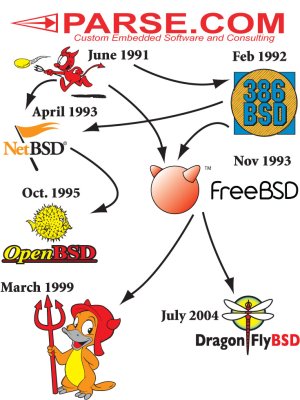
![[FreeBSD GSoC 2011 poster thumnail]](2011-freebsd-gsoc.jpg)